


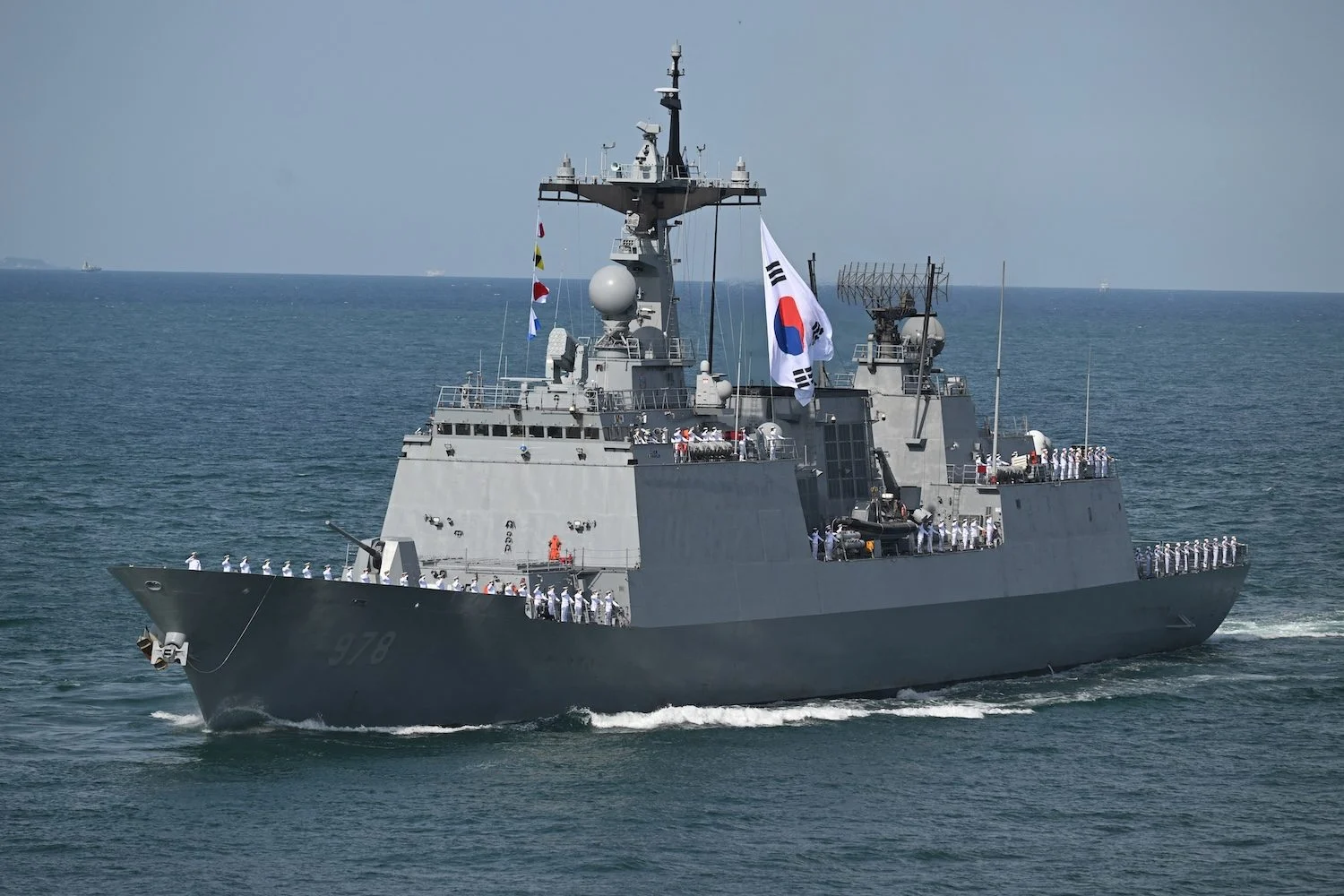
Last week, South Korean President Lee Jae-myung’s administration appeared poised to request that the legislature deploy the country’s navy to the Strait of Hormuz. Rumors had been building for days, and while presidential officials had been keen to emphasize that no final decision had been made, press reports suggested plans for a noncombat naval deployment of ships and that maritime aircraft were nearing their final steps. Iran was reacting, as well, making announcements in Korean warning against the deployment.
South Korea’s navy is well equipped and capable of sustaining long-term missions in waters far from its shores, and it has experience in counterpiracy and patrolling missions in the region. The challenge, then, that Lee faces is not operational. Instead, it is political, rooted in Korea’s convoluted history with the United States.
Last week, South Korean President Lee Jae-myung’s administration appeared poised to request that the legislature deploy the country’s navy to the Strait of Hormuz. Rumors had been building for days, and while presidential officials had been keen to emphasize that no final decision had been made, press reports suggested plans for a noncombat naval deployment of ships and that maritime aircraft were nearing their final steps. Iran was reacting, as well, making announcements in Korean warning against the deployment.
South Korea’s navy is well equipped and capable of sustaining long-term missions in waters far from its shores, and it has experience in counterpiracy and patrolling missions in the region. The challenge, then, that Lee faces is not operational. Instead, it is political, rooted in Korea’s convoluted history with the United States.
President Donald Trump has long been upset that no U.S. ally has wanted to become involved in his war against Iran. In recent weeks, he criticized the Lee administration for not directly supporting the war at the same time that he had ordered a reduction in joint U.S.-South Korean military drills.
At home, however, polls show that a majority of Koreans oppose sending warships to Hormuz, and there have been continued protests in front of the presidential estate. The issue has exacerbated a political divide within country’s National Assembly, with the left wing urging caution and the right wing accusing Lee of letting down a vital and powerful ally.
As a result, Lee is now facing a difficult decision over deployment. Whatever happens, Washington has already weakened its relationship with Seoul just by making him decide.
Lee is a scion of the Korean left wing, whose lineage goes back to the democratization movement against the country’s Cold War military dictatorship. Historically, the left advocated for greater autonomy in Korea’s relationship with the United States. Now, Washington’s mounting pressure on Seoul to support the Iran war has opened up old wounds over past instances when the United States called on Korea for military support.
At a recent protest in Seoul, several people carried signs reading, “Remember the mistakes of the Vietnam War.” Between 1964 and 1973, South Korea sent combat troops to Vietnam in exchange for hundreds of millions of dollars in U.S. economic and military aid. The move sparked accusations that Korean soldiers were “mercenaries,” the jackbooted thugs of a “subempire” carrying out Washington’s bidding.
Similar tensions emerged during the U.S. invasion of Iraq in 2003. Then, as now, the United States redeployed military assets out of Korea without prior consultation while also pressuring the country to send its own troops. Seoul initially declared that it would send only medics and engineers in a noncombat mission, but Roh Moo-hyun, South Korea’s president at the time and a progressive like Lee, eventually caved to pressure from the Bush administration to deploy combat troops.
Roh later suggested that his decision was necessary in order to show South Korea’s international commitments and—most importantly—to preserve U.S. diplomatic support for the Six-Party Talks with North Korea. Nonetheless, the mission caused fractures within the Korean progressive camp and was unpopular with the Korean public. While the U.S.-Korea alliance survived, the move strengthened preexisting Korean fears over the unequal nature of Seoul’s relationship with Washington.
Today, any Korean mission to Hormuz would likely be designated as a “noncombat” deployment. But as the Iran war has shown, in a conflict fought with missiles and drones, soldiers in support positions can and will be targeted. Korean Marines may not be invading Kharg Island, but they will still be deployed in a combat zone where U.S. air defense stockpiles are running low. Even with the safeguards of a noncombat designation or international support, Korean sailors’ lives would be at risk.
For Korean conservatives who support the mission, if not the Iran war itself, the hope is that sending warships will appease Trump and prevent him from withdrawing military assets from the Korean Peninsula. An opinion columnist for the conservative Chosun Ilbo newspaper, for example, wrote that supporting the United States might be a matter of survival in a fragile international environment on the cusp of a “third world war” (even as he went on to criticize “Trump’s greed” and “imperialistic territorial expansion”). Deployment might also appeal to members of Korea’s business community. Korean companies have made significant investments in U.S. markets in recent years, and some businesspeople may believe that appeasing Trump will help preserve their access.
But trying to cater to Trump’s whims carries diplomatic risks. The U.S. president has stated his interest in restarting nuclear negotiations with North Korean leader Kim Jong Un, something that he believes will secure his personal legacy. If these negotiations move forward, they will likely require further military concessions to North Korea. This raises the possibility that South Korea might actually be putting its sailors at risk for the sake of a deeply unpopular U.S. war, only to be asked to make further sacrifices to its security at home.
Facing a mercurial and increasingly militarist Trump administration, the Korean public was already coming to embrace the importance of “self-reliance.” The current pressure from Washington has stoked the embers of a generational concern that Korea—despite its cultural, economic, and political capital—remains at the beck and call of a bigger power that has kept troops on Korean soil since 1945. At the same time, there is a deep-seated Korean anxiety that the country might become internationally isolated if it chooses to do nothing. Any naval mission would likely be small and probably limited in its ability to actually change the course of the war or the situation in the Strait of Hormuz. But already, the deliberations about it, carried out under the shadow of Trumpian bullying, have sharpened the sense that Korea needs to diversify its options for allies and support away from the United States. Voices on the right have become increasingly vocal about gaining an indigenous nuclear arsenal. In time, a growing sense of U.S. unreliability might invigorate the more cautious and tepid support for nuclear capabilities among the left as well.
Of all U.S. allies over the last two turbulent years, South Korea, along with Japan, has been among the most reliable and cooperative, willing to increase its financial and military contributions and take on responsibilities of regional leadership. Whether the United States wishes to retrench responsibly or eventually seek to try to hold on to its old mantle as a global leader, it will need Korea on its side.
If Seoul does deploy forces to Hormuz, it is likely to further inflame anti-U.S. attitudes among Koreans, which have already shot up rapidly in the past year. In other words, Washington may very well be squandering a valuable alliance in pursuit of a futile war.
