


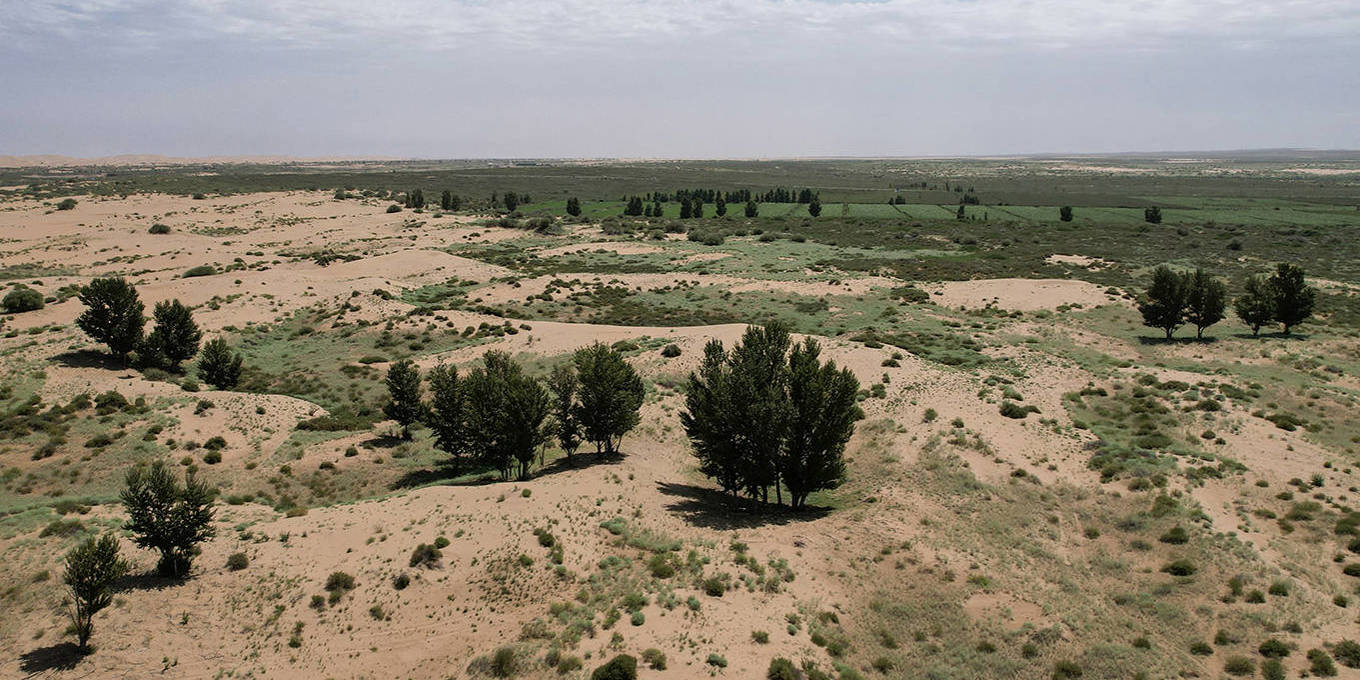
As delegates gather this week in Ulaanbaatar, Mongolia, for the 17th Conference of the Parties (COP17) to the UN Convention to Combat Desertification, momentum is building toward a more ambitious global response to land degradation. In fact, there are five promising signs that this time could be different.
RIYADH—Every second, land degradation claims four football fields of healthy terrain, resulting in a yearly loss equivalent to two Spains. As one would expect, the costs of these losses are staggering, putting billions of people at risk and draining the global economy of nearly $1 trillion annually. Left unchecked, up to 95% of the world’s land could be degraded—defined as a loss of capability to produce benefits from a particular use—by 2050, with droughts hitting more than three-quarters of the world’s population.
Nonetheless, there is cause for optimism. As delegates gather in Ulaanbaatar, Mongolia, for the 17th Conference of the Parties (COP17) to the UN Convention to Combat Desertification (UNCCD), there is growing momentum for a more ambitious global response. The summit’s theme, “Restoring Land. Restoring Hope.,” reflects a growing recognition that land restoration is not just an environmental imperative but an economic and development opportunity.
For the first time, the key ingredients for large-scale land restoration—political will, international cooperation, implementation capacity, and financing—are beginning to align. Five recent signs suggest that this could be the moment when we turn ambition into action.
The first is broader participation in the UNCCD process. COP16 in Riyadh in 2024 was the largest and most inclusive such summit to date. It elevated land use and drought on the global agenda and linked them to issues such as food and water security, gender equality, and land tenure. The landmark result was the Riyadh Action Agenda, the first global framework dedicated to land, which has since brought together more than 100 public and private partners.
COP16 also mobilized $12 billion for programs like the Riyadh Global Drought Resilience Partnership, alongside expanded private-sector engagement through Business4Land. Now, two forthcoming Riyadh Action Agenda initiatives—Land & Soil Breakthroughs and the Community Platform—aim to accelerate progress as countries increasingly translate political commitments into national drought plans and land-degradation-neutrality targets.
The second sign is the progress made toward greater convergence among the Rio Conventions. For decades, the climate, biodiversity, and land agendas that emerged from the 1992 Rio Earth Summit advanced separately. Yet they are now increasingly seen as interconnected dimensions of a single planetary crisis—an understanding that is long overdue and essential to developing more integrated approaches to policymaking, finance, and implementation.
COP16 reinforced this new thinking with a decision to strengthen collaboration among the Rio Conventions. The same trend is apparent across a wide range of initiatives, from the water, energy, food, and ecosystem nexus and various just-transition frameworks to more integrated sustainable-finance taxonomies.
Indeed, the momentum behind these new forms of collaboration continues to build. Both the Belém Joint Statement and the Antalya Dialogue on Rio Convention synergies signal growing recognition that 2026—when the United Nations Framework Convention on Climate Change, the UN Convention on Biological Diversity, and the UNCCD hold COPs within months of one another—offers a timely opportunity to align efforts to address the planetary crisis.
The third promising sign is the growing leadership role of developing and emerging economies. The UNCCD’s COP-hosting record reflects this shift. Since 2013, every biennial summit has been hosted by a developing or emerging economy, from Namibia and China to India and Côte d’Ivoire, with Egypt expected to host COP18. And national initiatives are reinforcing the same trend. Ethiopia’s Green Legacy Initiative, Pakistan’s Ten Billion Tree Tsunami, Saudi Arabia’s Saudi Green Initiative, and China’s Three-North Shelterbelt Program all demonstrate that large-scale restoration is achievable.
Then there is the growing ecosystem of global partnerships, from the Brazil-led Resilient Agriculture Investment for Net-Zero Land Degradation initiative to local networks advancing restoration and resilience across Asia, Africa, and Latin America. Together, these developments point to a new reality: developing and emerging economies are increasingly shaping the vision and driving the implementation of the global land agenda.
The fourth sign is the emergence of a new generation of large-scale restoration initiatives. Beyond national efforts, restoration programs are now operating across entire regions, joining a lineage that traces back to the 2011 Bonn Challenge, which aims to restore 350 million hectares of degraded and deforested landscapes by 2030. For example, the Middle East Green Initiative, backed by almost 30 endorsing countries, seeks to plant 50 billion trees and restore 200 million hectares.
At the same time, the Riyadh Global Drought Resilience Partnership works to shield the world’s 74 most drought-vulnerable countries. In Africa, the Great Green Wall is regaining momentum, with support from 22 countries, while Initiative 20×20 has rallied 18 Latin American and Caribbean countries around restoration commitments. Together, these initiatives demonstrate that restoration is no longer just a national undertaking but increasingly a regional and continental one.
The fifth sign is the mobilization of capital. After years of chronic underinvestment, finance for land restoration and drought resilience is beginning to scale up. Climate financing by multilateral development banks has increased in recent years, reaching a record $163 billion in 2025, some of which benefits land and promotes drought resilience.
More importantly, the financing model is evolving rapidly. Initiatives such as the Middle East Green Initiative and the Riyadh Global Drought Resilience Partnership are designed to use strategic public funding to unlock far larger pools of concessional and private capital. Innovative vehicles are accelerating this shift. Luxembourg’s Drought Resilience Investment Facility aims not only to fund drought resilience but to build a viable market for it. And private-sector coalitions such as Business4Land, together with instruments such as thematic bonds and resilience credits, are helping redefine healthy land as a productive asset capable of generating economic, social, and environmental returns.
While much remains to be done, it is clear that the global land agenda has reached a turning point. The question is no longer whether large-scale land restoration is possible but whether governments, institutions, and investors can move quickly enough to convert unprecedented momentum into action before the costs of delay become prohibitive.
