


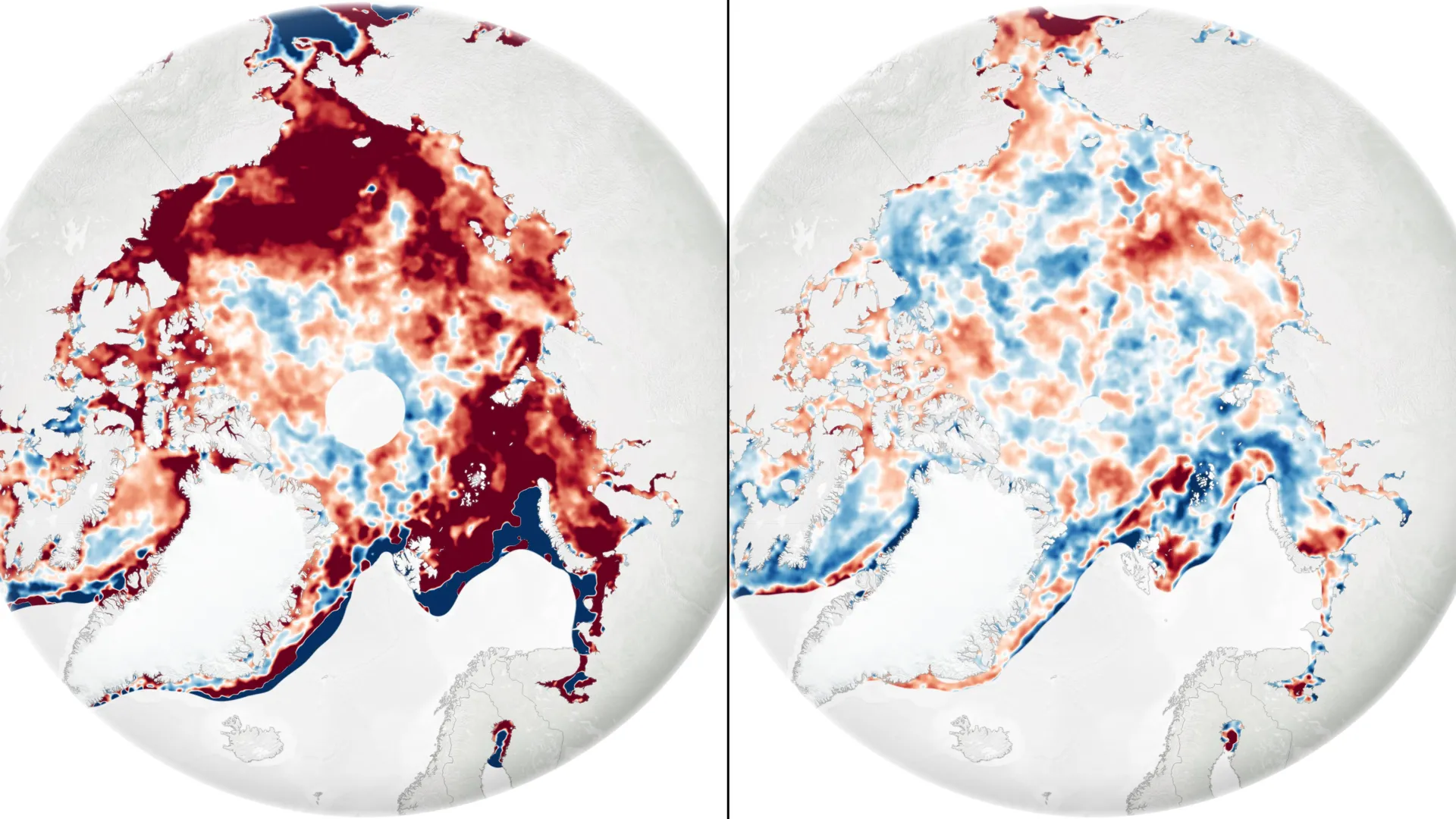
For most of the satellite record, the Arctic sea ice melt season kept getting longer. Around 2010, however, that long-running trend unexpectedly flattened.
For decades, Arctic sea ice generally began melting earlier in the spring and did not freeze again until later in the fall. Together, those changes extended the annual melt season and contributed to major losses of sea ice across the Arctic.
A new NASA-led study now finds that although the melt season has lengthened dramatically since satellite monitoring began, its average duration has changed relatively little since about 2010.
Arctic Melt Season Is About 40 Days Longer
The researchers found that the Arctic sea ice melt season is now about 40 days longer than it was in 1979.
Most of that increase occurred before 2010. Since then, the average length of the melt season has remained fairly steady, even though the timing can still vary sharply from one year to the next.
To track those changes, the team analyzed satellite observations spanning 1979 through 2023. They identified when melting began each spring and when sea ice started freezing again in the fall.
Their analysis showed that the longer melt season was caused mainly by later autumn freeze up, rather than by a large shift toward much earlier spring melting.
“Previously, there was more of this multiyear ice that didn’t melt away each summer,” said Linette Boisvert, a co-author on the study and ice scientist at NASA’s Goddard Space Flight Center. “Now that the ice is thinner and there’s less of it, there’s a lot more variability.”
Even so, the average decline in sea ice thickness and extent that accelerated during the 2000s appears to have paused for the time being.
Why the Earlier Rapid Change Slowed
To understand why the trend changed, the researchers examined the Arctic’s energy balance. This refers to the difference between energy entering the region from the Sun, atmosphere, and ocean and infrared energy escaping back into space.
During the rapid sea ice losses of the 2000s, shrinking ice cover left more dark ocean water exposed. Bright sea ice reflects much of the Sun’s incoming energy, while darker ocean water absorbs more of it.
That added heat helped postpone autumn freeze-up, which in turn extended the melt season.
In the left map above, the darkest red areas mark the places where the melt season lengthened fastest during that decade. In some regions, the increase reached as much as 5 days per year.
At the same time, the Arctic ice itself was changing. Much of the sea ice that remains today is younger and thinner than the multiyear ice that was once far more widespread across the Arctic Ocean.
Because thinner ice is easier to disrupt, the remaining cover is now more sensitive to short-term changes in clouds, storms, and winds.
Cloud Changes May Be Playing a Larger Role
Since 2010, shifts in cloud patterns have reduced the amount of sunlight reaching some areas of the Arctic Ocean.
That change appears to have helped hold the average melt season relatively steady over longer periods, even though individual years can still differ substantially.
The right map above illustrates that shift, with lighter reds and blues showing much smaller rates of change during that decade.
The findings do not suggest that climate change has stopped affecting the Arctic.
The region continues to warm nearly four times faster than the global average, and the sea ice that survives today is much thinner than it was several decades ago.
Instead, the researchers say the Arctic may have entered a different phase in which yearly atmospheric conditions have a stronger influence over how long the melt season lasts.
“Melt season length is much more dependent on atmospheric effects,” Boisvert said. “They seem to be playing a bigger role because the ice is generally thinner and more vulnerable to begin with.”
The Plateau Could Be Temporary
The researchers caution that the recent leveling off may not continue indefinitely.
Thick Arctic sea ice still survives year-round north of Greenland and around the Canadian Arctic Archipelago.
If that remaining thick ice continues to thin, the Arctic could enter another period of rapid sea ice decline. If that happens, the melt season could begin lengthening again.
For now, the results highlight the importance of continued satellite monitoring of Arctic sea ice, along with the energy balance that controls how the ice melts and reforms.
Scientists still do not know whether the recent stabilization represents a lasting shift in the Arctic melt season or simply a temporary pause before another period of rapid change.
