


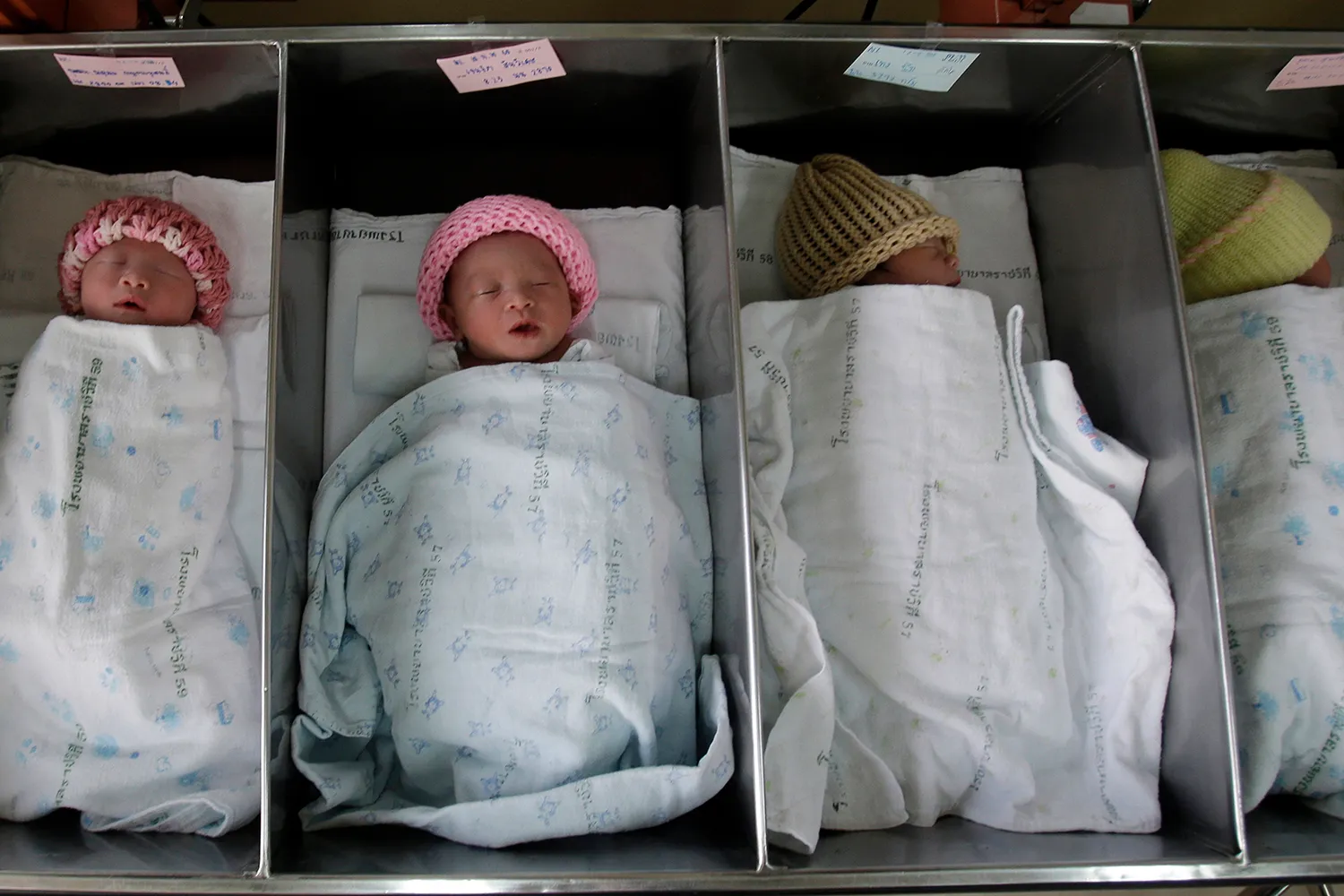
At the start of the year, Thailand’s Department of Health held a press conference under the ominous title, “Every Birth Matters… When the Silent Countdown Begins.” Officials said that in 2025, deaths in the country had exceeded births by nearly 140,000, and that if current trends held, the population could halve in the next 50 years. A director-general from the department warned that the decline could affect Thailand’s economy, tax base, and even government stability.
In a statement in July, the National Savings Fund, which handles public pensions, echoed this alarm. It described declining births as a “warning sign,” as a contracting labor force puts pressure on the welfare system and forces “everyone to rely more on themselves.” Other officials have said that working-aged people will be forced to shoulder a greater burden to support an elderly population, which could lead to an increase in the retirement age.
Thailand’s sharply declining birth rate follows a pattern often attributed to rising costs of living and women attaining higher levels of education. However, the demographic crisis has arrived in upper-middle-income Thailand early compared to elsewhere in the global south. The country’s fertility rate of 1.2 births per woman places it near Italy, Singapore, Spain, and South Korea—economies with four to 11 times Thailand’s per capita GDP.
South Korea’s fertility rate first dropped below 2.1 births per woman—generally seen as replacement level—in 1984, as its economy was growing rapidly. Thailand, by comparison, is in a period of prolonged economic stagnation. Birth rates are declining across Southeast Asia, but those of Thailand and Singapore are the lowest in the region. Of the 11 countries in the Association of Southeast Asian Nations, six have dipped below 2.1 births per woman.
A 2024 study comparing provinces in Thailand and countries across Southeast Asia reported that technocratic Singapore has managed to “slow the declining birth rate, but it has not been able to increase it back to the level of previous years … despite Singapore having the highest government effectiveness” in the region.
Singapore has offered tax relief, childcare and preschool subsidies, priority access to public housing for married couples, and expanded maternity and paternity leave. Though its fertility rate has occasionally risen, it tends to fall back down and remains low. Thailand, meanwhile, “has a relatively low level of governance in terms of political stability, corruption control and accountability in government,” the study said, raising questions about its ability to stem the decline through similar policies.
At the February press conference, Thai health ministry officials said that they are seeking to expand access to fertility treatment and reduce the financial burden of raising children. This includes offering some childcare support to people below a certain income level as well as establishing fertility clinics in all public hospitals, intrauterine insemination clinics in all provinces, and in vitro fertilization at regional hubs.
Thailand may be facing a declining birth rate sooner than other countries at its income level due to greater gender equality and limited stigma against contraception. In 2021, Thailand formally legalized abortion in the first 20 weeks of pregnancy, but it was broadly accessible before then, and the national government has long encouraged the use of contraception.
In the 1990s, after concerns emerged that a rising population would lead to high unemployment, Thailand was celebrated by the Christian Science Monitor as “one of the world’s leading success stories” in family planning, credited to cooperation between the government and civil society, efforts to train nonphysicians to distribute birth control, and a cultural flexibility to new ideas. (Singapore and Vietnam, meanwhile, pursued even more aggressive policies, limiting families to two children.)
“Government family planning policies and improved healthcare have significantly reduced Thailand’s birth rate,” said Sasiwimon Warunsiri Paweenawat, who focuses on labor and gender as an associate professor in the faculty of economics at Thammasat University. “Around 50 years ago, Thai women had an average of 6 children.”
Thailand generally ranks higher than other developing countries in terms of gender equality, particularly when it comes to education enrollment and workforce participation. Though neighbors such as Cambodia may have similar workplace participation rates, the women there are often working low-paying factory jobs.
“Women’s education in Thailand has progressed much further,” Paweenawat said. “Many Thai women now work in higher-paying jobs and are therefore more reluctant to leave their careers to have children.” She added, “Women with a bachelor’s degree or higher tend to marry later and have fewer children—on average, about 0.5 children per person.”
The cost of living is highest in Bangkok and the surrounding areas, where roughly 25 percent of the Thai population lives. More than 60 percent of people live in urban areas, up from 19 percent in 1990. Jongjit Rittirong, the deputy director for research at the Institute for Population and Social Research at Mahidol University, said that raising children is “costly, so many couples wait until they earn enough to pay for expenses.” By then, it can be “too late,” she said.
Though assisted reproductive technology, including egg freezing, is available in Thailand, it is not publicly funded. The cost of one cycle ranges from $1,000 to nearly $6,000, higher than the median annual household income. Still, Thailand’s fertility services market is growing rapidly, with some projections predicting a 9.3 percent compound annual growth rate through 2030 by. Thais account for only 55 percent of this market value, as the country is a major medical tourism destination.
In Thailand, women receive 120 days of maternity leave at 50 percent pay; 15 days of spousal leave was only added last December. Singapore and South Korea offer similar paid maternity leave: 12 to 16 weeks and 90 days off, respectively. In wealthier countries, more generous leave policies have failed to make significant headway toward stemming birth rate decline.
The Thai government also provides a one-time grant of 15,000 baht, or around $450, for medical fees associated with childbirth, plus up to 1,600 baht ($48) per month per child for support until they are 6 years old. For comparison, a 2017 analysis commissioned by the United Nations Population Fund found the cost of raising a child to be nearly 105,000 baht per year, more than five times the government stipend.
In September, a group of Thai scholars posited that reluctance to have children is not driven strictly by rising costs of living, but also by lifestyle expectations, which they argued can be influenced by social media. They cite the “relative income hypothesis”—the idea that “young people don’t make decisions about having children based on absolute income … but rather on how their current standard of living compares to their expected standard.”
Sarila Chattakulchai, a 45-year-old woman in Chiang Mai who was married last year, said she leaned toward not having children, citing Thailand’s education system and political situation. “The public school system in Thailand feels outdated and not aligned with today’s global standards,” she said, adding that her own experience studying in Australia shaped her views.
Though public education and healthcare are generally free in Thailand, elite international schools or private healthcare can be very expensive. The premier international high school in Chiang Mai costs around $25,000 per year—roughly three times Thailand’s per capita GDP.
Chattakulchai said she was also concerned about Thailand’s chronic political instability. The country has seen 10 prime ministers in the past 25 years, two of whom were overthrown in military coups. “These factors can affect long-term policy continuity, including education reform and economic development,” she said.
One advantage that Thailand may have for boosting its population is that it is a multiethnic society with a more liberal conception of national identity than many of its neighbors. Immigration could slow the demographic crisis, but it won’t totally offset an annual population decline of 150,000. In late 2024, Thailand approved plans to naturalize some 500,000 undocumented residents, many of them descendants of long-term migrants and refugees, with virtually no public outcry.
At that time, some 4 million migrant workers were registered in Thailand, mostly from Cambodia and Myanmar, with nearly 2 million more likely remaining unregistered. But attitudes toward migrants can change rapidly. Following the Thai-Cambodia border clashes last year, both governments encouraged some 900,000 Cambodian migrant workers to return home, with the Thai authorities even expelling poor laborers whom they accused of espionage.
The declining birth rate has not yet become a serious issue in Thai politics; most people are focused on more immediate economic issues, such as the rising cost of living. The political parties that have mentioned the demographic crisis have mainly pledged cash handouts, illustrating the economic populism that has dominated Thai politics for decades.
In response to the financial incentives, Paweenawat asked: “Are these financial supports sufficient, and are these policies truly effective in encouraging women to have more children?” She added, “Another interesting policy—though it is uncertain whether it can be implemented—is promoting knowledge and changing social attitudes.”
Likewise, the current government response seems to revolve around platitudes like those unveiled at the February press conference—flush with slogans, but short on funds and political will.
