


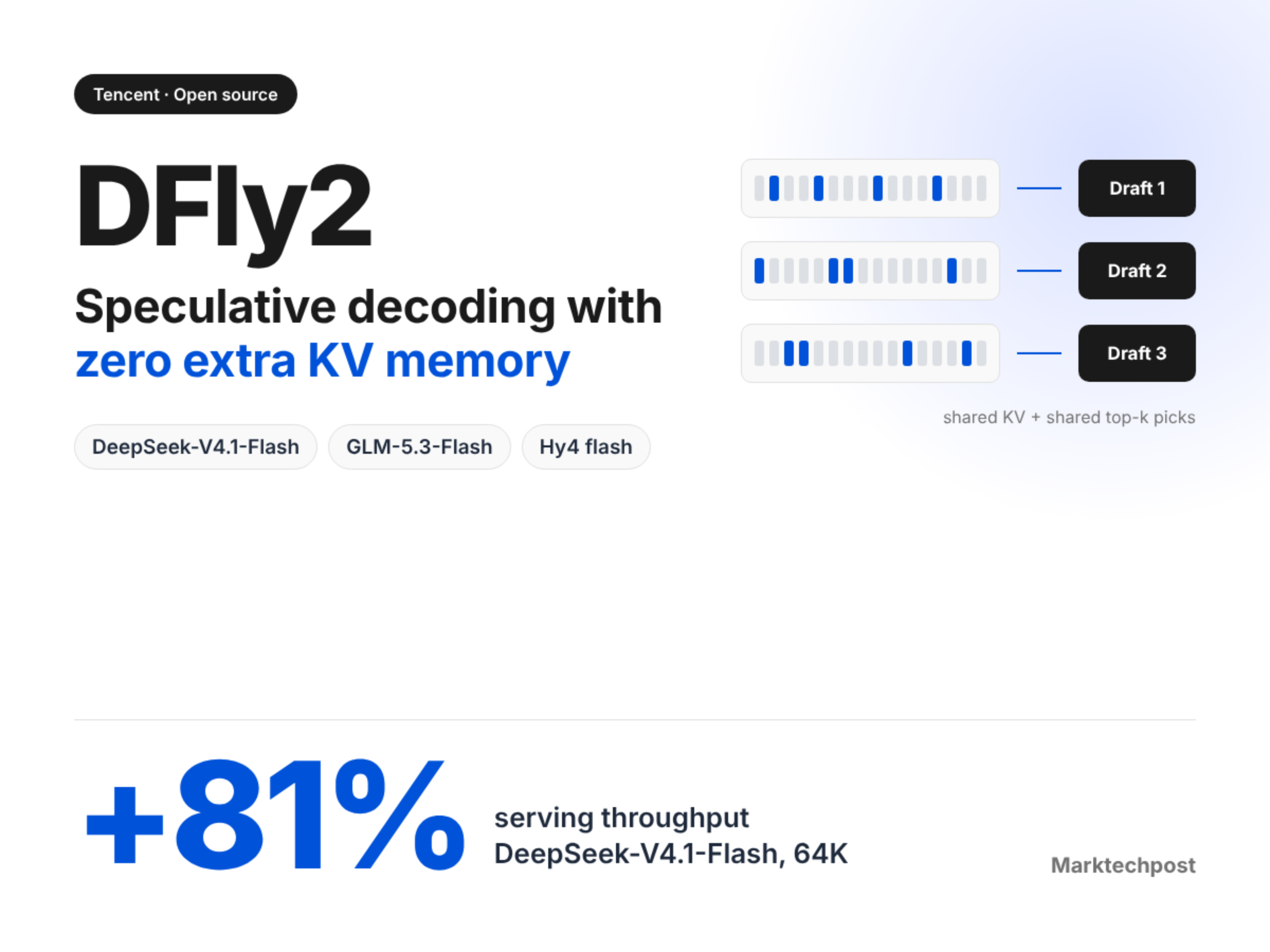
Tencent has open-sourced DFly2, a speculative decoding drafter built for natively sparse LLMs. DFly2 speculative decoding targets models like DeepSeek-V4.1-Flash, GLM-5.3-Flash and Tencent’s own Hy4 flash. Its main approach is that the drafter keeps no KV cache of its own. This is important for long-context and agentic serving, where draft memory competes with concurrency.
TL;DR
- Size: 0.85B-parameter, 5-layer drafter shipped with Hy4 flash.
- Runs on: Serving tests used NVIDIA H20 GPUs with vLLM, TP8 per instance. Hy4 flash’s vLLM recipe defaults to 8x H200.
- Performance: Higher draft acceptance than same-recipe DFlash and DSpark on all 3 targets and all general benchmarks.
- Best: Up to 81% more throughput on DeepSeek-V4.1-Flash (SWE 64K), at matched per-user speed.
- Worst: Smallest gain on Hy4 flash general tasks: only 3.9% over DSpark at temperature 0.
What is DFly2?
DFly2 is a block-parallel speculative decoding drafter from Tencent’s Hunyuan AI Infra team. It is described in the research paper ‘DFly2: Turbocharging Long-Context Speculative Decoding by Sharing the Target’s Sparsity‘.
Speculative decoding uses a small drafter to propose tokens. The target verifies them in 1 pass, so output stays lossless. Long context makes this costly. A normal drafter attends over the whole prefix and stores its own KV cache.
How does DFly2 work?
DFly2 pairs each draft layer with one sparse attention layer in the target. It shares 2 things with that layer.
- KV sharing: the draft layer reads the paired target layer’s latent KV cache.
- Index sharing: it attends only to positions the target’s indexer already selected (top-k sparse KV).
- Initialization: each draft layer starts from its paired target layer’s weights.
- Hidden injection: the target’s last-layer hidden state is gated into the draft block.
- Intra-block correction: the drafter rereads the shared context slot by slot within a block.
On DeepSeek-V4.1-Flash, a selection made 1 step early covers close to 90% of what later block tokens select. A same-size sliding window recovers less than 20%.
Per the AngelSpec GitHub page, each draft token attends to at most about 2K keys. So drafting cost stays roughly flat at any context length. DFly2 also skips prefill entirely. The prefill-to-decode transfer adds only 1 last-layer hidden state.
How much memory does a separate draft cache cost?
A conventional 3-layer drafter cache would add this much per token (bf16, paper Table 2):
| Target | Target KV | Drafter cache | Increase |
|---|---|---|---|
| DeepSeek-V4.1-Flash | 4.4 KiB | 3.4 KiB | 1.76x |
| GLM-5.3-Flash | 11.7 KiB | 3.0 KiB | 1.26x |
| Hy4 flash | 17.2 KiB | 3.4 KiB | 1.20x |
At 32K, removing the drafter’s cache lets the same memory pool hold 1.73x as many requests.
