


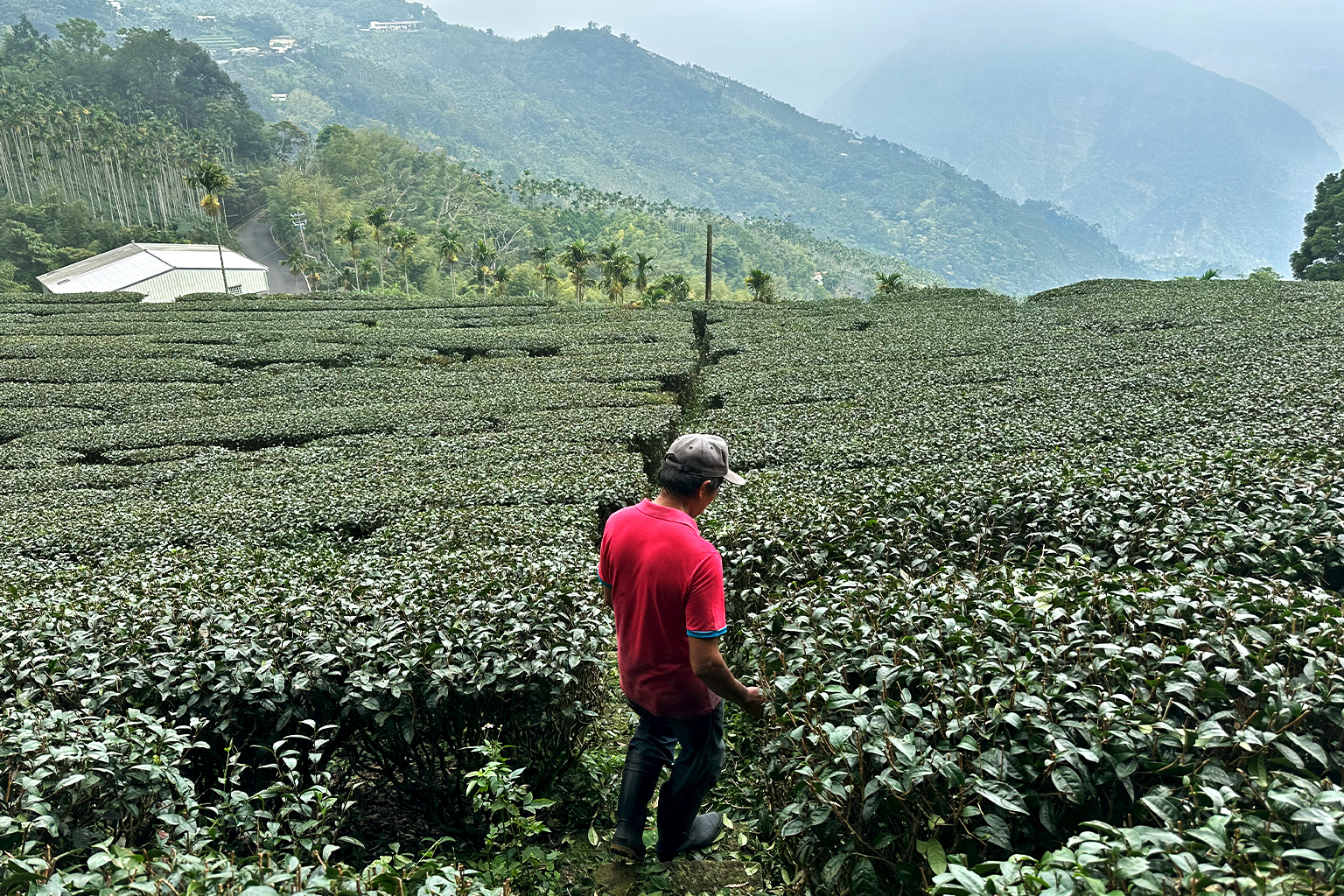
In the high-altitude Alishan mountain region of central Taiwan, tea growers cultivating prized oolong tea face mounting environmental crises: Between 2014 and 2023, local tea production dropped by 13.5% due to severe climate pressures and soil degradation. In response, a group of farmers is abandoning chemical inputs for nature-based solutions and wild cultivation, reports contributor Aylin Ho for Mongabay.
Alishan has warmed by 0.7° Celsius (1.26° Fahrenheit) over the past decade, nearly triple Taiwan’s average rate. The hotter weather has caused mist to dissipate, which otherwise blocks sunlight and helps tea leaves stay moist. Warming has also intensified spring droughts.
“Over the past five years, tea growers have experienced two or three spring droughts, at a time when they need water the most,” said Huang Cho-ying, chair of the Department of Geography at National Taiwan University in Taipei. Huang added that heavy winter rainfall and landslides further exacerbate crop damage.
The use of chemical fertilizers over the years “has made the soil more acidic and has reduced the availability of certain nutrients to plants,” said Jiang Hong, an associate professor in the Department of Geography and Environment at the University of Hawai‘i at Mānoa.
Lin Kuang-li, 60-year-old sixth-generation grower, transitioned away from pesticides to natural farming 30 years ago in Longyanlin village. Lin grows alfalfa to make “green manure,” and uses cut branches as ground cover to retain topsoil moisture.
“My soil has a better capacity to absorb and drain water than soil treated with chemical fertilizers,” Lin said, adding that crops must build climate resilience. “You have to let the tea plant adapt to the climate. If it does not have the ability to withstand stress, it can easily become diseased and die.”
In nearby Taihe village, tea growers Chang Chih-tsung, 51, and Yeh Hsin-wen, 45, practice a different yefang (wild-grown) method, allowing Jhin-hsüan oolong bushes to naturally under forest canopy.
“We don’t prune them, we don’t water them, and we don’t add any products,” Chang said.
Yeh said wild cultivation forces plants to develop deep root systems. “Our plants have to search for water and nutrients deep underground: They grow downward, and their roots are deeper,” Yeh said. These deep roots enabled their wild tea plants to survive recent severe droughts that killed crops on conventional farms, especially those without access to irrigation.
Fewer than 10 growers in Alishan have adopted natural farming due to lower yields, according to Jiang Hong. Chang and Yeh harvest just 24-36 kilograms (53-79 pounds) annually, requiring alternative income streams like renting out a guesthouse.
“All of them are committed to a model of degrowth; they produce less and therefore have lower incomes, which goes hand in hand with producing in an environmentally friendly way,” Jiang said.
Read the full story by Aylin Ho here.
Banner image: Lin Kuang-li stands among his oolong tea plants in Taiwan’s Alishan tea-growing region. Image by Aylin Ho for Mongabay.
