


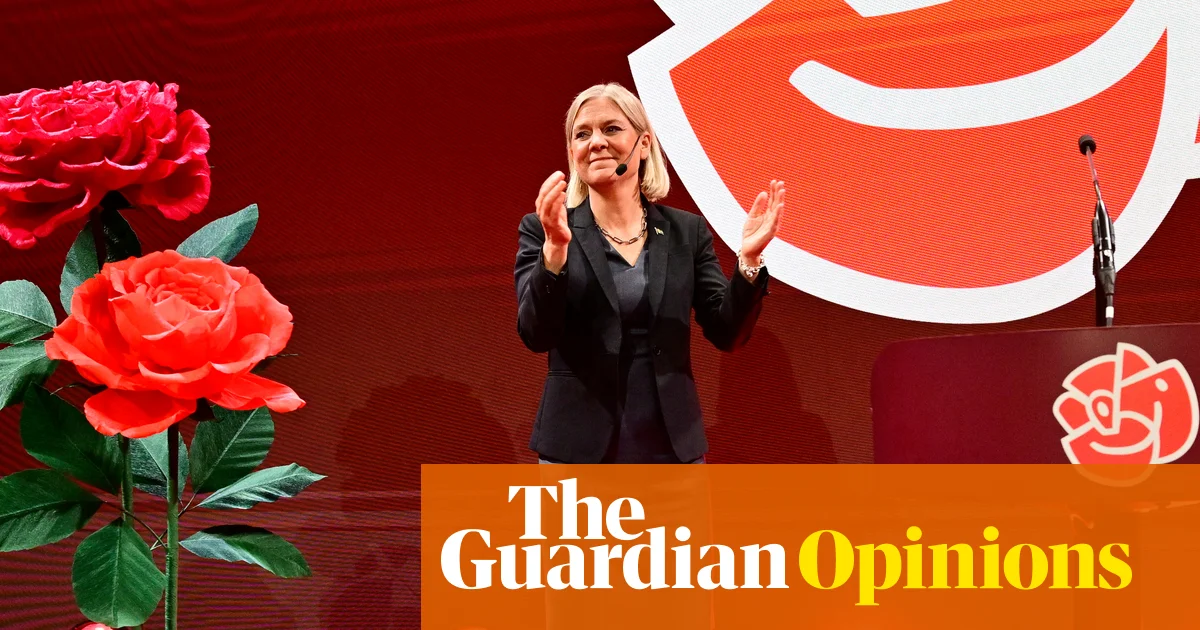
After the previous Swedish general election, in 2022, the leaders of the two biggest Swedish parties made a risky decision. Jimmie Åkesson, the leader of the far-right Sweden Democrats (SD), chose to support the rightwing minority government of the Moderate party prime minister Ulf Kristersson, while Magdalena Andersson, the Social Democrats’ leader, decided to copy the “Danish model” in an attempt to regain power. In both cases, the strategy led to electoral loss but political success.
After the general election in the country on Sunday, the Social Democrats (often referred to as S or Sap), in common with its Danish counterparts, will probably lead the new government despite an electoral defeat, losing roughly 2%, its worst result since 1908. The party’s return to power is purely a result of Swedish bloc politics and the victories of its likely coalition partners: the Left party (V), the Green party and the Center party (C), which all increased their support by 1.5%, 1.7% and 0.4% respectively. Together, this left bloc has a majority of just three seats in the new parliament. So while Andersson will probably return to power, she is also in a very vulnerable position.
While the three leftwing parties agree on a lot of socioeconomic issues, particularly undoing some of the worst rightwing policies of the past years and investing more in the public sector, they hold very different views on issues like crime and immigration. Should Andersson continue to demand strict immigration rules and link crime to immigration, this could lead to significant tensions in her coalition, similar to those that her Danish counterpart, Mette Frederiksen, faced in her first government.
At the same time the small Center party, the least leftwing of the left bloc, has ruled out a (formal) coalition with the “radical” Left party, and will want to protect the market from too much state intervention. This will create further tensions within the left bloc in a probable minority government. Given that format and the inevitable internal tensions, a majority of just three seats would require almost unrealistic levels of discipline for the minority government to sit out a full term.
On the other side of the political spectrum, the Sweden Democrats had their first loss in a national parliamentary election. Still, there is little reason to assume that Åkesson will face a backlash. First, he was the only leader who had any significance to a majority of his party’s electorate. Second, his support strategy worked: the Sweden Democrats is now completely normalised within the right bloc, as the leader of the Moderate party (or M), Kristersson, had already announced before the election that the Sweden Democrats would be part of a next rightwing government. Third, the party’s nativism is now shared by all the major parties, albeit in lighter form, from the Moderates on the right to the Social Democrats on the left.
We should also not forget that the 2022 election campaign offered the perfect political context for the Sweden Democrats, given that it was dominated by two themes: immigration and the acceptance of the Sweden Democrats. As we know from other elections (such as in the Netherlands in 2023), when opposition to immigration and the acceptance of the far right dominate the political agenda, the far right wins big. This time round, those topics were still there, but they did not dominate the campaign – in fact, no single issue did. On top of that, the Sweden Democrats were linked to some scandals close to the election, which might have further decreased support for the party. Still, it held on to 78% of its 2022 electorate, more than the centre-right Moderates (59%) and centre-left Social Democrats (73%).
While Andersson may try to convince her party, and herself, that the “Danish model” has worked, she should take a better look at her small neighbour to the west. The Danish Social Democratic party has hit historical lows in national and local elections (notably in the capital, Copenhagen). And although Frederiksen in Denmark is such a convincing nativist that even far-right leaders in other countries hail her as an example, the far right is barely less popular than before – just more divided.
Interestingly, while Andersson thanked the youth and student branches for their great work in her election night speech, the Social Democrats scored significantly lower among first-time voters than among the electorate as a whole (21% and 28%, respectively). In contrast, the Left and the Greens did significantly better among the youth. This reflects a development we see across Europe, namely that young people prefer outspokenly leftwing parties over centre-left parties. The Social Democrats were the most popular among Swedes with non-European roots, however, gaining no less than 38% of support within this growing part of the electorate. No doubt this group is also not looking for more nativist policies and rhetoric.
In short, even if the Social Democrats have regained power because of the “Danish model”, which is in itself debatable, this same strategy will be a risk for the new coalition and for the electoral future of the party. Rather than continuing to be a “moderate” or “sensible” alternative to the Moderates, Andersson should fully commit to a progressive political agenda, both on socioeconomic and socio-cultural policies. That way she not only has a better chance of holding her coalition together, but also might make her party attractive to new and younger voters again.
after newsletter promotion
-
Cas Mudde is the Stanley Wade Shelton UGAF professor of international affairs at the University of Georgia, and author of The Far Right Today
