


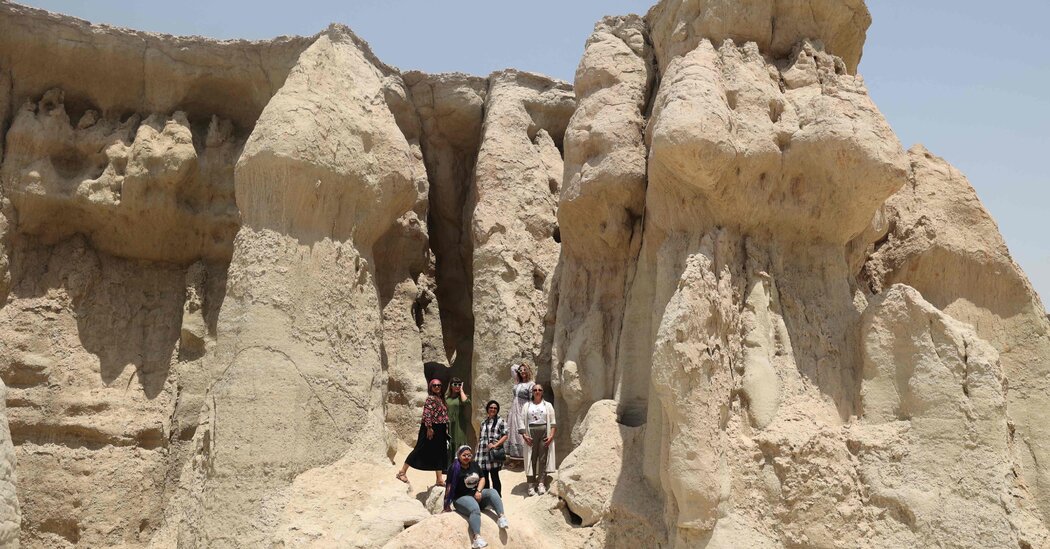
The turquoise blue waters, white sandy beaches and dramatic cliffs on the island of Qeshm until recently drew millions of annual visitors and a devoted community of artists, investors and designers who helped turn the island into Iran’s hottest vacation spot.
It is so exquisite that it earned a UNESCO Global GeoPark designation because of its natural wonders, with names that seem out of a fairy tale: the Valley of Stars, the Hara Forest mangroves and the Hawksbill turtles of Shib Deraz.
But the war with the United States and Israel, now stretching into its sixth month, has upended life, leaving the once bustling destination desolate and its population struggling.
Farideh, 25, works in the tourism industry in Qeshm and said in a telephone interview from the island that everyone in the tourism sector had been affected and that the war never abated for the people of the south, unlike elsewhere in Iran, because of near-constant airstrikes. She said they lived in a perpetual state of alert.
“Many people owned boats and transported passengers, ran guesthouses, rented motorbikes to tourists or operated cafes. Almost all the cafes gradually closed, sometimes one or two a day. Some people simply packed up and left the island,” said Farideh, who, like everyone interviewed for this article, spoke on the condition that her last name not be used for fear of retribution.
Qeshm was one of Iran’s rare economic success stories, fueled by robust domestic investment that led to development and job growth. In 2025, nearly four million visitors traveled to Qeshm, and investment in the island grew by 241 percent compared with the year before, according to government data.
The tourism sector employed about 40 percent of Qeshm’s 150,000 people, and the island’s free-trade zone, allowing for imports and exports at minimal cost and free of tax, made Qeshm a trade hub.
But that has all changed, particularly as the U.S. bombing campaign has become largely focused on the south of Iran, targeting Iranian forces, installations involved in attacking vessels in the nearby Strait of Hormuz, and critical infrastructure used by civilians.
City dwellers who once hopped to the island for weekend and winter getaways have stopped coming, people say. The traditional houses turned into stylish boutique hotels, typically booked weeks ahead, remain empty. Cafes and restaurants along the beach, known for impromptu dance parties to the beat of local drummers, are mostly closed.
The island’s other main economic activity — fishing — has come to a near halt as fishermen fear venturing into the open sea, according to interviews with nearly two dozen residents, business owners and frequent travelers to Qeshm island.
“My life has been completely disrupted,” said Ali, 48, a fisherman on Qeshm reached by phone. “I have spent my entire life fishing. It was my only source of income, but at the moment, I have no income whatsoever.”
He said fellow fishermen from nearby islands and on the coast of the mainland faced a similar predicament. “We have fear, fear, fear,” he said. “Fear of terrible events and fear of war.”
Tayeb Mofidi, a member of Qeshm’s tourism board, told local media recently that the island’s economic distress had rippled widely, from hotel owners facing bankruptcy to the local fishing industry and handicraft market. He said some people had started selling personal belongings to survive.
“The situation is simply devastating,” said Hossein, a 29-year-old teacher from Qeshm. “The regional economy has practically come to a standstill.”
Endless War
For the south of Iran, the violence that first erupted with American and Israeli airstrikes on Feb. 28 never ended, except for two intervals, even as a fragile cease-fire held in other parts of the country. The U.S. military said it had targeted military and surveillance facilities, as well as infrastructure like coastal radar towers, ports and bridges.
But bombs have also landed on tunnels, ports, railways, harbors lined with fishing boats, factories and water desalination plants, according to videos, Iranian state media and officials. The U.S. military said just last month after the cease-fire collapsed that more than 1,000 new targets were hit in the south, with the strategy being to cut off the area from resupplying.
From April 8 — when Tehran and Washington announced a cease-fire and began negotiating over an interim peace deal — until July 30, the United States attacked the south of Iran almost nightly except for from April 8 to May 7 and then again from May 7 to 25, according to a review of statements from U.S. Central Command.
The fighting has followed a predictable pattern: Iran attacks ships trying to bypass its blockade of the Strait of Hormuz, the U.S. bombs targets in the south of Iran, and then Iran retaliates with drones and ballistic missiles against U.S. military bases in the region.
The south of Iran is the heart of the country’s oil and gas industry and home to major ports, refineries, energy and military installations, making it a vital region for the country’s economy and security. But it is also home to millions of civilians who are increasingly bearing the economic and human toll of the war.
The effects have been felt in many southern cities. In Jask, at least 100 fishing boats in the harbor were destroyed, local officials said, affecting the livelihood of more than 3,500 people. In Kenarak, 17 fishermen have been missing since May when their boat disappeared in the Sea of Oman after warning shots from an American helicopter, the state news agency IRNA reported.
“Since the attacks began, there has been a constant feeling of uncertainty,” said Reza, 28, a resident in Bandar Abbas, the largest city in southern Iran. “Even when Bandar Abbas itself is not being attacked, people are still worried because no one knows what might happen next.”
Fatemeh, 35, a mother of two small children in the city of Lar, close to Iran’s southern coast, said the repeated airstrikes and gnawing sense of uncertainty were taking a toll on her mental health. She said she has had panic attacks, shortness of breath and a feeling of hopelessness.
“Every time I hear the word ‘war,’ I immediately panic, and it continues for several days,” said Fatemeh. She added, “We have no way out. In front of us is an enemy attacking, and behind us a government that is brutal and making life difficult for people.”
For the residents of Qeshm, July 30 marked the moment when the abstract fear evoked by explosions in the distance became a tangible threat of being killed in your sleep.
In the early hours of that day, an enormous explosion rocked the island, rattling walls and windows like an earthquake. When neighbors and rescue workers arrived at the scene of the blast, they found a modest family house of mud bricks reduced to a pile of debris and a family of five trapped under the rubble. The bomb had created a giant crater.
A New York Times visual investigation found that the U.S. had dropped a 2,000-pound bomb, one of the most powerful weapons used in this war, on the house, located in a densely populated residential area in the village of Chah-Tangou. There were no military facilities in its vicinity.
The airstrike killed the father and mother and their 2-year-old son. It injured their two other sons, 8 and 14, according to official reports. The father, Gheysar Jaffari, had worked as a taxi driver. He had been struggling to find work and make ends meet during the war, according to comments by his relatives to Iran’s top newspaper Shargh.
“Under the blazing 125-degree heat, he drove around all day looking for a passenger,” Mr. Jaffari’s cousin told Shargh.
The Highest Price
Amir, 45, a businessman from Tehran, moved to Qeshm about 10 years ago with his family, drawn to the island by its slower pace of life, natural beauty and economic opportunities. He bought a property, renovated it and then began a business of converting homes into trendy hotels. He said there were challenges: a poor road network, inadequate medical care and spotty internet.
But the past year, Amir said, has been the hardest. First, the government shut down the internet to quell protests during a nationwide uprising crushed by brutal force in January, disrupting advertising and booking, which is mainly done through social media. Then came the war in February at the peak of the tourism season, and the financial losses piled up.
Daily power and water cuts, amid extreme heat, and travel difficulties because of damage to infrastructure have added to the misery, Amir said.
“I would like the world to know that ordinary people have never wanted this war and are not on either side of it,” he said. “Yet they are the ones paying the highest price.”
Abbas, 38, a surfer, tour guide and boat operator, said the island, its waters and its beaches were his home, and like many native residents, he could never leave it behind no matter how bad it gets. But he said it pained him to watch the years of work building a thriving economy slip away.
“People are deeply frightened, and feeling everyone else’s fear affects me too,” Abbas said. “It weighs on me.”
“I swear we are exhausted,” he said. “The best thing the government can do is make peace with the world.”
