


- A unique approach to ecosystem restoration in South Africa — repairing exhausted farmlands through the mass planting of an endemic drought-tolerant succulent called spekboom — is receiving global attention as one new entrant gets an injection of $91 million to dramatically increase its plantings.
- This financing will contribute toward the goal of planting more than 300 million spekboom (Portulacaria afra) cuttings, funded by investors through global carbon markets.
- Smaller restoration projects have blazed a trail until now, helping to improve planting and land management methods to get maximum plant survival, bush recovery and, ultimately, carbon credit returns.
- Plant survival rates through the next five planting seasons will dictate how well farmlands recover in coming decades, whether they deliver on the carbon drawdown expectations, and whether investors get their returns. But Mongabay’s investigation finds that things may be getting off to a rocky start.
This is the second article in Mongabay’s three-part investigation of spekboom-led ecosystem restoration in South Africa. It is part of an award-winning collaboration between independent science writer Leonie Joubert, the Stellenbosch University School for Climate Studies, and the Henry Nxumalo Foundation which supports investigative journalism in Africa. Read parts one and three. Read Part 1.
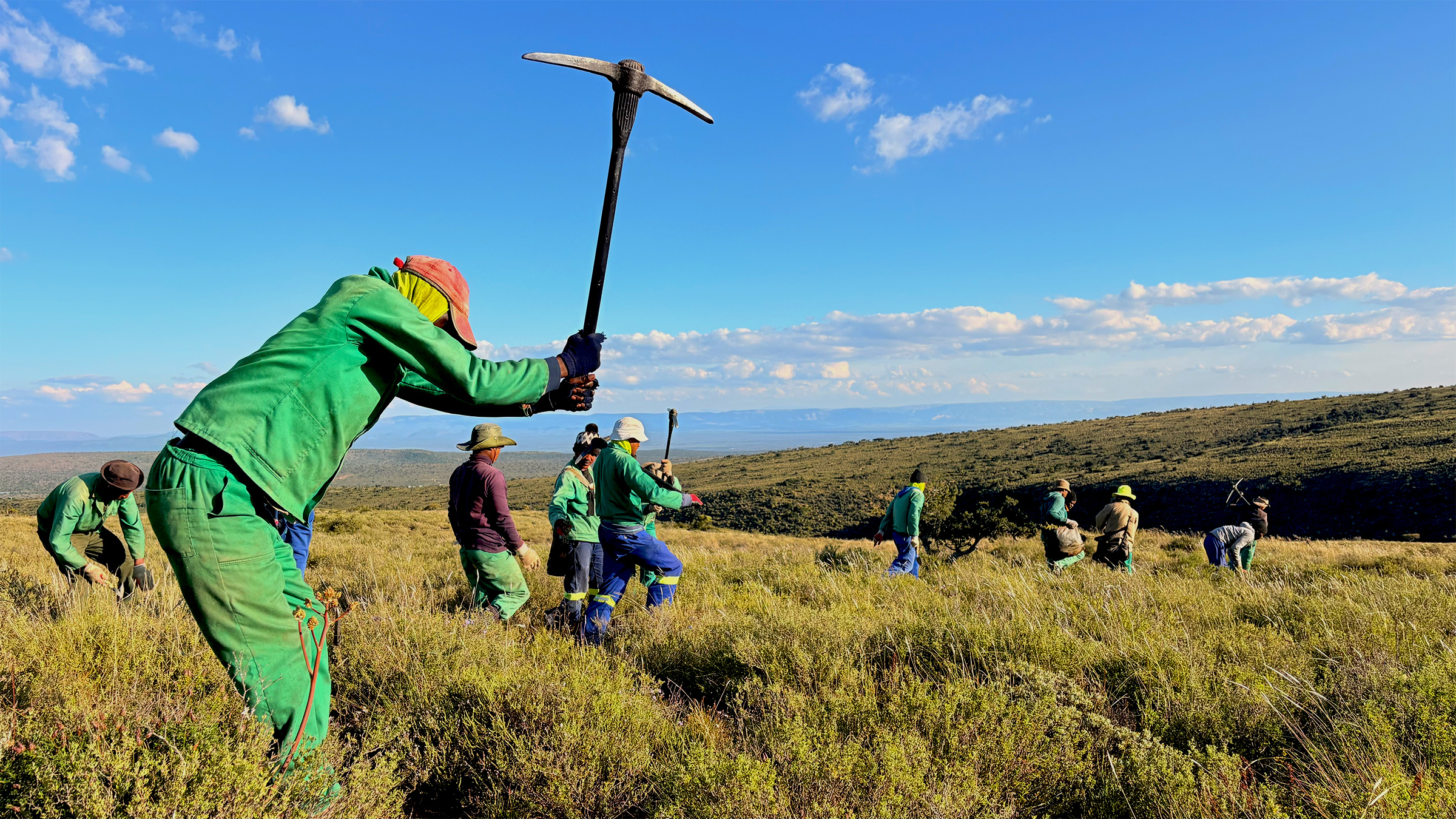
GQEBERHA, South Africa — The team of diggers crisscrossing a hard-to-reach hill on a remote farm in South Africa’s Eastern Cape province shows how tough spekboom planting is. A row of men, each arcing a pickax over his head to his own rhythm, punctures a Morse code of holes into the earth. Behind him, a planter drops a rooted spekboom cutting into the hole, fills it, and tamps the soil gently with a trowel. Between them, a runner, his bag not unlike that of an old-school postman, ferries cuttings from the tractor that has labored up a treacherous country track from the nursery on a nearby farm.
They’ll get a few thousand plants into the ground today, give or take, but the team works so fast that the numbers blur after a while.
It’s grueling. But the men are upbeat. It’s work, many say, in a region where unemployment is high and the stagnant farming sector is unlikely to change anytime soon.
The planters are doing the first steps in helping repair the land on a farm owned by Hive Ecosystems, one of the more established outfits in a small but emerging restoration sector. Here, ecologists hope that mass planting with spekboom (Portulacaria afra) will be the first step in the recovery of what’s known as the Albany thicket ecosystem. Generations of heavy livestock rearing — mostly with mohair-producing goats — have reduced once-impenetrable hedge-like bush to something akin to desert across 1.5 million hectares (3.7 million acres) of farmland. Nothing much will grow here anymore. Except spekboom.
These projects are drawing on carbon markets to raise the capital needed to fund the wide-scale planting of this drought-hardy, easy-to-grow plant. Investors provide the funds now, with the promise of earnings from a new kind of agricultural crop down the line: atmospheric carbon banked away in the plants and soils, which translates into the currency of carbon credits.
The business case for this has been in development for roughly two decades. It is now so convincing that the World Bank recently listed an outcome-based bond tailored specifically to fund the work, with a pot of $120 million that’s available to developers in the spekboom sector. The first to draw on this loan is a new entrant: Singapore-based infrastructure developer Imperative Global Solutions Pte. Ltd., which specializes in ecosystem restoration at scale, and whose operations are taking what was artisanal and making it industrial in size and approach.
Spekboom planting is now increasing at a pace and scale unlike anything tried before. What happens in the field over the next four or five years will determine how well the vegetation and, hopefully, the broader ecosystem recover over the coming decades. Planting success will dictate whether it delivers on the carbon capture expectations promised by developers, how this translates into carbon credits and, ultimately, whether investors get their returns.
This little corner of the country needs the restoration work the way a burn victim needs lifesaving skin grafts. Many of these farmlands are so exhausted that there may only be one agricultural crop left to grow here: carbon. If projects don’t make good on their promises, insiders worry that it will undermine investor confidence, scare off financiers, and be the death knell for a farming sector that’s already on life support.

Getting it right: How to plant a succulent, at scale
The Hive Ecosystems project is roughly halfway toward its goal of getting spekboom sprigs into 5,431 hectares (13,420 acres) on its properties near Jansenville, about an hour’s drive inland of the port city of Gqeberha. Managing director Japie Buckle would like to double that planting area if they can buy more land.
The thicketeers — that’s what some ecologists, researchers and project implementers call themselves — agree that planting spekboom isn’t rocket science. But doing so fast and at scale needs to be done carefully, and they’re sharing what they learn as they go.
Their field notes might sound like succulent wonks geeking out on gardening hacks. But their watchful attention to planting and post-planting teething issues — what works and what doesn’t, even months or years down the line — will be key to ensuring the survival of well over 300 million spekboom plants that will be put in the ground across all projects, cutting by cutting, laboriously and by hand, over the next four or so winter planting seasons.
“Spekboom is hardy. It’s evolved here,” says Nick Hamp-Adams, general manager of Return to Thicket, one of the smaller restoration projects that incorporates two exhausted former mohair goat farms. No need to coddle it in the nursery or too much after planting, he says, but be gentle when putting it in the ground and do immediate post-planting follow-up.
“How you plant matters,” Hamp-Adams adds, smiling. “Make sure your teams are handling them like babies.”
The process that most projects follow is simple: Harvest cuttings from wild-growing spekboom; give them roughly three or four months in the nursery to establish roots; and then plant them in a degraded spot. Most of the projects are deliberately low-tech and bare bones. They might work on an estimated cost-per-unit of 9-21 U.S. cents to get a cutting through the process.
Rooted cuttings take time and cost more to get veld-ready, but they establish better than unrooted ones, which don’t need much nursery time, according to Buckle, a seasoned restoration ecologist with decades of wetland rehabilitation under his belt. There’s a sweet spot where a cutting’s stem thickness and root size improve its odds, without spending too much time in the nursery.
Little tweaks at planting can improve a cutting’s chances, like propping a small rock at an angle to its base. This captures condensation, moistens the roots, and creates a gentle microclimate, says Jacquie Pastor, a consultant to a restoration project KBH Carbon, set up by its parent company, the mining conglomerate KBH Group, which has planted the first 1,000 hectares (about 2,500 acres) with the goal of eventually restoring 5,000 hectares (roughly 12,000 acres) of land.
The tradeoff: Slower planting speed, better survival.

Learning from the teething problems
“You need to calculate in some die-off,” Hamp-Adams says, scanning a section of one Return to Thicket farm where the sparse ground cover has sprigs of spekboom dotted about in every direction. It’s early winter, and the cuttings have had four months to settle in.
There will always be some cuttings that don’t make it. Many of the smaller projects report relatively low mortality — between one and three cuttings dying for every 10 planted. But that figure can vary, depending on how the cuttings are planted and how the land is managed in the weeks and months that follow.
One pilot site at Kwandwe Private Game Reserve near the town of Makhanda — part of an ecotourism-focused collection of farms owned by C-SA Properties, whose restoration work is being done by CSA Carbon — had “super high mortality rates” along one edge of the plot, according to Kwandwe’s environment manager, Craig Sholto-Douglas. Six or seven out of 10 cuttings died. But toward the center of the plot, jackpot: Eight out of 10 made it.
Speaking at a thicket restoration forum in 2024, Sholto-Douglas put this down to the dance between predator and prey: Antelopes were lingering in a part of the site where they felt safe, so they browsed heavily here. But they moved quickly through the open area where they felt in danger, only nibbling the plants along the way.
Sholto-Douglas has been overseeing spekboom planting across 2,000 hectares (roughly 5,000 acres) of reclaimed farmlands around the edge of the reserve. This initiative is one that’s geared toward improving natural bush for wildlife and ecotourism, much like a similar project run at Kuzuko Private Game Reserve not far from here.
In spite of having a breather from heavy livestock pressure, parts of these farms still haven’t recovered on their own after 25 years, according to Sholto-Douglas. The spekboom plants should change that.
These real-life experiences are all critical data points for landowners who might one day want to reintroduce wildlife or livestock onto recovering lands. All have different histories, Sholto-Douglas says, all are in different states of disrepair. With only four years to learn from these teething problems, time is ticking for this emerging sector.

Going big
Most projects are artisanal in size, and planting is proceeding slowly. It’s taken Hive Ecosystems three years to achieve the first half of its planting goal with a crew of nearly 50 people in the nursery and out in the veld. Return to Thicket got its first 1,000 hectares planted in 14 months, with 10 people handling the nursery side and 10 planting.
The new entrant to the sector, Imperative, which has attracted World Bank funding and Amazon’s attention, has bigger ambitions. It aims to complete its goal of planting 100,000 hectares (about 247,000 acres) within the next four to five years. According to Tiaan Burger, Imperative’s spekboom restoration project manager, the operation will be able to plant 20,000 hectares (nearly 50,000 acres) per year once it’s running at full speed.
The company has also opted for a more technical approach to propagating its cuttings, using a trademarked specialist rooting method from Danish company Ellepot, which is said to shorten nursery time and protect against planting shock, according to the manufacturer.
Burger wouldn’t comment on Imperative’s cost per unit to get a cutting from harvesting to planting. And Ellepot’s South Africa office also wouldn’t disclose the cost per unit for the product that Imperative uses. However, based on industry information from others familiar with such calculations, Mongabay estimates that Imperative’s cost per unit is perhaps 50 cents per rooted cutting, roughly double what smaller operators budget for.

While the smaller projects’ plantings are ticking over slowly, Imperative arrived in the area in 2024 and had its first 10,000 hectares (25,000 acres) planted in just over a year. According to Burger, planting began in November 2025 on the second phase — the 50,000 hectares (nearly 124,000 acres) that have attracted a $91 million loan funded in part by the World Bank and derisked with Amazon’s buy-in. The goal, he says, is to complete all this planting — five times the size of phase one — within two years. With further planned expansion, Imperative calculates a total carbon drawdown of 41.6 million metric tons of carbon dioxide across its 100,000 hectares over 40 years, averaging out to 10.4 metric tons of carbon dioxide per hectare per year.
Projects are unlikely to see much carbon build-up in the total carbon stock — the plant matter and soils — in the first five or so years, because the young trees will need to establish. It will take roughly 10-15 years before they’re developed and shedding enough leaf litter and root matter to reflect significantly in soil and plant biomass samples. Carbon uptake will plateau once the canopy has grown closed, and spekboom will still be the predominant plant.
Whether the recovering lands show they’ve captured as much carbon as hoped for will depend on how well and how quickly the young cuttings establish.

How fast is too fast?
Questions have emerged about how successful Imperative’s first-phase plantings have been, though, whether it’s scaling up too fast and whether it’ll be able to meet its ultimate targets.
Mongabay has credible information from sources indicating that some of Imperative’s early plantings have experienced die-offs of as much as 80-90%. Burger wouldn’t comment on whether these figures are accurate. He did say, however, that investors had done their due diligence, including visits to first-phase plantings. Mongabay wasn’t able to establish which sites were visited, by whom or when. But Burger maintained that Imperative’s financiers wouldn’t have agreed to the loans if they didn’t have confidence in the company’s ability to deliver.
Imperative CEO Scobie Mackay also wouldn’t comment on mortality rates and said the developer was learning from its early planting experiences. Many parties working with Imperative, including its implementing partner, NatCarbon Africa, are tied into nondisclosure agreements — standard practice for commercial ventures of this scale, according to Mackay — which makes it difficult to independently verify information provided by Imperative representatives or its partners.
An environmental scientist with extensive experience in restoration work of this type in South Africa, but who asked not to be named because of their proximity to the sector, told Mongabay that such high mortality rates are possible — and not just for spekboom — if plants don’t get the right follow-up care and appropriate land management.
“Our experience on other projects in the region where such care is absent has shown that an 80% to 90% plant mortality rate is not uncommon,” they said. “One cannot just stick a sapling in the ground and hope it will survive.”
There are many things that can kill a sprig: a heat wave; a frosty snap; or unusually wet soils causing rot. Hungry animals, too.

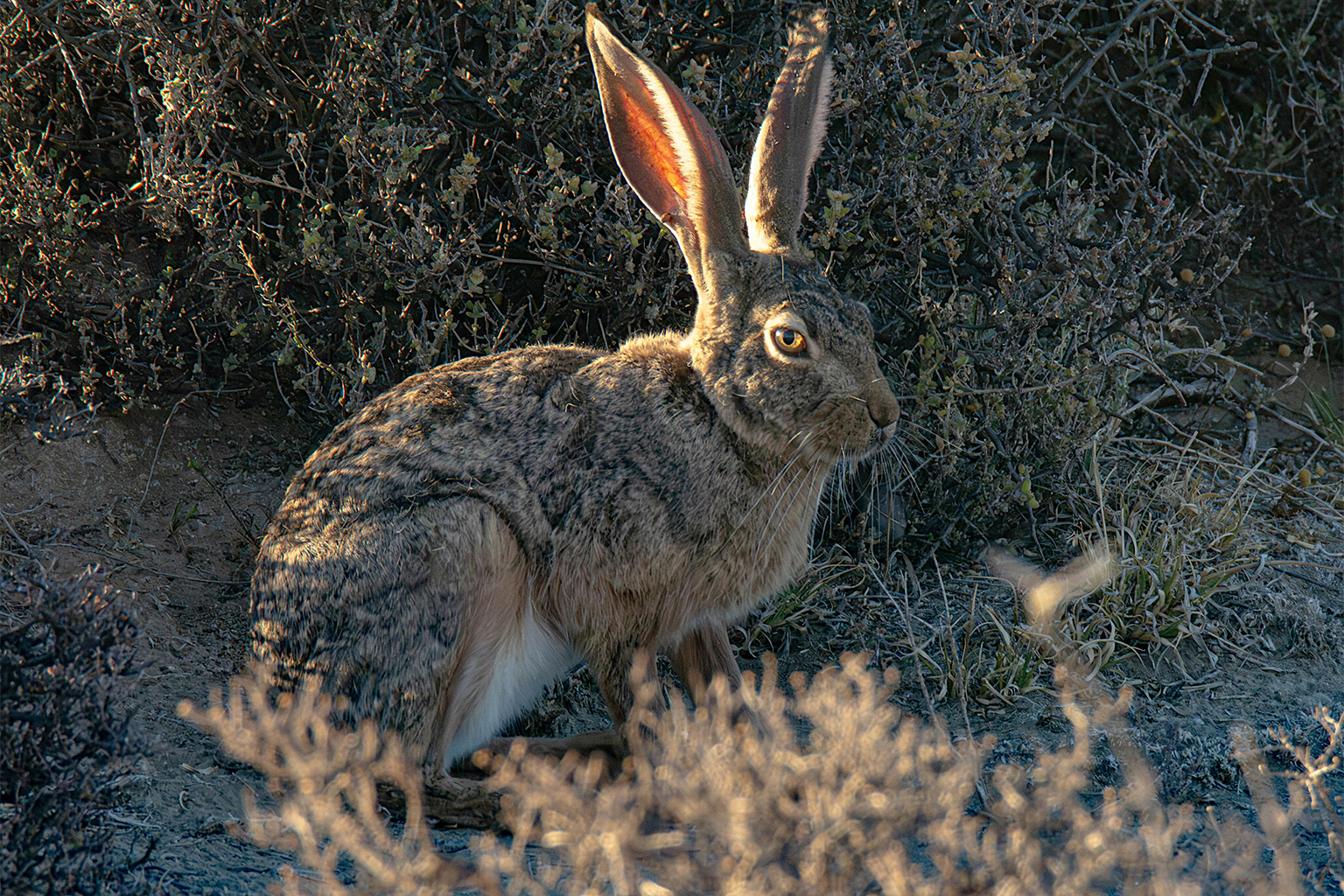
The Kwandwe reserve team found a few unusual candidates taking advantage of some of their young spekboom.
One batch of plants had been in the ground for 18 months and, by all accounts, looked like they were surviving. But they weren’t thriving.
“All of them still upright. All of them rooted beautifully,” Sholto-Douglas says.
It turns out that, while the reserve’s management team had been able to keep the large browsing animals out of these recovering lands, they hadn’t accounted for the little ones, like Cape scrub hares (Lepus saxatilis) and gray duikers (Sylvicapra grimmia), a regular antelope to these parts.
Locals here say that spekboom is to goats what ice cream is to a toddler. But it seems that small wildlife feel the same way about these irresistible plants, another important data point for the sector as spekboom planting goes industrial scale.
Banner image: The number of cuttings this Hive Ecosystem team manages to plant in a day is dizzying. This project is halfway toward its original goal of planting spekboom across nearly 5,500 hectares (nearly 13,000 acres). Image by Leonie Joubert for Mongabay.
FEEDBACK: Use this form to send a message to the author of this post. If you want to post a public comment, you can do that at the bottom of the page.

