


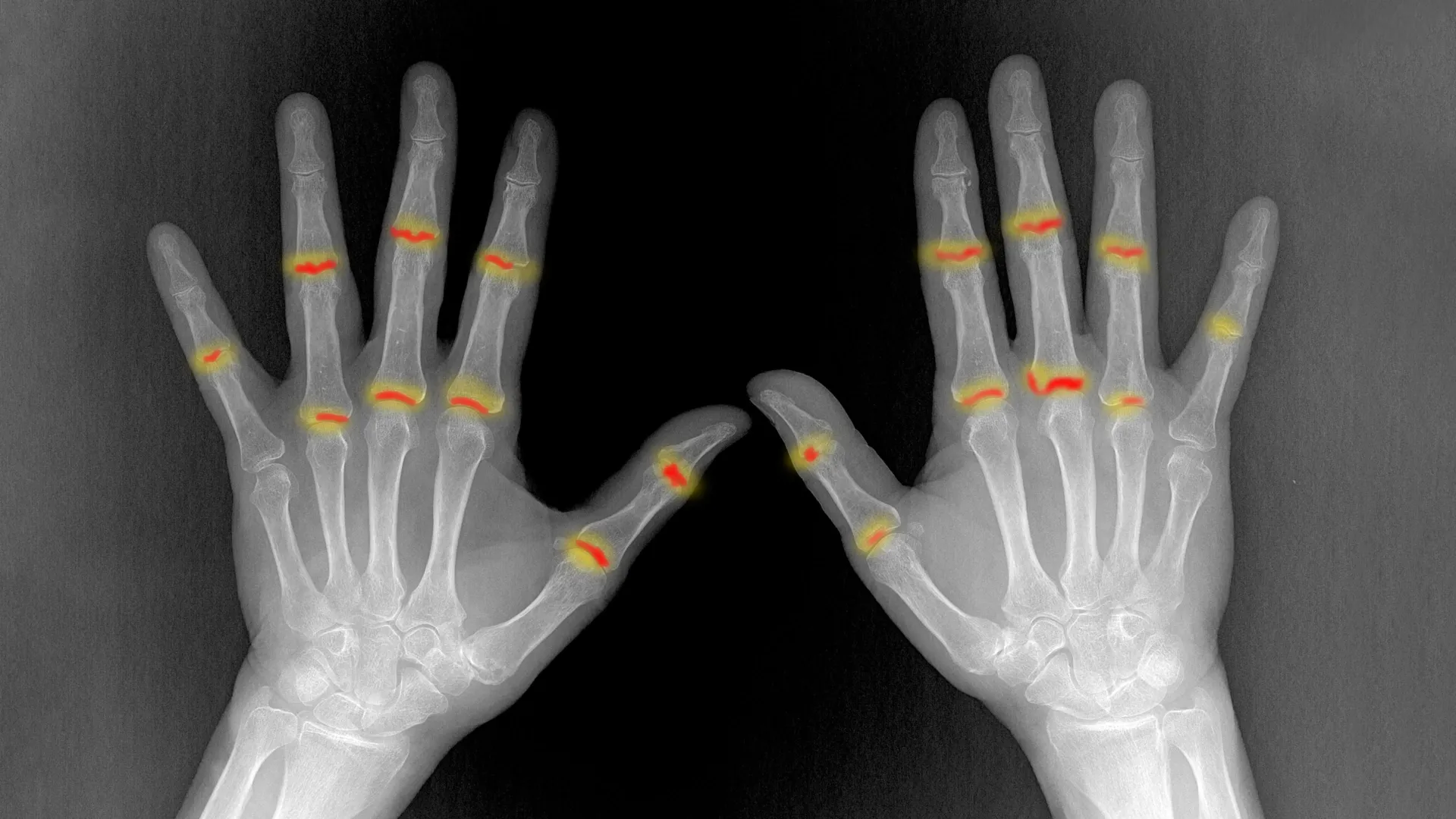
Researchers at the Kennedy Institute have found evidence that some joints may be more vulnerable to inflammatory arthritis before birth. The discovery could help explain a long-standing puzzle in rheumatoid arthritis: why the disease repeatedly attacks certain joints while leaving others largely untouched.
The study, “The embryonic origins of site-specific arthritis,” was published in Nature Immunology. It suggests that the answer may depend not only on the immune system, but also on biological differences built into individual joints during development.
Rheumatoid arthritis is an autoimmune condition in which the immune system attacks the synovium, the tissue that lines the joints. This produces pain, swelling and stiffness and, over time, can damage cartilage, bone and surrounding tissues.
Some Joints Are Different Before Birth
To investigate why rheumatoid arthritis favors particular joints, the researchers examined two types of finger joints with very different patterns of disease susceptibility.
They compared proximal interphalangeal (PIP) joints, which are frequently affected by rheumatoid arthritis, with distal interphalangeal (DIP) joints near the fingertips, which are generally spared.
The PIP joints had a larger volume of synovial tissue and contained more PI16-positive (PI16+) fibroblasts, a specialized type of connective tissue cell. Importantly, these differences were already present before birth. This suggests that the local tissue environment of a joint may influence whether inflammation is able to take hold later in life.
Christopher Buckley, Kennedy Professor of Translational Rheumatology at the University of Oxford, said: “For decades we have known that rheumatoid arthritis selectively targets particular joints, but one of the great unanswered questions is why? Our findings suggest that the answer lies not only in the immune system but also in the tissues themselves. The cellular and structural characteristics established during development may help determine where inflammation takes hold later in life.”
Mapping Developing Human Joints
The team used single-cell sequencing, advanced image analysis and high-resolution 3D X-ray scanning to build a detailed map of human finger joints as they developed.
Looking at joints during development allowed the researchers to study entire joints in a level of detail that is difficult to achieve with adult tissue.
They found that developing joints consisted primarily of structural cells rather than immune cells. These included fibroblasts and cells responsible for forming cartilage. The researchers then examined the signals that cause these cells to develop into different specialized types.
One group of particular interest was the fibroblasts that form the synovial lining. These cells produce substances that lubricate joints, helping protect them and allowing them to move smoothly. In arthritis, however, these same cells can behave abnormally.
Further analysis indicated that the synovial lining may develop from two sources, cartilage and surrounding joint fibroblasts. Local conditions also appeared to influence this process, including areas with low oxygen levels.
Understanding these developmental signals could provide new clues about how synovial fibroblasts acquire their functions and potentially reveal ways to restore their normal protective behavior in arthritis.
Specialized Cells in Arthritis Prone Joints
The researchers found several important differences between PIP and DIP joints.
Using a specially developed image analysis tool, they showed that Pi16+ fibroblasts were more abundant in PIP joints. These cells were concentrated around blood vessels and at locations where tendons and ligaments connect with nearby tissue.
PI16+ fibroblasts also reacted differently to inflammatory signals than other fibroblast populations. Although PI16+ fibroblasts and PI16- fibroblasts shared a general pro-inflammatory response, the PI16+ cells also showed distinct changes in biological pathways involved in immune regulation and the organization of tissue.
The differences extended beyond individual cell populations.
Using high-resolution 3D imaging at Diamond Light Source at the Harwell Science and Innovation Campus, the team found that PIP joints had more synovial tissue and that this tissue was organized differently from the synovium in joints that are typically spared by rheumatoid arthritis.
Taken together, these differences in both cell populations and tissue structure could help explain why inflammation develops more readily in some joints than in others.
Dr. Sarah Davidson, Postdoctoral Researcher at the Kennedy Institute and one of the first authors of the study, said: “We found that joints commonly affected by rheumatoid arthritis already contain distinct cellular populations before birth. PI16+ fibroblasts were enriched in vulnerable joints and responded differently to inflammatory signals. Their location and behavior suggest they could help shape where disease develops.”
A Developmental Clue to Rheumatoid Arthritis
The findings point to a broader explanation for why rheumatoid arthritis selectively affects particular joints.
Rather than joint vulnerability being determined entirely by immune activity later in life, the tendency for inflammation to develop may also depend on cellular and structural features established while the joints are forming.
In other words, each joint’s local biological environment may help determine how susceptible it becomes to rheumatoid arthritis years or decades later.
The research was led by scientists at the Kennedy Institute of Rheumatology, University of Oxford, working with colleagues at the University of Birmingham, University College London and Diamond Light Source.
The study was supported by the Medical Research Council (MRC).
