



In brief
- Solana closed its first binding on-chain governance vote, passing SGP-0002 to double the network’s disinflation rate from 15% to 30%, hitting the 1.5% issuance floor by 2029 instead of 2032.
- The vote came down to the wire, passing 67.0% to 66.67% required, after Kraken opposed it through the count before flipping at the last minute.
- Validators also ratified SGP-0001, the Solana Constitution, with 86% support, but rejected SGP-0003, a “Resource and Inclusion Fee” that would have burned up to 14x more SOL daily.
The Solana network will soon print a lot less SOL on a yearly basis, as network validators today voted to double the rate of disinflation for the token.
It’s music to the ears of Solana investors, who expect the outcome of today’s vote to be bullish for the price of SOL going forward. But it didn’t come without some drama.
Solana validators today closed out the network’s first-ever binding governance vote, a stake-weighted ballot run through the new Solana Governance Proposal system, otherwise known as SPGs, that lets validators and their delegators vote on-chain for the first time.
The package today bundled three proposals, and they did not all land the same way.
The most consequential of the trio was SGP-0002, the “Double Disinflation” proposal, which only passed by a hair—67.0% for (176.29M SOL) against 66.19M against, on 1,326 votes, with 60.7% quorum.
The proposal tracks SIMD-550, filed by engineers at infrastructure firm Helius. The proposal, now passed, doubles Solana’s disinflation rate—the yearly pace at which new-token issuance shrinks—from 15% to 30%.
Solana’s inflation already declines a bit every year on its way to a fixed 1.5% floor. SIMD-550 just gets there faster, hitting that floor by 2029 instead of 2032, which works out to roughly 18.9 million fewer SOL created over the next six years.
What it means, ultimately, is less SOL in circulation on a yearly basis, which could prove bullish for the token long-term if an increase in demand coincides with the supply crunch.
It doesn’t come without some drawbacks, though, since the rate of inflation (i.e. new token issuance) is what pays stakers—the people and companies who lock up SOL to help secure the network—through rewards called yield. As 21Shares put it, if you cut that issuance, then staking yield falls from around 5.25% today to about 2.25% within three years.
That’s likely why some staking providers, such as cryptocurrency exchange Kraken, initially voted against the disinflation proposal today, while others like Galaxy initially abstained (effectively standing against) before changing their votes in the final hour.
Kraken, for its part, nearly sank SGP-0002. The exchange, whose voting power stood at 8.92 million SOL, voted against the double-disinflation proposal through the count, then took back its stance at the last minute. “Custodians should be conduits, not voices,” Kraken’s Co-CEO Arjun Sethi, wrote in a reply to Helius CEO Mert Mumtaz.
Mumtaz, who lobbied hard for Kraken and others to vote for the proposal, welcomed the change of stance once Kraken moved. With 67.0% against a 66.67% requirement, a few million SOL one way or the other was the difference between a pass and a fail.
The other Solana proposals
Other than the disinflation debate, Solana validators had some more things to consider today that will shape the future of the network.
SGP-0001, the Solana Constitution, was the easy one. It formalizes how this voting system works going forward, and it passed with 86.0% of participating stake in favor—193.65 million SOL for against 4.63 million against, across 1,153 votes, with quorum met at 52.0% participation.
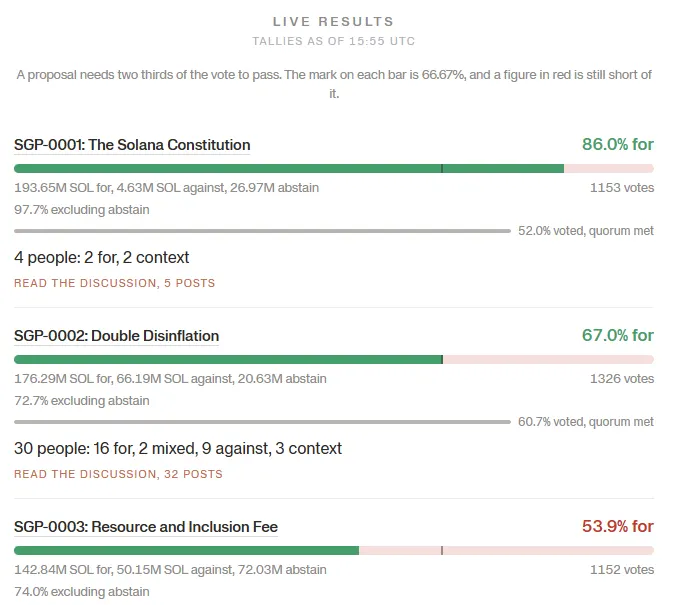
The other economic fight was SGP-0003, the “Resource and Inclusion Fee,” which failed.
It landed at 53.9% for—142.84M SOL for against 50.15M against, with a heavy 72.03M SOL abstaining—well short of the two-thirds bar. The proposal tracks SIMD-553, from R&D firm Temporal, which would have split Solana’s transaction fee in two: a base “inclusion fee” that still pays validators, and a new “resource fee” tied to a transaction’s compute use that would be destroyed outright.
That change would have lifted daily SOL burns from about 650 SOL (roughly $48,000) to as much as 9,000 SOL (around $668,000), a 12-to-14x jump. It had already cleared code review from Solana’s two client teams, Anza and Firedancer, on July 20; the vote was about turning it on, not whether it was ready.
Solana Company, the Nasdaq-listed treasury firm (HSDT), backed the constitution but voted against both economic changes, arguing the timing was wrong for institutional stakers who want predictable yield. DeFi Development Corp voted all three the other way and bought 19,000 SOL for $1.86 million afterward.
SOL had spent the week pricing in a supply squeeze, up roughly 44% on the month into the vote. The chart turned once SGP-0003 missed. The Aug. 28 daily candle on Coinbase opened at $109.18, hit a high of $110.14, sold off to a low of $103.63, and closed at $105.00—a 3.83% drop from the open, and about 5.4% off the recent swing high near $111.
Daily Debrief Newsletter
Start every day with the top news stories right now, plus original features, a podcast, videos and more.
