


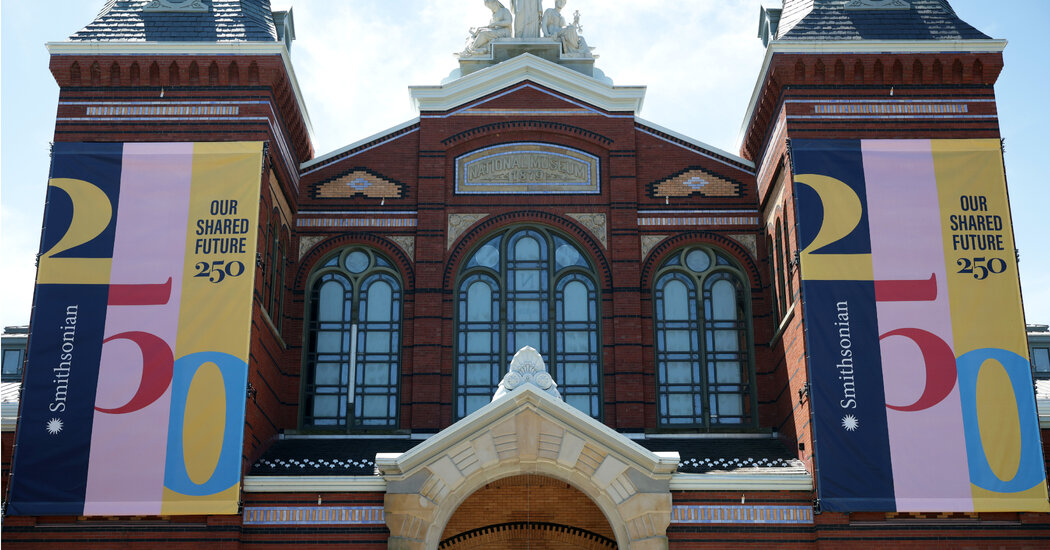
The Smithsonian Institution has called a board meeting to discuss giving one of its current buildings to the National Museum of the American Latino, which would bypass the need for congressional approval for a new site amid attacks by the Trump administration.
The Smithsonian confirmed the meeting but declined to comment further on Friday.
On Aug. 31, the Smithsonian will consider whether to give the Latino Museum its Arts and Industries Building, which was built in 1881 and is on the National Mall between the Smithsonian’s Castle and Hirshhorn Museum. It is used for exhibitions and programs, and reopened to the public this summer after having been closed for renovations since 2004.
The Latino Museum’s director, Jorge Zamanillo, declined requests for comment through a spokeswoman.
Four years ago, the Arts and Industries Building was eliminated as an option when the Smithsonian’s board selected two other possible sites near the National Mall to construct buildings for the Latino Museum and the American Women’s History Museum. Because those Washington sites are owned by the National Park Service, construction requires approval from Congress.
In May, the House rejected a bill that would have advanced plans to build the Women’s Museum at one of those sites, near the Tidal Basin across from the United States Holocaust Memorial Museum. A bipartisan coalition fractured over language that gave the president and his allies more influence and specified that the museum would be dedicated to presenting the experiences and achievements of “biological women.”
That site was also considered for the Latino Museum, whose leadership had concerns about the approvals required, the proximity to the water table and the fact that it was not directly on the National Mall. (The other site is across from the National Museum of African American History and Culture.)
The shift in plans to consider the Arts and Industries Building has fueled some speculation that the Smithsonian is looking to avoid a legislative process at a time when the institution is under fire from the federal government.
“The Smithsonian Institution is trying to use a loophole to sneak in a building for a yet-to-be-built controversial museum that remains homeless,” Mike Gonzalez, a senior fellow at the conservative Heritage Foundation, wrote in The Washington Examiner on Thursday. “It is an act of desperation by a museum complex beset with accusations of bias.”
The Latino Museum has been criticized by some conservatives who say it presents a negative version of Latino history that emphasizes grievances and struggle rather than accomplishments and triumph.
In 2023, a group of Latino Republican congressmen led a vote to eliminate the museum’s funding. Some commentators called the exhibition a Marxist portrayal that paints Latinos as victims of an oppressive United States.
In his 2026 budget request to Congress in May, President Trump requested that funding for the Latino Museum be zeroed out and replaced with a decentralized Smithsonian Latino Center, which would present exhibitions across some of the Smithsonian’s 21 museums.
The Latino Museum had hoped to construct its own building from scratch with a distinctive design by a brand-name architect, according to one person involved in the decision-making who was not authorized to speak publicly.
But frustrated with the slow pace of development, the person said, the museum decided it needed to nail down a location to begin fund-raising. Better to settle for an existing building, the museum ultimately determined, than risk never getting one at all.
The museum asked the Smithsonian to accelerate the process by holding committee meetings, commissioning a feasibility study and calling a board meeting at which its site designation could be changed from the Tidal Basin site to the Arts and Industries Building.
Construction of a new building for the Latino Museum was originally expected to cost about $800 million, with half coming from federal sources. The museum has so far raised $72 million in private funding.
Several Smithsonian museums have been under fire during the second Trump administration.
A White House report last month about the American History Museum accused its director of “radical activist ideology” and the museum of undermining “faith in American institutions.”
The director, Anthea M. Hartig, underwent two days of questioning by members of Congress, some of whom strongly chastised her for exhibitions that they say portray the country in a negative light and overemphasize slavery, immigration and transgender issues. The White House then ordered that warning signs be installed outside the museum to tell the public that it did not accurately reflect American history. The signs have yet to materialize.
President Trump has also complained about the African American Museum, accusing it of focusing too much on “how bad slavery was” and not enough on the “brightness” of America.
