


- In January, U.S. armed forces removed Venezuela President Nicolás Maduro from office and began opening the mining sector to foreign investment.
- Over the last eight months, officials have passed mining reforms, taken down leaders of criminal groups, and raided illegal mine sites. Nevertheless, observers say the illegal mining crisis is getting worse, not better.
- Illegal mining has expanded this year, in some cases in protected areas, and criminal groups involved in mining have tightened their hold in many parts of the country, experts say.
U.S. Secretary of the Interior Doug Burgum traveled to Venezuela in March with over a dozen mining company executives, holding a meeting in Caracas with local officials to discuss creating a “legitimate mining sector” and removing the criminal groups that currently operate at many mine sites.
The economic potential of Venezuela’s mining sector, he said, could be worth billions.
Burgum’s trip came just a few months after a U.S. military operation removed then-President Nicolás Maduro and transported him to a detention center in the U.S. state of New York. Since then, officials have heralded a new era for Venezuela, and tried to make the mining sector more attractive to foreign investment: Passing mining reform laws, taking down leaders of criminal groups involved in mining, and raiding illegal mining sites.
The U.S. is also considering an executive order aimed at improving access to critical minerals, Reuters reported.
Yet at the same time, observers say the illegal mining crisis is getting worse, not better. Illegal mining has expanded this year, in some cases in protected areas, and criminal groups involved in mining have tightened their hold in many parts of the country, according to sources contacted by Mongabay.
“[Since Maduro’s capture], nothing has changed in the criminal and legal ecosystem,” Cristina Burelli, founder of SOSOrinoco, an advocacy group studying the social and environmental impacts of mining in Venezuela, told Mongabay. “If anything, we have seen an increase in certain areas.”
Venezuela has one of the largest gold reserves in the world, as well as deposits of bauxite, iron ore and other critical minerals needed for the clean energy transition.
Despite the January operation and other measures, there are still at least 26 armed groups working in mining areas, including gangs, mining “syndicates,” and guerrilla groups like the National Liberation Army (ELN) and dissidents of the Revolutionary Armed Forces of Colombia (FARC), according to a recent SOSOrinoco report.
In June, U.S. Southern Command and Venezuelan armed forces allegedly killed the leader of the drug trafficking organization Tren de Aragua, which also controls gold mines in Bolivar state in eastern Venezuela. But mining hasn’t diminished in its areas of control, such as El Callao and Las Claritas, local media reported. Other members of Tren de Aragua took over leadership, reorganized their control of the mines and continued operations.
An August flyover and analysis of satellite imagery of forest loss in Canaima National Park in the state of Bolivar revealed a new 30.7-hectare (75.9-acre) mine site inside the protected area, adding to the over 300 hectares (741.3 acres) lost to mining expansion between 2024 and 2025. The park is a UNESCO World Heritage Site and home to geological table-top formations known as tepuys, sacred to many Indigenous communities.
That same month, other flyovers and satellite analysis identified a separate 5.8-hectare (14.3-hectare) mine site at the mouth of the Carrao River, which leads into the Caroní River, the country’s second biggest river.
At the end of 2025, satellite data detected at least 49 dredges inside the park, dozens of dredges along the Caroní River and 14 active mine sites along the Caruai River.
The Ministry of the Popular Power of Ecological Mining Development didn’t respond to Mongabay’s request for comment.
Yapacana National Park, in Amazonas state, also has confirmed mining activity that appears to be expanding, according to SOSOrinoco. Unregulated mining has contributed to deforestation and pollution, and health issues for the Indigenous Yanomami. The Inter-American Commission on Human Rights (IACHR) has reported malnutrition, respiratory infections, tuberculosis, birth defects from mercury contamination, hepatitis, and sexually transmitted infections as a result of mining activity.

A mining reform law passed in April was marketed as a solution to organized crime in the mining sector, outlining increased state control and legal pathways for international investment. It also committed to limiting the environmental impact of mining — a promise that critics said was unrealistic and amounted to greenwashing.
“The new mining law that was introduced is simply a way of saying, ‘Well, institutional changes are being made,’” a member of SOS Orinoco, who asked to remain anonymous due to security concerns, explained to Mongabay. “… But in effect there’s no movement on the ground.”
In an August 2026 statement following a public hearing, the IACHR called for “robust guarantees regarding environmental and social assessment, access to public information” and consultation with Indigenous communities.
“Indigenous peoples are among those most affected by the expansion of mining,” it said in the statement. “The occupation of Indigenous lands by persons engaged in mining activity has been documented, as well as the prolonged paralysis of demarcation and land titling processes and the growing militarization of Indigenous territories.”
The commission referenced its own 2024 request that Venezuela address the violence and health impacts on Yanomami people living in mining areas, citing violent deaths, disappearances and torture, among other human rights violations.
“[The IACHR urges] the state to adopt effective, culturally appropriate and concerted measures to protect Indigenous territories, prevent the illegal occupation of their lands, advance pending demarcation and titling processes,” the statement said.
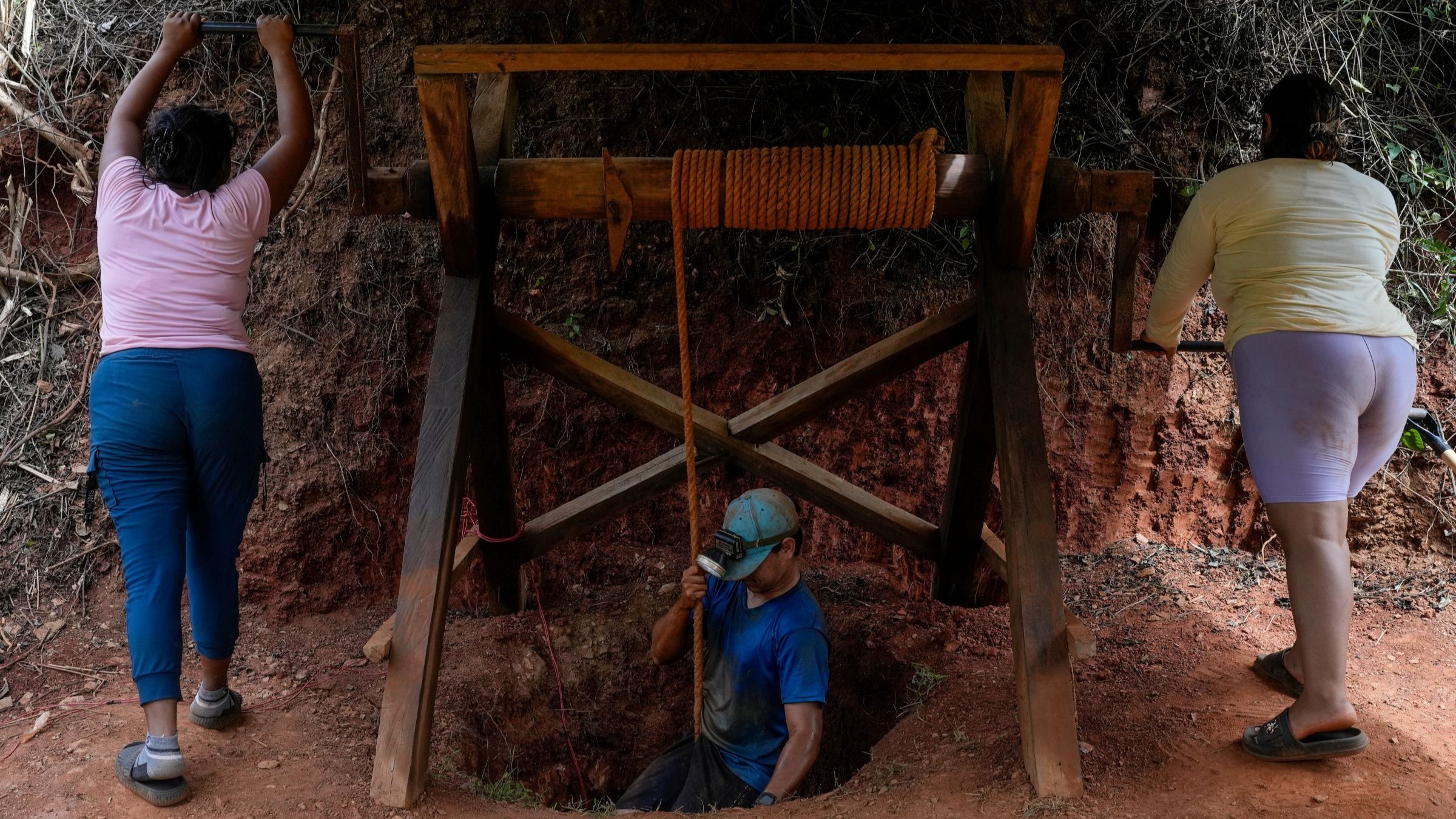
Banner image: Women lower a miner into a gold mine pit in El Callao, Venezuela. (AP Photo/Matias Delacroix)
See related from this reporter:
Nicaragua’s gold boom is now encroaching on protected areas and Indigenous land
FEEDBACK: Use this form to send a message to the author of this post. If you want to post a public comment, you can do that at the bottom of the page.
Cite this article
Maxwell Radwin (2026). Since US intervention, Venezuela’s illegal mining crisis has only worsened, critics say. Mongabay Conservation news. DOI: https://doi.org/10.66709/news-329729

