


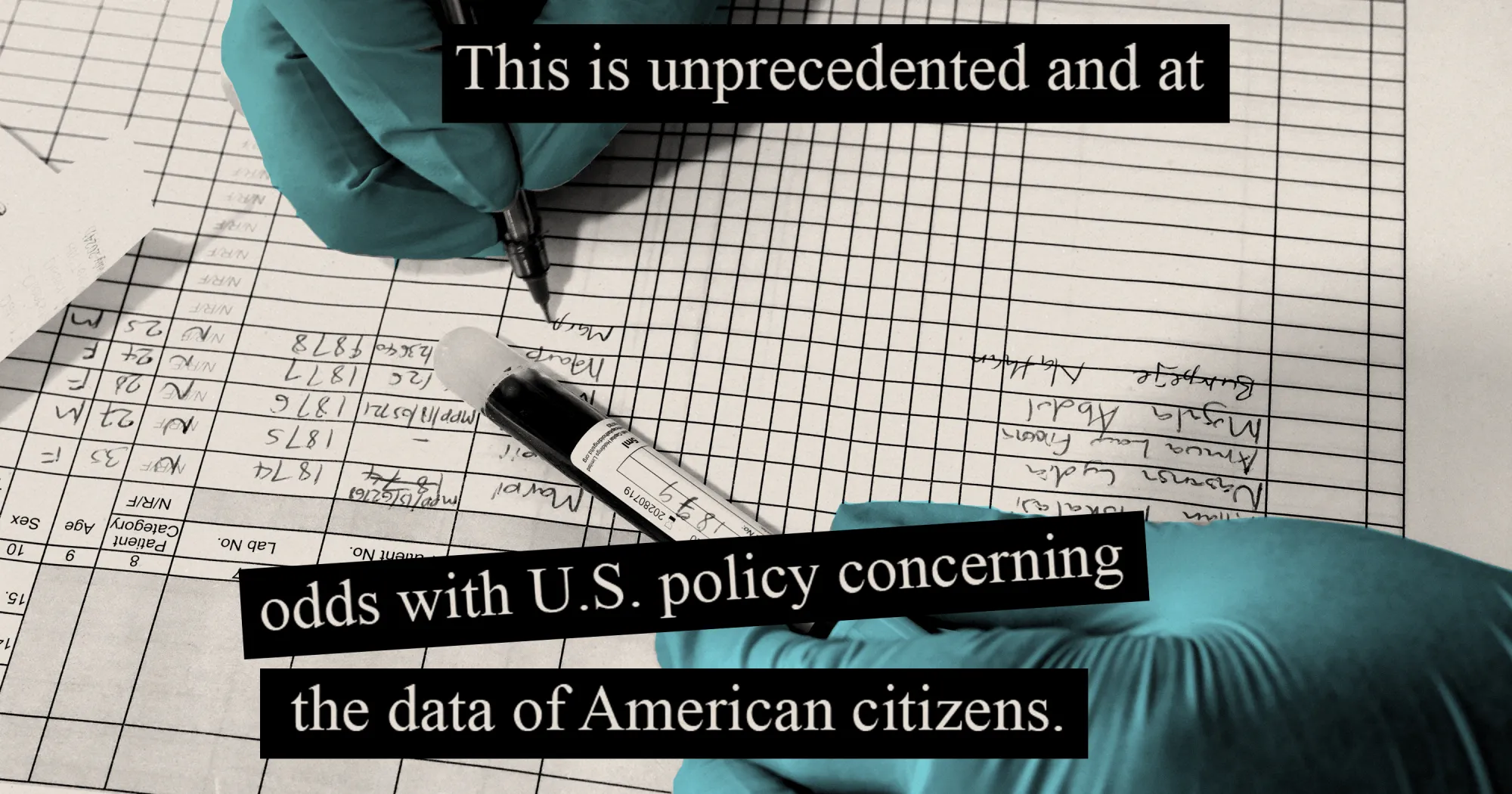
What Happened: Citing reporting by ProPublica, eight Democratic U.S. senators have criticized the Trump administration’s demands to access the health data of millions of people as a condition of giving lifesaving aid to other countries. In a letter to Secretary of State Marco Rubio, the senators, including minority leader Chuck Schumer, said the U.S. demands were “unprecedented and at odds with U.S. policy concerning the data of American citizens.”
The inquiry into the administration’s approach to foreign health data referred to a ProPublica story published in June about agreements the U.S. struck with African countries — and the risks they posed to people there. Experts told ProPublica that the deals are vague and lack language used in most data-sharing agreements to adequately limit what information is collected and how it can be used. As a result, they said, there is an increased risk that individuals’ personal data could be exposed, misused or commercialized without their consent.
The senators — who include Tim Kaine of Virginia; Chris Van Hollen of Maryland; Brian Schatz of Hawaii; Amy Klobuchar of Minnesota; Christopher Coons of Delaware; Jeff Merkley of Oregon and Raphael Warnock of Georgia, who led the effort — requested a briefing on the healthcare agreements’ data requirements. They also asked Rubio to respond in writing to a list of questions by the end of August.
What They Said: In the letter, which was sent last week, the senators expressed concern that the requirement to access foreign health data might reverberate beyond the countries where the aid agreements were struck and “set international precedents that ultimately harm Americans.” They noted that the demands for data appear to be at odds with the Trump administration’s National Cyber Strategy, which emphasizes the right to privacy for Americans and their data.
“These new demands set an alarming precedent that is seemingly contrary to the Administration’s longstanding support for the privacy of U.S. citizens’ data,” they wrote.
The senators also laid out the details of a data-sharing agreement between the U.S. and Uganda that were first reported by ProPublica. The deal demanded that Uganda provide the U.S. — and its contractors — with logins “or other secure access mechanisms” to directly enter the nation’s health data systems.
“While global health programs have historically included data sharing components,” the senators wrote, “they have never required direct access to privileged electronic systems for U.S. government representatives.”
The letter ends with more than a dozen questions for Rubio, including why the State Department has not made the health care agreements public, as federal law requires, and whether any of the data will be shared with “U.S.-based third parties for any commercial purpose, including to train any artificial intelligence models.”
The senators also asked what privacy rights foreign citizens will have over data that is transferred to the U.S. and how those rights will be enforced in the case of a data breach or another unethical use of their personal information.
Background: After the Trump administration dismantled the U.S. Agency for International Development and drastically reduced funding for international health work done by the Centers for Disease Control and Prevention, Congress required the executive branch to continue providing foreign aid. The State Department has since faced the challenge of finding new ways to get the funding to countries, ensure that it was being spent wisely and address potential pandemics. The task has been especially challenging because the administration cut ties with most of the international partners and fired staff the government had previously relied on to carry out this complex work.
In the past, PEPFAR, the U.S. program that provides aid for treating and preventing HIV around the world, built its own systems to handle anonymized data, separate from foreign government health records. In contrast, the Ugandan agreement provides the U.S. with direct access to the government’s own health data systems.
Through separate agreements, the U.S. has also arranged for countries to provide it with specimens of pathogens that could cause pandemics, along with related information.
The effort to establish these new aid arrangements was led by Brad Smith, an entrepreneur who founded three healthcare companies, one of which sold for a reported $2.7 billion. Before joining the State Department, Smith led the government efficiency panel that would become the Department of Government Efficiency and oversaw some $67 billion in cuts to the Department of Health and Human Services.
The U.S. agreement with Uganda provides up to $1.7 billion in aid for HIV, tuberculosis and malaria, among other diseases. As a condition, the deal calls for the sharing of aggregated data with all personally identifiable information removed and specifies that the information should be used for delivering and auditing healthcare services. But experts told ProPublica that it is possible to reverse-engineer data that has been anonymized.
The shift in the approach to health data is part of the America First Global Health Strategy, which is intended to make America “more prosperous” and “promote American health innovations.” Rubio explained in September that under this new strategy, aid will be given “in a way that directly benefits the American people and directly promotes our national interest.”
Why It Matters: Privacy experts say that, if health data is mishandled under the agreements, it could have serious consequences. Revealing healthcare histories, including whether someone has had an abortion, a mental health condition, substance-use treatment or a sexually transmitted disease can be devastating anywhere. In Africa, research has shown it can lead to discrimination and violence.
In the age of artificial intelligence, health data has become especially valuable. But the agreements reviewed by ProPublica provide no guarantee that Africans subject to them will have a say in how their data is used or whether they would receive any potential financial benefits.
Response: The State Department declined to answer specific questions about the senators’ letter, saying that it does not respond to questions about congressional correspondence. In a statement sent to ProPublica, a State Department spokesperson defended the data requirements in the health agreements.
“Neither the U.S. government nor any private American companies receive or review any personally identifiable information (PII) under these data sharing agreements,” the statement said, going on to note that the new deals “share only the same kinds of aggregated, de-identified data that has been shared and used for years in the fight against HIV/AIDS, malaria, tuberculosis, and other diseases. All data sharing is consistent with each country’s laws and approvals.” The spokesperson also said no country has been coerced to sign the agreements with the U.S.
