


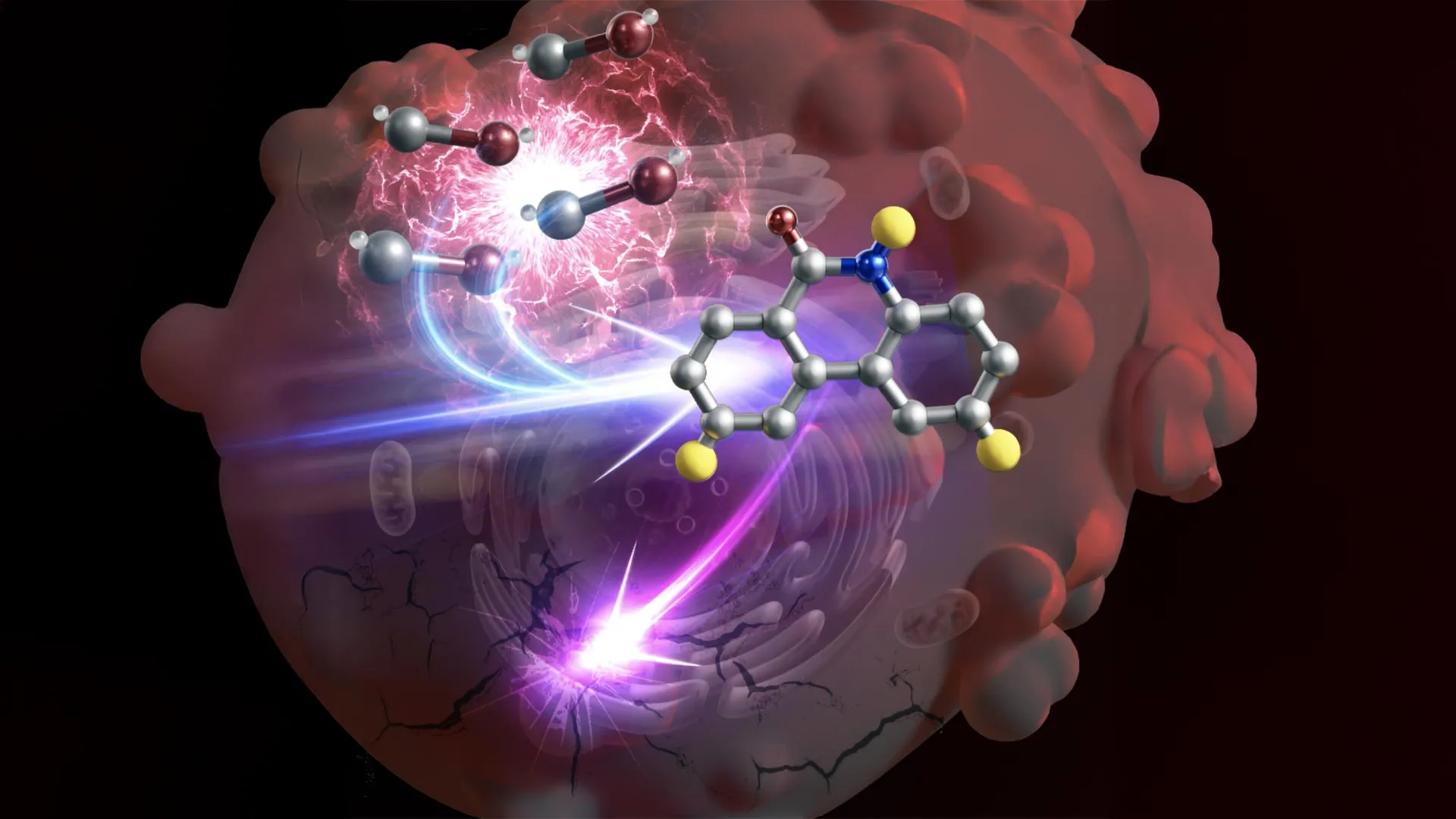
Researchers in Japan have developed an innovative way to turn a chemical produced by cancer cells into a weapon against them. Instead of delivering toxic drugs throughout the body, their experimental approach uses carbon monoxide released by cancer cells to manufacture anticancer compounds directly inside the cells themselves.
The research, led by Katsunori Tanaka at the RIKEN Pioneering Research Institute (PRI) in Japan, was published in Nature Communications. In laboratory experiments, the team demonstrated that a specially designed compound could trigger drug production inside cancer cells without generating the same toxic substances in healthy cells. Although the technique is still at an early stage, it could eventually provide a way to attack tumors while reducing the harmful side effects associated with conventional cancer treatments.
Turning Cancer’s Own Toxic Gas Against It
One of the greatest challenges in cancer treatment is destroying malignant cells without damaging healthy tissue. Traditional chemotherapy can cause serious side effects because its toxic effects are not always limited to tumors. Tanaka and other researchers are investigating more selective strategies that could make cancer treatments safer.
Their long-term goal is to replace the direct delivery of toxic drugs with relatively harmless compounds that become active only after entering cancer cells. These compounds would use substances already present inside tumors to generate therapeutic drugs exactly where they are needed.
Carbon monoxide offers an intriguing opportunity for this approach. Although best known as a poisonous gas produced by sources such as gasoline engines, carbon monoxide is also generated naturally by many types of cancer cells. Because tumors can produce unusually high amounts of the gas, it may serve as a useful biological marker for identifying cancer cells, provided it can be detected.
Scientists in RIKEN’s Biofunctional Synthetic Chemistry Laboratory investigated whether they could exploit this difference. Their strategy involved delivering a metal catalyst into cells and using the excess carbon monoxide in cancer cells to drive a chemical reaction that produces a toxic compound. In principle, the reaction would occur primarily in cancer cells, where enough carbon monoxide is available, while sparing normal cells.
Protecting the Catalyst Inside Cancer Cells
To make the system work, the researchers turned to a class of compounds known as palladacycles. These metal-containing compounds can react with carbon monoxide to produce an organic molecule called phenanthridinone. Certain derivatives of phenanthridinone are toxic to cells and have already been incorporated into anticancer drugs.
However, there was a major obstacle. When palladacycles are introduced directly into cells, substances such as glutathione rapidly deactivate their central palladium catalyst. Without an active catalyst, the reaction cannot produce the desired drug.
Tanaka’s team addressed this problem by building on its previous work using metal catalysts to carry out chemical reactions in living systems. The researchers enclosed a palladacycle within albumin, a protein commonly found in blood. This protective protein carrier allows the complex to travel through the bloodstream while shielding the palladium catalyst from substances that would otherwise deactivate it after entering cells.
Laboratory Tests Reveal Selective Drug Production
The scientists evaluated their system through a series of experiments. They began by testing different palladacycles to identify which one could generate the greatest amount of phenanthridinone.
Next, they exposed cultured human liver, cervical, breast, and lung cancer cells to the albumin and palladacycle complex for 48 hours. They also tested the compound on a noncancerous cell line to determine whether the same chemical reaction would occur in healthy cells.
After 48 hours, the researchers detected phenanthridinone in the cancer cell lines but not in the normal cells. The findings indicated that the albumin carrier successfully protected the catalyst from glutathione and that the chemical reaction occurred selectively in the cancer cells under the conditions tested.
The team then refined the system so that the newly formed compound could separate from the carrier and move freely throughout the cell. Additional modifications allowed the reaction to generate a particularly toxic phenanthridinone derivative already used in anticancer drugs.
When the researchers introduced this modified system into cultured liver cancer cells, they observed the anticancer compound forming inside the cells. The cells subsequently showed signs of damage caused by the toxic drug, providing proof that the approach could generate a cancer-fighting substance directly within its intended target.
Why the Experimental Drug Did Not Form in Blood
An important safety concern involved carbon monoxide already present in the bloodstream. If that gas triggered the chemical reaction before the compound reached cancer cells, the resulting drug could damage blood cells instead of its intended target.
Fortunately, laboratory testing showed that the toxic drug was not produced in blood. The researchers believe this is because carbon monoxide in the bloodstream is largely attached to hemoglobin, the protein responsible for transporting oxygen. In this bound form, the gas appears to be unavailable for the reaction needed to manufacture the drug.
The finding suggests that the system may be able to travel through blood without prematurely generating harmful substances, although further studies will be needed to establish its safety in living organisms.
“This work represents an important advance in therapeutic in vivo synthetic chemistry,” says Tanaka. “In our therapeutic strategy, molecules naturally present or generated within the body — including disease-associated metabolites — are used as endogenous chemical feedstocks to synthesize therapeutic molecules directly at the site of disease.”
The researchers now plan to move beyond cultured cells and test the approach in animal models. If future experiments are successful, the technology could help establish a new class of cancer treatments that exploit the chemistry of tumors to produce drugs directly at the disease site, potentially limiting damage to healthy tissue.
