

Close Menu
NCIJ Network NCIJ Network
    What's Hot

    Pasta, pies and paperwork errors: the reality of Brexit food checks | Brexit

    November 15, 2026

    Alzheimer’s may start shrinking two brain regions years before memory loss

    November 15, 2026

    Oxford is platforming race baiter Nathan Cofnas. I know how corrosive that will be for Black students | Ebony Riddell Bamber

    November 15, 2026
    Facebook X (Twitter) Instagram
    Trending
    • Pasta, pies and paperwork errors: the reality of Brexit food checks | Brexit
    • Alzheimer’s may start shrinking two brain regions years before memory loss
    • Oxford is platforming race baiter Nathan Cofnas. I know how corrosive that will be for Black students | Ebony Riddell Bamber
    • Planned asylum seeker detention centre next to Oxfordshire sewage works criticised | Immigration and asylum
    • Britain’s veto could stop the UAE’s choice from running the United Nations. Miliband must use it | Steve Bloomfield
    • Key Witness in Comey Case Attests to Justice Dept.’s Aggressive Tactics
    • Targeted by al-Shabaab for defending Kenya’s ecosystems: Foundation founder gets award
    • Crows can make decisions twice as fast as humans, scientists discover
    • About
      • Our Team
      • Editorial Policy
      • Editorial Independence
      • International Support
    • Trust & Standards
      • AI Usage Policy
      • Conflict of Interest Policy
      • Corrections Policy
      • Ethics Policy
      • Fact-Checking Policy
      • Source Protection
    • Get Involved
      • Guide for Sources
      • Support Independent Journalism
    • Legal
      • Cookie Policy
      • Privacy Policy
      • Terms of Use
    Facebook X (Twitter) Instagram
    NCIJ Network NCIJ Network
    Sunday, November 15
    • Home
    • World
    • Ai
    • Business
    • Politics
    • Health
    • Crypto
    • Science
    • Technology
    • Cybersecurity
    • Defense & Security
    • Economy
    • Energy
    • Europe
    • More
      • Fact Check
      • Investigations
      • Opinion & Analysis
      • Environment
    NCIJ Network NCIJ Network
    Home»Science

    Scientists just imaged the hidden quantum shape of a molecule

    NCIJ NETWNCIJ NETWORKBy NCIJ NETWNCIJ NETWORKAugust 25, 2026 Science No Comments3 Mins Read
    Share
    Facebook Twitter LinkedIn Pinterest Email

    Quantum mechanics has long challenged the familiar idea that an object must occupy one precise place at a given moment. Fundamental particles such as electrons are instead described by a “wavefunction,” a mathematical representation that researchers can use to calculate the probabilities of properties such as position and momentum.

    Inside molecules, electron wavefunctions are known as “molecular orbitals.” These orbitals contain valuable information about how a molecule behaves and interacts with its environment, including how it absorbs light and how chemical reactions may unfold. Obtaining a complete three-dimensional picture of a wavefunction would therefore give scientists a powerful view of molecular behavior, but producing such an image has been extremely difficult.

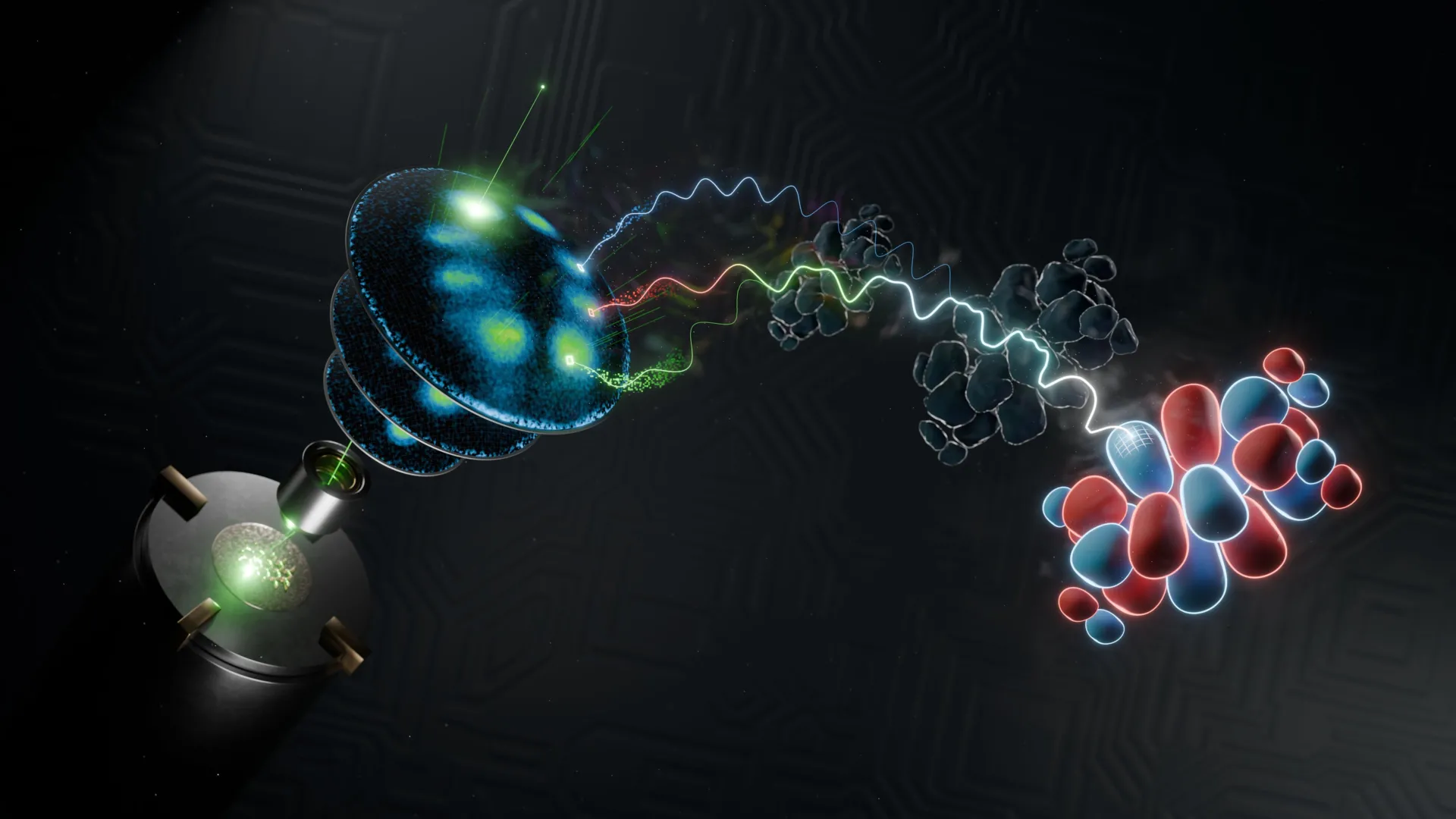
    Now, an interdisciplinary team at the University of Göttingen has successfully imaged the three-dimensional wavefunction of an organic molecule only nanometers in size. The researchers accomplished this by combining advanced photoelectron spectroscopy with sophisticated mathematical algorithms. Their findings were published in Nature Communications.

    Reconstructing an Elusive Quantum Wavefunction

    “The wavefunction is a fundamental quantity in quantum mechanics, yet it cannot be directly observed or measured,” explains Professor Stefan Mathias at the University of Göttingen.

    Because the wavefunction itself cannot simply be measured, the researchers used an indirect technique called photoelectron spectroscopy. The method measures the momentum of electrons emitted from the molecule, giving scientists access to one half of the wavefunction without physically changing its state.

    Advanced computer algorithms were then used to reconstruct the missing half. This allowed the team to produce an image of the complete molecular orbital and distinguish features that are even smaller than the distance separating the carbon atoms within the molecule.

    Until now, extending this approach into three dimensions required lengthy measurements at major synchrotron research facilities. That requirement made the technique difficult to use widely and created an especially large obstacle for efforts to image “dynamical” wavefunctions as three-dimensional videos at atomic scales.

    Toward Ultrafast 3D Movies of Molecules

    Dr. Matthijs Jansen, University of Göttingen, and co-leader of the study, highlights the originality of the team’s approach: “We introduce two powerful new concepts. First, by redesigning the computer algorithm from the ground up, reliable 3D images can now be obtained using much less experimental data. Second, the experiment is based upon a powerful, lab-based soft-X-ray light source that provides ultrashort light pulses. It is the combination of these two techniques that has this remarkable impact.”

    The redesigned algorithm dramatically reduces the amount of experimental data required to generate dependable three-dimensional images. At the same time, the researchers can perform the measurements using a powerful soft X-ray source in the laboratory that produces extremely short pulses of light. Together, these advances could make three-dimensional wavefunction imaging much more practical.

    Dr. Wiebke Bennecke, first author of the study, adds: “This technique might mean that stroboscopic videography becomes a reality, allowing us to observe not just the shape of wavefunctions, but also to see how it changes with ultrafast, even femtosecond or one quadrillionth of a second, resolution. This will mean we can learn how a molecule adapts to optical, electronic, or chemical changes and find new ways to control these interactions at the level of a few atoms.”

    If the technique can be extended in this way, researchers could move beyond static images and watch molecular wavefunctions evolve over time. Such observations could reveal how molecules respond to light, electronic effects, and chemical changes on femtosecond timescales, potentially giving scientists new ways to understand and control interactions involving only a few atoms.

    hidden imaged molecule Quantum Scientists shape
    NCIJ NETWNCIJ NETWORK
    • Website

    Keep Reading

    Alzheimer’s may start shrinking two brain regions years before memory loss

    Crows can make decisions twice as fast as humans, scientists discover

    Tiny flaws in diamonds could unlock a quantum computing revolution

    The Sun unleashed a monster storm. Earth may have made it worse

    Scientists discover a surprisingly simple way to turn coffee waste into fuel

    A giant icy world hiding beyond Pluto could be our sixth dwarf planet

    Add A Comment
    Leave A Reply Cancel Reply

    Editors Picks

    Pasta, pies and paperwork errors: the reality of Brexit food checks | Brexit

    November 15, 2026

    Alzheimer’s may start shrinking two brain regions years before memory loss

    November 15, 2026

    Oxford is platforming race baiter Nathan Cofnas. I know how corrosive that will be for Black students | Ebony Riddell Bamber

    November 15, 2026

    Planned asylum seeker detention centre next to Oxfordshire sewage works criticised | Immigration and asylum

    November 15, 2026
    Latest Posts

    Auditing Preference Biases and Fine-Tuning Language Models with Direct Preference Optimization on Anthropic HH-RLHF Using TRL and LoRA

    August 20, 2026

    Cognition CEO denies report that SpaceX tried to acquire the startup

    August 20, 2026

    Burnham announces plans to clean up worst three illegal waste dumps

    August 20, 2026

    Subscribe to News

    Get the latest sports news from NewsSite about world, sports and politics.

    NCIJ Network is an independent digital news platform delivering trusted investigative journalism, European and global news, in-depth analysis, and fact-based reporting with accuracy, transparency, and integrity.

    Facebook X (Twitter) Instagram Pinterest YouTube

    Pasta, pies and paperwork errors: the reality of Brexit food checks | Brexit

    November 15, 2026

    Alzheimer’s may start shrinking two brain regions years before memory loss

    November 15, 2026

    Oxford is platforming race baiter Nathan Cofnas. I know how corrosive that will be for Black students | Ebony Riddell Bamber

    November 15, 2026

    Subscribe to Updates

    Get the latest creative news from FooBar about art, design and business.

    Type above and press Enter to search. Press Esc to cancel.