


- Researchers at gene banks scattered across Southern Africa have spent decades collecting and duplicating specimens of valuable wild fruit trees.
- Among the species cloned by researchers from the Landscape Alliance is the wild loquat — an evergreen tree that produces large quantities of highly sought-after berries that provide income and nourishment for millions of people.
- Alice Muchugi and her colleagues are skilled practitioners of “air layering,” which ingeniously spurs a branch to produce roots, hugely reducing the time needed to establish a new, mature, fruit-bearing tree.
- Planting and preserving prolific indigenous fruit trees protects both the biodiversity of miombo woodlands and an important alternative food source for communities who live in them.
Plant geneticist Alice Muchugi recalls meeting a group of furious fruit sellers on the side of a dusty road not far from Zimbabwe’s capital, Harare, in 2024. They told her that a group of men armed with chainsaws had felled some of the district’s most prolific fruit trees, robbing the women of a steady source of income: the trees’ sweet, yellow, apricot-sized berries. The men wanted the wood from the trees to burn in brick-making kilns, Muchugi said.
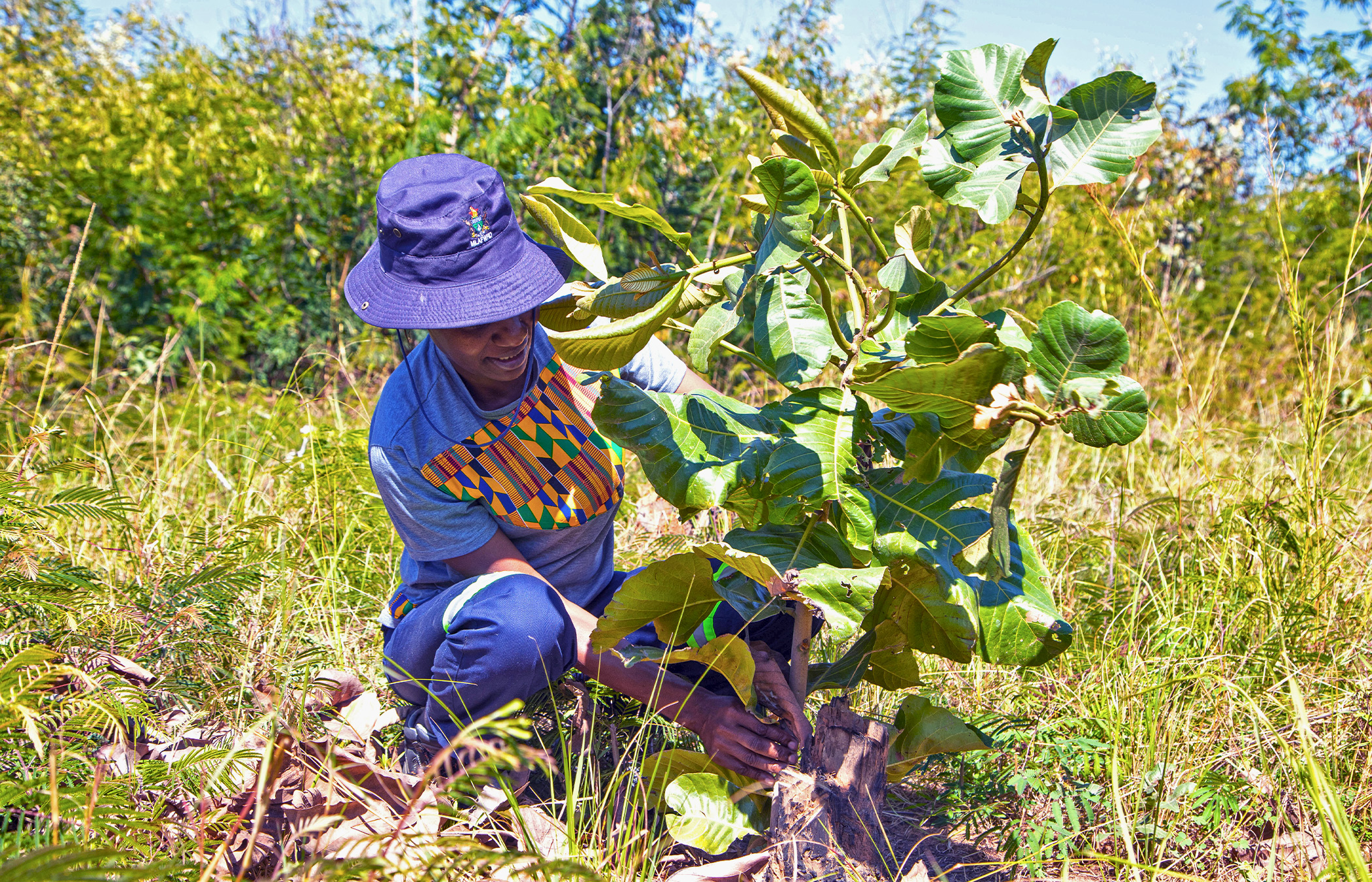
Muchugi, leader for tree diversity and productivity at the Landscape Alliance, an international forestry and agroforestry research organization, immediately knew which trees the women were referring to. They were wild loquats (Uapaca kirkiana), cloned more than 20 years ago from superior mother trees in 25 different geographical locations across four countries within the region and growing at her organization’s field gene bank in Domboshava, around 30 kilometers (19 miles) northeast of Harare.
Once data on the trees had been collected by staff at the gene bank — essentially an orchard dedicated to growing clones of especially fruitful wild trees — the women had been given permission to harvest the fruit for sale, Muchugi said. The loss of the trees after the loggers stole onto the gene bank’s land under cover of darkness highlighted the challenges facing both fruit collectors and plant geneticists.
“One night you can wake up and find everything is gone,” Muchugi said.
Fortunately, duplicates of most of the trees cut down by the charcoal burners in Zimbabwe still exist in the Landscape Alliance’s other gene banks in Malawi and Zambia. Muchugi said sustainable funding is needed to continue the work of selecting the best trees in the wild, monitoring their cultivation, and maintaining security at gene banks.
The miombo trees found across Southern and Central Africa are under severe threat wherever they grow in the wild. A recent study shows that from 2000-2023, more than 500,000 square kilometers (193,000 square miles) of this dry forest biome was lost across Angola, Burundi, the southeastern Democratic Republic of Congo, Malawi, Mozambique, Tanzania, Zambia, and Zimbabwe — representing nearly 22% of the area’s total woodland cover. Among the worst-affected countries were Malawi and Zimbabwe, which lost nearly 17,700 and 47,000 square kilometers (around 6,800 and 18,100 square miles) respectively.
Wild loquats, known in Zimbabwe as muzhanje or mashuku, are one of at least 75 tree species growing wild in miombo woodlands that bear edible fruit. The incident at the Domboshava gene bank showed that being a fruit tree much loved by millions is no guarantee for survival.
It’s not that wood harvesters don’t eat the fruit, said Isaac Nyoka, the Landscape Alliance’s Malawi-based Southern Africa leader, “but because their business is in charcoal, whenever they see a tree, they see charcoal. So, it’s different interests that do not seem to converge.”

Someone who has witnessed similar destruction firsthand in Malawi is Brian Nduw, a researcher at the African Centre of Excellence in Neglected and Underutilized Biodiversity at Mzuzu University, in northern Malawi. His recent study of two northern forest reserves, Perekezi and Kaning’ina, found that wild loquat trees were being heavily targeted by illegal wood harvesters in Kaning’ina, probably due to its proximity to the city of Mzuzu.
Older trees left standing were struggling to regenerate. In addition, the activities of local church sects, which worship beneath trees inside Kaning’ina and create bare patches of ground where seedlings fail to take root, were having an impact.
Active intervention is needed to protect what’s left and ensure regeneration takes place, Nduw told Mongabay. But ex-situ conservation, like that being pursued by the Landscape Alliance, is equally important to ensure trees like the wild loquat don’t die out.
Wild loquats and other miombo species like marula (Sclerocarya birrea), mobola plums (Parinari curatellifolia, also known as hissing trees), and even baobabs (Adansonia digitata) are neglected in terms of conservation, despite being important for people’s well-being.
“These all need to be domesticated,” Nduw said.

For a long time, researchers have said that in the face of ongoing forest loss, cultivated stands of indigenous fruit trees, if properly sourced, could provide important reservoirs of information that could otherwise be lost with the destruction of genetically distinct wild tree populations.
There is, however, a snag. While trees like wild loquats do germinate readily from seed, they only start producing fruit after around 17 years — far too slow to make their cultivation an attractive proposition for communities that could ultimately benefit. That’s where the work of the field gene banks, like Domboshava or at Makoka, in Malawi, comes in.
Since 2003, the Landscape Alliance’s work at those gene banks and two others in Zambia and Tanzania has been duplicating highly productive, wild-growing fruit trees through grafting or air layering, reducing the amount of time the duplicates take to produce a harvest to just four or five years, Nyoka said.
Through grafting, branches or shoots known as scions are cut from superior trees and joined to the stems of rootstocks from the same species. Air layering, on the other hand, involves encouraging a tree branch to grow roots by cutting a ring of bark from around its base, packing that groove with a growing mixture of soil and sawdust, for example, and wrapping plastic around it to retain the moisture. It tricks the branch into producing roots, and once those are established, the branch can be cut off and planted into the ground as a replica of the mother tree.
In December, around 200 farmers in three farming districts in southern, central and western Malawi will get around 800 scions — around four per farmer — to graft onto rootstocks they themselves have raised from seed, Nyoka said.
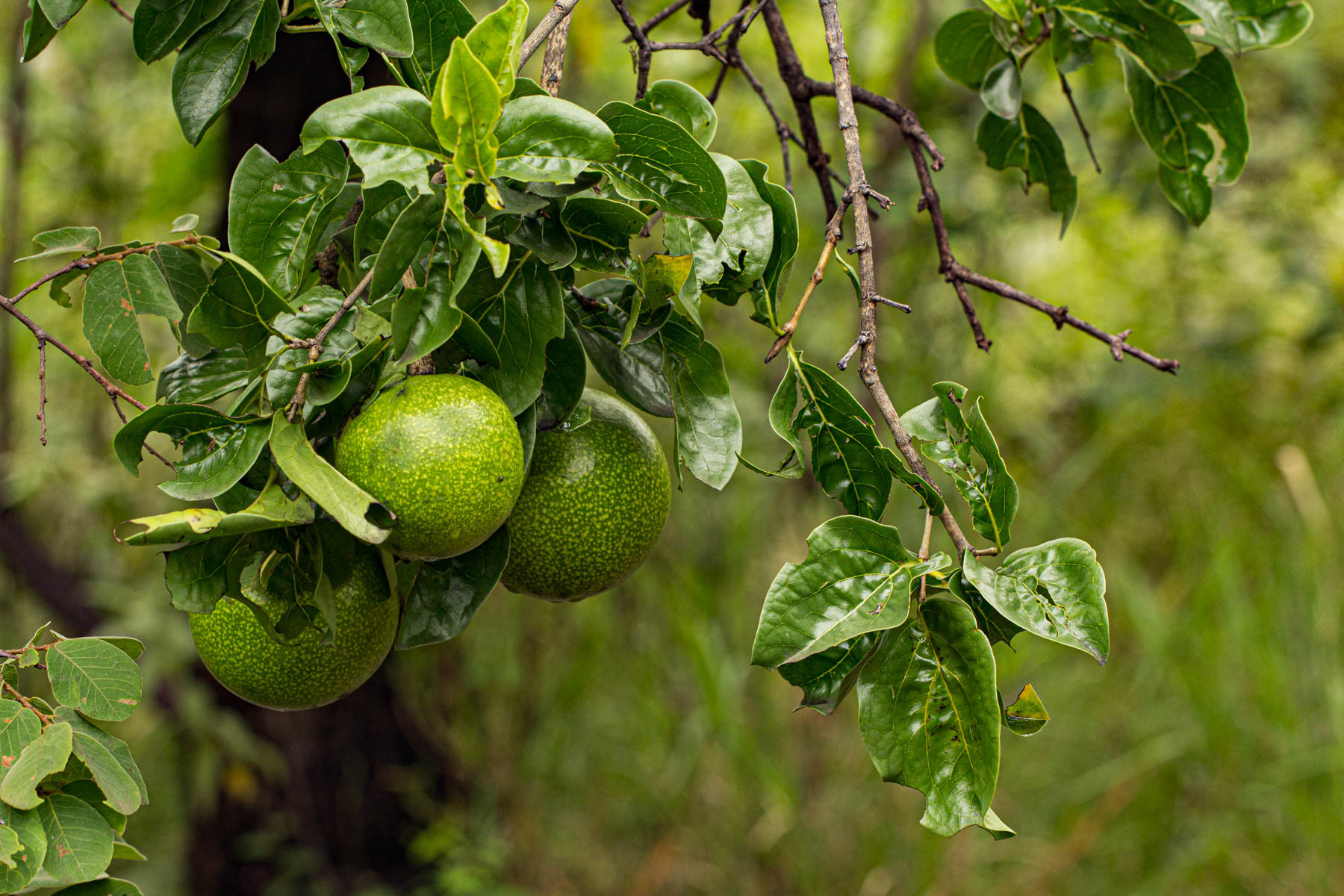
Work is also underway to clone the trees of another miombo species with sweet fruit encased in perfectly spherical hard green shells: the corky monkey orange (Strychnos cocculoides).
This small tree, as attractive as any garden ornamental, is named after the soft, deeply ridged bark on its trunk. “It’s the second most important fruit tree [after the wild loquat] in Southern Africa,” Nyoka said.
Some have been cultivated by his Zambian counterparts at a research station in Chipata, just over the Malawian border. They reveal what an orchard of indigenous fruit trees should look like.
“It’s about 4 hectares [10 acres],” he said, “and it’s beautiful.”
Banner image: Agronomist Christine Tapiwa, from Zimbabwe’s Department of Research and Specialist Services, a partner institution of Landscape Alliance, at Domboshava with the coppicing stump of a wild loquat tree cut down in 2024. Like many other miombo tree species, wild loquats have remarkable regenerative powers. Image courtesy of Landscape Alliance.
Growing Indigenous food trees in East Africa fights malnutrition and biodiversity loss
With a drastic decline in tropical fruit, Gabon’s rainforest mega-gardeners go hungry
Shea’s silent guardians restore Uganda’s traditional parklands
Citations:
Khoji Muteya, H., N’tambwe Nghonda, D., Malaisse, F., Bogaert, J., & Useni Sikuzani, Y. (2025). Mapping and quantifying deforestation in the Zambezi ecoregion of Central-Southern Africa: Extent and spatial structure. Frontiers in Remote Sensing, 6. doi: 10.3389/frsen.2025.1590591:
Nduw, B. O., Mhango, J., & Ngulube, E. (2026). Population structure, regeneration status, and health condition of Uapaca kirkiana (Phyllanthaceae) in Perekezi and Kaning’ina forest reserves, northern Malawi. Feddes Repertorium, 137(3). doi:10.1002/fedr.70141
Feedback: Use this form to send a message to the author of this post. If you want to post a public comment, you can do that at the bottom of the page.
Cite this article
Ryan Truscott (2026). Scientists clone Southern Africa’s wild fruit trees as forests disappear. Mongabay Conservation news. DOI: https://doi.org/10.66709/news-330841

