


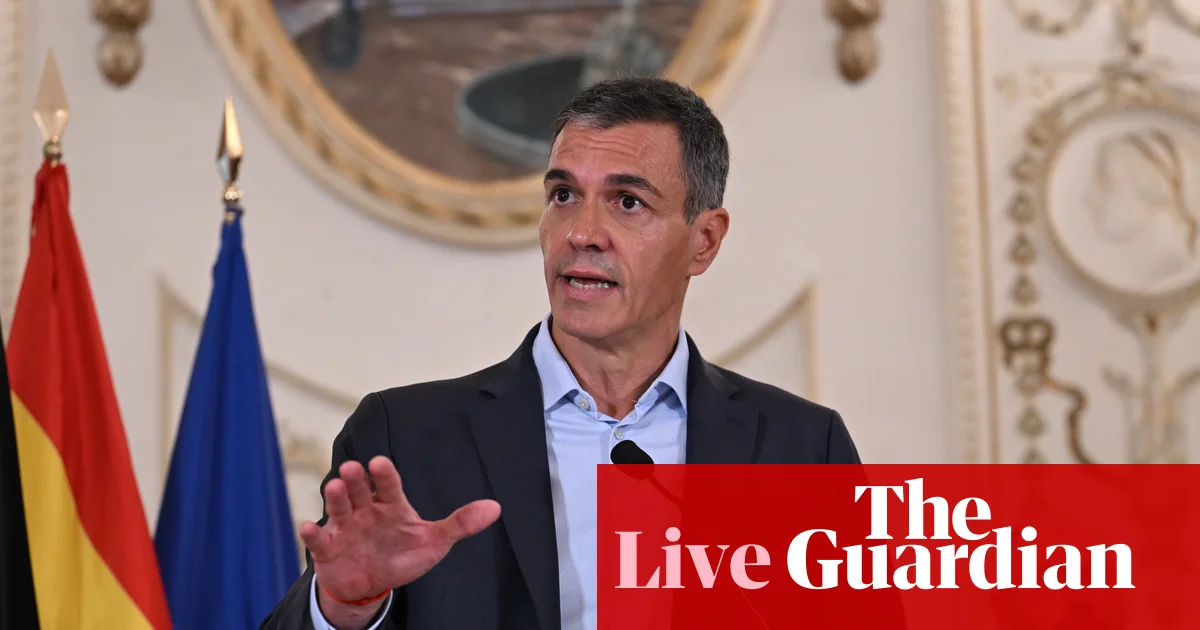
Spanish PM criticises ‘selfish’ attitude of some EU countries over Ceuta crisis
The Spanish prime minister, Pedro Sánchez, has hit back at some EU countries for what he described as their “selfish, polarising and illegal reaction” to the mass border crossings at Ceuta, as he thanked Morocco for its help in dealing with the crisis.
In a letter to Brussels, he said several European states have chosen to “attack” Spain and request its temporary exclusion from the Schengen area, driven by “prejudice, fake news, ignorance, or political interests” that is contrary to European law, humanitarian law and the principles of EU solidarity, the Spanish El Pais newspaper reported.
Sánchez argued that in less than 48 hours, his government managed to “fully restore control of the border, provide extensive humanitarian assistance, return virtually all migrants who crossed irregularly and prevent any unauthorised movement towards continental Europe”.
“All of this has been achieved in close coordination with the Moroccan authorities and with very little support from other European states,” he added.
He called for an emergency meeting of EU interior ministers “as a matter of urgency”.
El Pais reported Ceuta is “gradually returning to normal” this morning, with shops reopening, traffic moving freely and fuel supplies restored after days of disruption. While small groups of young people remained in parts of the city, the large crowds seen earlier this week had largely dispersed.
Key events

Lisa O’Carroll
An emergency meeting of EU officials will take place at 2pm today to discuss any further responses to the migration crisis in Ceuta.
It comes after Spanish prime minister confirmed “virtually all” the irregular migrants had been returned “preventing any unauthorised onward movement towards continental Europe”.
However he has asked for the meeting following what appears to be a breakdown of EU unity on external border policy with Italy attacking Spain.
Irish justice minister Jim O’Callaghan who is leading as part of Ireland’s EU presidency said he has convened the meeting of the EU integrated political crisis response [IPCR] mechanism and a meeting of EU ambassadors on Monday.
The meeting is designed to help member states make clear responses using expert opinion.
It is also expected to respond to Spain prime minister Pedro Sánchez’s call for an extraordinary meeting of EU ministers of interior following what he sees as political weaponisation of the crisis.
In a strongly worded letter he reminded EU leaders, who have used the crisis to attack Spain, how the EU-wide migration policy has enabled the country “to reduce irregular arrivals through our territory dramatically, making Spain the second most secure external border in the EU, despite being the only Member State with a land border with Africa.”.
In a sideswipe at Giorgia Meloni who said it was prepared to “take extraordinary measures” to control its border, Sánchez also noted how it came to the assistance, as called for by the EU migration policy, to Italy.
“This successful policy has also allowed us to assist other Member States when they faced similar crises, like when we hosted several of the migrants that arrived to Eastern Europe through Belarus in 2021 and to Lampedusa in 2023,” he said.
He said he has asked for the interior ministers’ meeting “as a matter of urgency” so that they can “establish a common response to situations of this kind” and reaffirm that “security of our external borders is a shared responsibility” and not just those with external borders.

Sam Jones
This week’s mass crossing in Ceuta dwarfs the last similar event in May 2021, when Morocco loosened its border controls, allowing about 10,000 people to enter the territory over the course of two days.
That crossing came amid heightened tensions between Madrid and Rabat over Spain’s decision to allow the leader of the Western Sahara independence movement, the Polisario Front, to be treated for Covid-19 in Spain. Morocco and the Polisario Front both lay claim to Western Sahara, which was under Spanish rule until 1975, when colonial authorities handed over the territory to Morocco and Mauritania.
That diplomatic crisis ended in 2022 when Madrid reversed its longstanding policy of neutrality and backed Morocco’s plan for Western Sahara – a move that had caused a diplomatic rift between Spain and Algeria, which had supported the Polisario group.
Pedro Sánchez visited Algiers on 20 July – the first such visit by a Spanish head of government in four years – marking a thaw in relations with Algeria.
The Spanish government has attributed the latest influx to “human trafficking mafias” that have taken advantage of a decision by Spain’s supreme court, which recently ruled that those intercepted at sea while trying to enter Ceuta, or Spain’s other north African enclave of Melilla, could not be summarily returned under special rules.
But some migration experts have expressed doubts about that explanation. Mauricio Valiente, the director general of the Spanish Refugee Aid Commission, said the route into in Ceuta was very different from the Atlantic route from Africa to the Canary islands, which is often operated by people-smugglers.
“From what we’re seeing, these are people who buy a float and jump into the sea,” he told elDiario.es.
“It makes no sense. It’s important to keep in mind – and this also explains the concentration of these incidents – that unlike what happens in the Canary Islands, these aren’t people who have to get into a small boat. This is a matter of being just metres from a land border, jumping into the sea, and trying to get around a breakwater, which makes it much easier to do, even with all the risks.”
Valiente also said there had been a steady increase in arrivals to Ceuta this year, even before the supreme court ruling.
“The causes are complex, and there are surely many reasons,” he said. “But to simplify it by referencing the court ruling or organised crime – to say there’s a direct cause-and-effect relationship – is completely unfounded.”
Back to Ukraine, where nine people were killed in Kyiv this morning from a Russian missile and drone attack.
Damage was reported in seven districts of the capital, according to Ukrainian officials, with Ukrainian president Volodymyr Zelenskyy saying fires broke out across the city and residential buildings, a school and infrastructure sites were hit.
Lithuania’s foreign ministry said parts of its embassy were damaged, including broken windows and solar panels, while debris was scattered across the grounds.
Kyiv officials said seven people were killed in the Darnytskyi district on the eastern side of the Dnipro river and two in Solomyanskyi district on the west side, with dozens more injured, including four children.
“I looked at my phone, it was 1.30am and sirens (blared), I was lying dressed in my bed, I got up immediately. And at once explosions started – boom, boom,” Nadiia Komarova, a 68-year-old concierge at an apartment building, told Reuters.
“Our ceilings have started to crumble. My window here is smashed, and everything has fallen inside.”
‘Megafire’ in Gironde region of France ‘contained’ as wildfires continue to burn in Greece and Spain
Wildfires continued to put pressure on emergency services across Europe, with Greece, France and Spain all battling major outbreaks.
But the wildfire in the Gironde region of south-west France has been “contained”, the French interior minister Laurent Nuñez said. The “megafire”, as it has become known in France, that ravaged 42,000 hectares (about 103,800 acres) of land “is no longer spreading”, Nuñez announced this morning, according to the French newspaper Le Monde.
This followed what firefighters described as a “mild night”, with “slightly more favourable” weather conditions.
However, a wildfire in the south-eastern Var area reignited after being brought under control, spreading rapidly and forcing nearly 2,500 people to evacuate as firefighters worked to contain it, the French news channel BFM TV reported.
In Greece, strong winds fuelled fires in several areas, including the central region of Boeotia, about 80km (50 miles) north-west of Athens, where more than 200 people were evacuated by sea, Reuters reported. Emergency alerts were also issued for the Attica region around the capital and the nearby island of Evia.
Spain faced a mixed situation, with fires continuing in several regions including León and Zamora in the north-west and Castellón on the eastern coast. Some areas saw conditions improve and evacuation orders lifted, with the fire in Castellón’s Vall d’Uixó area stabilised after burning nearly 10,000 hectares (24,700 acres) of land, with authorities investigating suspected arson after finding two ignition points. Major fires in central Spain, including Madrid and Ávila, had also been brought under control.
Grande-Marlaska said between 50,000 and 60,000 people crossed from Morocco to Spain’s Ceuta, but that “the vast majority have returned”.
El Mundo reported more of his remarks:
Those who entered irregularly on 30 July have no option to regularise their status, which is why they returned to their country in less than 48 hours. I know the images were very shocking, but that’s why I want to highlight the efficiency of our country in reversing the situation in just over 24 hours.”
As a reminder of the EU countries that have issued strong warnings or rebukes over the events in Ceuta, my colleagues Sam Jones in Madrid, Angela Giuffrida in Rome and Jakub Krupa reported the following:
Italy’s foreign minister, Antonio Tajani, blamed the situation in Ceuta on the Sánchez government’s decision to offer a now closed scheme to regularise the status of more than 1 million undocumented migrants and asylum seekers. He said the programme had incentivised human trafficking and was “profoundly wrong”.
The Swedish prime minister, Ulf Kristersson, urged Spain to “act swiftly to regain control of the situation and fulfil its commitments within Schengen cooperation”.
The Finnish interior minister, Mari Rantanen, said that as Spain had “completely failed to protect the Schengen area’s external border”, all EU countries should support Italy’s proposal to suspend its Schengen status.
Read more:
Grande-Marlaska addressed the letter sent by Sánchez to Brussels.
He said:
It is true that most European Union countries have expressed their support for Spain in a difficult and complex situation that we have reversed in a short period of time, but there are other countries that have shown an absolutely selfish and unsupportive attitude.”
Spain interior minister accuse some EU countries of ‘ignorance and bad faith’
The Spanish interior minister, Fernando Grande-Marlaska, is speaking now from Ceuta, I will bring you the latest lines.
He has echoed the Spanish prime minister’s criticism of some EU countries who have blasted Spain’s handling of the crisis (see post at 10:34), accusing them of “ignorance and bad faith”.
“We reversed the situation that arose on 30 July on our own, in collaboration with Morocco,” he said, according to the Spanish newspaper El Mundo.
“Morocco is not a threat to Ceuta, nor to Spain; it is a reliable partner.”
Spanish PM criticises ‘selfish’ attitude of some EU countries over Ceuta crisis
The Spanish prime minister, Pedro Sánchez, has hit back at some EU countries for what he described as their “selfish, polarising and illegal reaction” to the mass border crossings at Ceuta, as he thanked Morocco for its help in dealing with the crisis.
In a letter to Brussels, he said several European states have chosen to “attack” Spain and request its temporary exclusion from the Schengen area, driven by “prejudice, fake news, ignorance, or political interests” that is contrary to European law, humanitarian law and the principles of EU solidarity, the Spanish El Pais newspaper reported.
Sánchez argued that in less than 48 hours, his government managed to “fully restore control of the border, provide extensive humanitarian assistance, return virtually all migrants who crossed irregularly and prevent any unauthorised movement towards continental Europe”.
“All of this has been achieved in close coordination with the Moroccan authorities and with very little support from other European states,” he added.
He called for an emergency meeting of EU interior ministers “as a matter of urgency”.
El Pais reported Ceuta is “gradually returning to normal” this morning, with shops reopening, traffic moving freely and fuel supplies restored after days of disruption. While small groups of young people remained in parts of the city, the large crowds seen earlier this week had largely dispersed.
France has been battling one of its most destructive wildfires in decades, with firefighters facing a vast and unpredictable inferno in the south-west of the country.
In this feature, my colleague Jason Burke reports from Le Porge, where he explores the extraordinary efforts of those on the frontline, from firefighters and soldiers to volunteers, as they fight to contain a “megafire” that has devastated thousands of hectares of land.
We have gone beyond what we thought possible,” said a senior firefighter at Le Porge, downing a litre of water in less than a minute. “We stared into an abyss.”
You can read Jason’s feature here:
Death toll in Spain-Morocco border crisis in Ceuta climbs to 67
There has been an update by the Spanish government on the Ceuta border crisis, with officials saying the death toll has risen to 67. The government also announced plans to install a containment barrier extending from the breakwater into the sea to deter further crossings after tens of thousands of migrants entered the Spanish enclave from Morocco this week, AP reported.
The Spanish foreign minister, José Albares, said that “practically the entirety of those who entered Ceuta have already returned to Morocco”. In a post on X, he added:
It is not possible to travel from Ceuta or Melilla to mainland Spain without presenting identification at a police checkpoint. The integrity of the Schengen area is fully guaranteed.
To understand more about the migration flashpoint, my colleague Angela Giuffrida put together this helpful explainer yesterday:
Nine people killed in Russian attack on Ukraine as Zelenskyy warns of low air defence supplies
Hello, and welcome to our Europe live blog. Nine people have been killed in Ukraine after Russia launched a barrage of missiles and drones at the capital Kyiv overnight, Ukrainian authorities have said.
Twenty-two people were also injured in the attack, which the Russian defence ministry described as a “massive strike” against “Ukrainian military-industrial complex facilities and logistics centres in Kyiv”. Andrii Sybiha, the Ukrainian foreign minister, said Russia was “intensifying its air attacks and terror against civilians”.
It came just two days after an onslaught of Russian missiles killed 10 people and injured more than 50 others across Ukraine, as Moscow looks to exploit Kyiv’s shortage of western-supplied air defence systems.
The scale of the problem was laid bare by the Ukrainian president, Volodymyr Zelenskyy, who said Kyiv managed to shoot down just one of the 27 ballistic missiles fired in the overnight attack because stocks of interceptor missiles for US Patriot systems had been depleted.
In a post on X, he said:
Overnight, the Russians launched 35 missiles at Ukraine, including 27 ballistic missiles, as well as 185 attack drones of various types. Kyiv was the primary target, but strikes also hit the Dnipro, Sumy, Kharkiv, and Poltava regions. Only one ballistic missile was intercepted, simply because there are no interceptors for the Patriot systems. And it is this shortage of ballistic missile interceptors that only encourages Russia to launch such attacks that take human lives.
He appealed to allies to urgently supply more Patriot interceptors, saying every additional missile saved lives and that shortages were leading to more civilian casualties.
Yesterday, he said he spoke to the US vice-president, JD Vance, and discussed a meeting with the president, Donald Trump, earlier this week in Washington, which Zelensky described as “positive and productive”.
Read more:
Elsewhere in Europe:
-
More than 300 firefighters were battling a fast-moving wildfire near the coastal Greek resort of Porto Germeno, about 45 miles (70km) north-west of Athens, as strong winds continued to fuel the blaze and complicate firefighting efforts. Greek authorities said the fire had spread to the shoreline, with officials confirming to AFP that homes had been damaged. It is one of several wildfires burning across Europe, with France and Spain also battling major outbreaks as extreme heat, prolonged drought and the climate crisis create increasingly fire-prone conditions.
-
France and Italy have bolstered border controls after about 60,000 people crossed into the Spanish enclave of Ceuta from Morocco. The crisis has turned increasingly deadly, with at least 57 people killed attempting the crossing, according to reports, prompting Spain to deploy troops to help regain control of the border. The Spanish prime minister, Pedro Sánchez, blamed trafficking gangs for orchestrating the surge, accusing them of exploiting vulnerable migrants by encouraging the dangerous crossings.
