


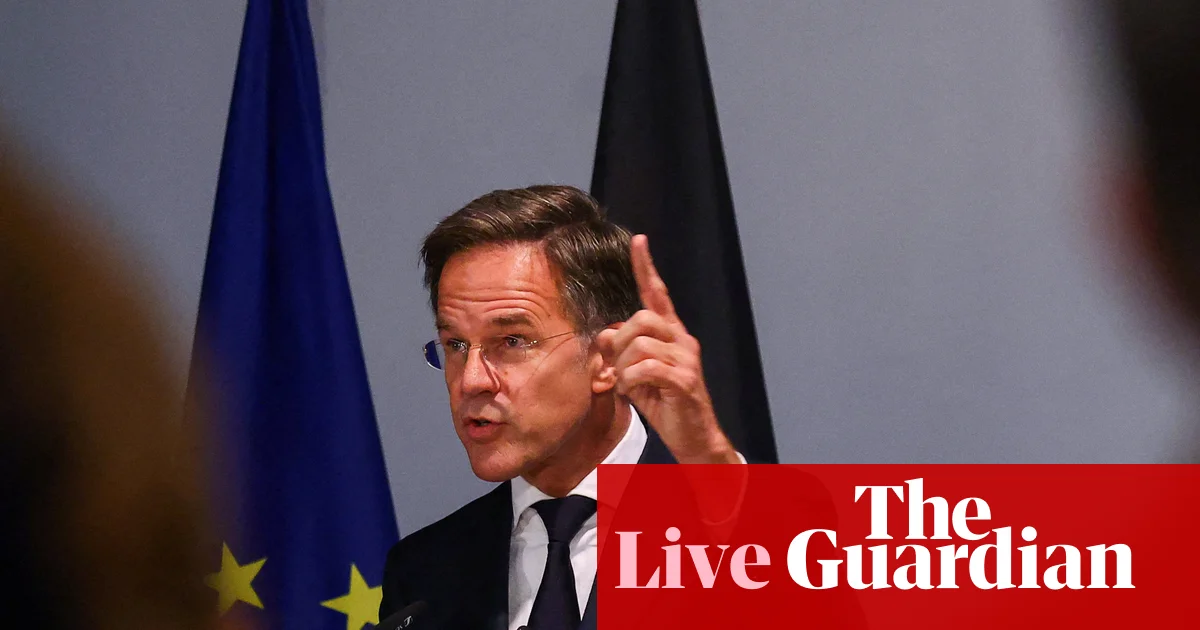
Russia’s actions are ‘reckless, dangerous and a threat to life,’ Nato’s Rutte warns, but says they only strengthen resolve to help Ukraine
In his speech, Rutte repeatedly praises Germany’s role within Nato, and then eventually gets to his stark assessment of the situation in Ukraine – and Europe.
He says:
“Russia’s brutal attacks against Ukraine are unrelenting. Russia is suffering enormous losses, now estimated at more than 40,000 killed or seriously wounded every month. Think about it for a moment. Over 40,000 every month.
Despite those heavy losses, Putin shows no willingness to bring the war to an end.
Instead, Russia repeatedly strikes Kyiv and other parts of Ukraine, often targeting civilians and civilian infrastructure, and at the same time, the list of Russia’s malign hybrid activities across Europe grows longer and longer: cyber-attacks, sabotage, arson, airspace violations, drone incidents.
…
The latest hostile actions by Russia are reckless, dangerous and a threat to life. But we are not intimidated. We know these are the tactics of a desperate regime that is failing to meet its objectives in Ukraine. Putin thinks he can divide us, destabilise us and weaken our support for Ukraine. But he will fail. These malicious actions are having the opposite effect.”
Key events
-
Closing summary
-
Tourists in England face nightly levy under new plans, a model well-proven in Europe
-
‘I fear the price could be high’: Inside the German city where the far right surged
-
European Central Bank raises interest rates
-
Poland issues third security alert to residents in areas bordering Ukraine in one day
-
Malta warned of corruption crisis after Daphne Caruana Galizia verdict sends ‘chill down the spine’
-
Macron meets Stubb for talks on Ukraine, European security
-
Swedish Muslims challenge far right ahead of key election this weekend
-
Germany needs to ‘show we have learned our lesson’ from Weimar Republic, foreign minister says
-
‘We cannot be naive’ about the threat posed by Russia, Nato’s Rutte says
-
Nato’s Europeans ‘increasingly understand taking greater responsibility for our own security is not optional,’ Rutte says
-
Russia’s actions are ‘reckless, dangerous and a threat to life,’ Nato’s Rutte warns, but says they only strengthen resolve to help Ukraine
-
Russian threat ‘has reached our doorstep,’ German foreign minister says
-
Russia’s reckless actions ‘a sign of weakness and a symptom of its failure to get its way in Ukraine’, Nato’s Rutte says
-
‘We should have no illusions’ about threats posed by Russia, Germany’s Wadephul says
-
‘Strength today is no guarantee of leadership tomorrow,’ EU’s von der Leyen says as she pledges to work on space economy
-
Macron wants Europe to develop its own crewed spaceflight capability
-
Russia arrests British embassy security guard for alleged false flag plot
-
Nato allies foiled Russian subsea cable sabotage plot, Reuters says
-
Morning opening: Russian attacks continue as Zelenskyy continues diplomacy tour
Closing summary
Jakub Krupa
And, on that note, we will be closing the blog for today.
-
Nato secretary general Mark Rutte has warned that Russia’s “reckless, dangerous” actions in Europe and “unrelenting” attacks on Ukraine will only strengthen the resolve to support Kyiv and invest in European defence (12:01).
-
Rutte said that Russia’s escalatory behaviour was “a sign of weakness and a symptom of its failure to get its war in Ukraine” (11:45, 12:10).
-
But European leaders “increasingly understand taking greater responsibility for our own security is not optional,” Rutte said (12:06), even as he insisted he had “no doubt” the US remained fully supportive of European allies (12:28).
-
Speaking alongside Rutte, German foreign minister Johann Wadephul warned that the Russian threat “has reached our doorstep and it’s tangible” (11:41, 11:53) as he discussed Germany’s lessons from a recent attempted drone attack in Leipzig.
And in the last few minutes, Poland’s prime minister Donald Tusk said Poland averted a threat to one of its border crossings with Ukraine overnight and expects its crossings will be targeted in the coming weeks. One to watch.
If you have any tips, comments or suggestions, email me at jakub.krupa@theguardian.com.
I am also on Bluesky at @jakubkrupa.bsky.social and on X at @jakubkrupa.
Tourists in England face nightly levy under new plans, a model well-proven in Europe
Holidaymakers will face a nightly levy on hotel and Airbnb-style stays across large parts of England in a move welcomed by many mayors but described as risking “irreparable harm” to the tourism industry.
But, as Angela Giuffrida explains, while a nightly tourist tax may be unfamiliar territory in the UK, countries in continental Europe have been cashing in on these kinds of levies for decades.
“Tourists usually need to pay the tax on the day they check out of a hotel or holiday let, and are often surprised by an extra fee on top of their accommodation costs.
Among the earliest introductions of a tourist tax was in Austria in 1842, specifically targeting those who stayed in spa and wellness retreats.
Similar measures were later implemented in France, Italy, Germany and Switzerland as a way to prevent the inhabitants of towns hosting such high-end resorts from paying for costs incurred by wealthy visitors.
Italy’s tourist tax structure has gone through various changes. During Benito Mussolini’s fascist regime, it was broadened to include any town or city classified as a tourist destination.
The tax was then completely abolished for the World Cup in 1990 as Italy embraced more visitors, only to be brought back in nationally in 2011, with Rome becoming the first city to reintroduce the levy.”
‘I fear the price could be high’: Inside the German city where the far right surged
After the AfD’s landslide win in Saxony-Anhalt over the weekend, people in the state capital shared with our correspondent Kate Connolly what they make of the result – and what comes next.
“Asking residents in a city where a seismic political event has just taken place ‘How do you feel?’ demands chutzpah – this struck me as I walked around Magdeburg, Germany on Monday.
The night before, the far-right populist, anti-immigrant, pro-Kremlin party Alternative für Deustchland (AfD) had landslide 44% win in Saxony-Anhalt’s state elections, sending shock waves to Berlin, across Germany and way beyond. Regardless of how people in the capital voted, it felt like a bit of an affront to probe.
Given the radical plans of the victors, a party classified by domestic intelligence as “rightwing extremist”, that is what I wanted to know. But from the 21-year-old Guinean-German paramedic I met at the central bus station, collecting donations for a local hospice, to the elderly couple returning to their apartment after a stroll down the Elbe river, almost everyone I met opened up to me warmly.
Judith, 88, was initially reluctant to talk, but shared some of her life story. Her experience as an eight-year-old refugee, forced to leave Poland in 1946 and eventually ending up move with her family in Magdeburg, had shaped her outlook on life, her successful career as a project engineer – as well as her politics. The news that AfD had not only won the election, but by such a wide margin, was “heartbreaking”, she said.
Huy, from Vietnam, who runs a newsagents in the city centre, was also reticent, but laughed and rolled his eyes as he sold the last copy of that day’s local paper, Die Volksstimme, and pointed to the headline that read: “Landslide in Saxony-Anhalt”. Shaking his head, he said: “44%!” “I don’t want to think what it might mean … but maybe it will all be OK?” His question hung in the air.
A glance at the AfD’s manifesto, in particular its pledge for the first 100 days, focuses the mind. Top of the list: challenging Germany’s postwar memory culture (which it says stands in the way of national pride) – so, “more Bismarck, less Hitler”, as they put it. “From the first minute”, they say, the party will start the deportation of what it refers to as “irregular migrants”.
I met Franz-Josef, a 71-year-old retired mechanic and Green voter, on holiday from a small west German town. He called the election a “catastrophe”, particularly in the light of the country’s Nazi past.
Luisa, a 34-year-old bank teller told me she hopes “those who voted for the AfD thought about what they were doing”. It was one thing, she said, to “deliver a kick in the shins” to Berlin, over its failure to pull the German economy out of the doldrums.
And maybe the AfD would fail to push through its promises in government. “But we cannot know, and I fear the price could be high.””
Read in full:
European Central Bank raises interest rates
The European Central Bank has raised interest rates for the second time this year, as widely expected, at it tries to bring inflation under control.
The decision was supported by a stronger-than-expected economy that suggests businesses can weather the higher borrowing costs, AP noted.
The central bank for the 21 EU member countries that use the euro currency raised its benchmark rate by a quarter percentage point to 2.50% at a meeting held in Berlin, away from the bank’s Frankfurt headquarters, it said.
More on that also on our business live blog:
Poland issues third security alert to residents in areas bordering Ukraine in one day
Poland has warned residents in two south-eastern regions that its air force is monitoring the skies amid ongoing Russian attacks on neighbouring Ukraine.
Locals have received three similar alerts in the past 12 hours – a stark indicator of the intensity of Russia’s attacks and the heightened concern across the border.
Malta warned of corruption crisis after Daphne Caruana Galizia verdict sends ‘chill down the spine’
Juliette Garside
Malta is vulnerable to “repeated instances of high-level corruption” unless it strengthens the rule of law and protections for journalists, the Labour peer Shami Chakrabarti said at the opening of an inquiry into judicial failures following the death of Daphne Caruana Galizia.
Chakrabarti, a member of the House of Lords and former director of the human rights group Liberty, has been named special rapporteur for a Council of Europe investigation into the fallout from the assassination of the anti-corruption journalist, who died in a car bombing in October 2017.
Malta is in turmoil after the acquittal of a wealthy and politically influential businessman, Yorgen Fenech, of any involvement in Caruana Galizia’s murder. Fenech denies paying a middleman €150,000 to have her killed.
At the inquiry’s first hearing, on Wednesday, Chakrabarti said the verdict had “staggered many throughout Maltese society and beyond.”
“It’s now almost nine years since the assassination that struck at the very heart of Maltese public life but a mastermind has not yet been held accountable,” she added.
Macron meets Stubb for talks on Ukraine, European security
Over in France, it looks like Emmanuel Macron is focusing not only on future space endeavours, but also on very down-to-earth issues of European security.
Aside from his space conference (11:01), he met for talks with Finland’s influential president Alexander Stubb on “Russia’s war of aggression against Ukraine, European security, and ways to strengthen Europe’s strategic autonomy.”
“Finland and France are closer than ever before. France is an important partner for Ukraine and the whole of Europe,” Stubb said.
Despite its low-key format, the meeting is worth noting given Stubb’s central role to all diplomatic efforts on Ukraine, as he is one of the few European leaders that have a genuinely good rapport with the US president, Donald Trump, and so is closely involved in all relevant discussions on Ukraine, Russia and European security.
Jakub Krupa
By the way, we will be liveblogging the Swedish election night for you here on Europe Live, straight from Stockholm, so make sure to join us on Sunday night.
Swedish Muslims challenge far right ahead of key election this weekend
Swedes will vote on Sunday in a tight election that will be another litmus test of whether far-right parties should join the government, as the Sweden Democrats, with roots in the neo-Nazi fringe, poll at around 19% of the vote and could join the ruling centre-right coalition led by Ulf Kristersson.
The Guardian’s Ashifa Kassam visited Sweden recently to take stock of the atmosphere in the country ahead of the vote, and look at how migration and religion are being weaponised for political purposes.
“Not far from one of Scandinavia’s biggest shopping malls, Kashif Virk stood on the pavement, handing out flyers and smiling at those who passed by. On a cloudy Tuesday afternoon, the Swedish-born imam had taken to the street to invite people to ask him anything they had ever wanted to know about Islam.
For years, Sweden’s far right has peddled its own, distorted view of Islam, portraying it as being at odds with Swedish values. The Ask-a-Muslim – or Fråga en Muslim – campaign, conceived by Virk in 2017, was his way of fighting back.”
Rutte’s visit is not the only show in town in Berlin today, as the leader of the United Arab Emirates is paying a state visit to Germany, and is expected to sign off on multi-billion deals on energy, technology, and transport.
Sheikh Mohamed bin Zayed Al Nahyan is getting the full treatment and was welcomed with military honours by president Frank-Walter Steinmeier this morning, before meeting chancellor Friedrich Merz later today.
AFP noted that the UAE is Germany’s largest trading partner in the Gulf, with bilateral trade topping $15bn last year, and many big German companies have a presence there including BMW, Siemens, ThyssenKrupp and rail operator Deutsche Bahn.
The UAE meanwhile has made major investments in Germany, including in the chemical industry and offshore wind power.
Inexplicably, there is no joint press conference scheduled as part of the visit.
