


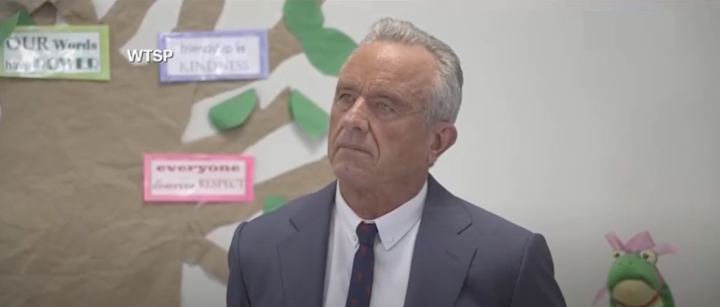
When asked about the largest surge in measles in over 30 years, Health and Human Services Secretary Robert F. Kennedy Jr. has repeatedly claimed that the U.S. is doing or has done “better … than any country in the world” in controlling outbreaks of the disease. But plenty of nations don’t have the high caseload America is now experiencing.
In recent remarks in Florida, Kennedy gave what has become his standard response when asked about measles.
“We’re doing a better job than any country in the world at controlling the measles outbreak. This is a worldwide epidemic,” he said when a reporter asked at an Aug. 26 event. “Mexico has 11 times the amount of measles cases as we do. Canada has four times the amount of measles cases. Britain has two times. … Every place there’s been a measles outbreak, I’ve sent the CDC in to cooperate with the state health agencies, and we’ve brought it to an end overnight.”
Kennedy has been claiming a superlative response and invoking international comparisons for months. In April, when testifying before Congress on multiple occasions, he repeatedly said that under his leadership the U.S. had “done better” at controlling, preventing or limiting measles outbreaks than any other country in the world, calling measles a “global outbreak.”
In June, when measles was surging in Virginia, Kennedy similarly told a local news outlet, “There’s a global measles epidemic right now. We’ve done better than any country in the world in controlling it.”
And last month, in an interview on CNN, he again referred to other countries when declining to accept any blame for the current situation.
“First of all, this is an international outbreak,” he said. “So we’re doing better at handling it than any country in the world. Mexico has 15 times the amount of measles per capita that we have. Canada has four times the amount of measles. England has two times the amount of measles.”
“We have stopped the outbreaks at record speed in South Carolina and Texas and Utah and Virginia,” he said later. “We have done better than any country in the world.”
As we’ll explain, it’s true that measles has seen a resurgence around the globe in the past several years, and that a good number of nations have had more cases per capita. But it’s also the case that dozens of countries have had fewer cases per capita than the U.S.
Many measles outbreaks in the U.S. have also lasted for months — and in some cases perhaps longer than a year — contradicting his claims about speed.
“The idea that the U.S. has the best response in the world, I mean, I don’t think that there’s any evidence that that is the case,” Josh Michaud, an associate director of global and public health policy at the health policy research organization KFF, told us. “There are countries that are sort of peer countries — you know, peer developed countries — which have very, very little, basically no outbreaks of measles.”
Experts also said Kennedy’s entire premise is flawed. How well the U.S. does compared with other countries isn’t really the right comparison, they said.
“We are in unprecedented circumstances. Let’s compare ourselves to ourselves,” Jennifer Nuzzo, a professor of epidemiology and director of the pandemic center at Brown University School of Public Health, told us. “And we are currently in the worst bout of measles that the United States has seen in more than 30 years.”
Kennedy also has blamed the measles outbreaks on “COVID lockdowns.” But some experts told us pandemic restrictions are not a primary reason why children are unvaccinated in the U.S. Kennedy also omits the role of vaccine misinformation.
We asked HHS for the basis for Kennedy’s claims but did not receive a response.
Flawed International Comparison
It’s difficult to directly compare measles outbreak responses across countries, experts told us, which makes Kennedy’s claim that the U.S. has done “better” than any other country a bit squishy.
But a reasonable place to start is with the per capita rate over the same period of time, Ana Bento, an assistant professor of infectious disease ecology at Cornell University College of Veterinary Medicine, told us. And on that measure, the U.S. is nowhere near the best.
According to measles data from the World Health Organization, as of Sept. 14, the U.S. had 13.2 measles cases per 1 million people in 2026. That’s the 65th highest rate of measles in the world for 2026, out of 169 nations with data. That places it in the worst 38% of nations, and about as good as Russia.
For 2025, the U.S. did slightly better, but with the 86th highest measles rate out of 184 nations, it still ranked in the lower half of countries for the fewest measles cases per population.
Kennedy often cites higher measles burdens in Mexico, Canada and the U.K. It’s true that those countries have had worse measles outbreaks this year and last. In 2025, for example, Canada had the 15th highest measles rate, while Mexico had the 28th and the U.K. the 63rd.
So far this year, Mexico has the 15th highest measles rate, with Canada at 39th and the U.K. at 51st. That puts Mexico’s per capita rate about 11 times higher than the U.S., Canada’s about 3 times higher and the U.K.’s about 1.6 times higher, close to but mostly lower than the figures Kennedy has used.
But this leaves around 100 countries this year that have had fewer measles cases per capita than the U.S.
“There’s always going to be a country experiencing more measles than the United States,” Michaud said. Rather than “cherry picking certain countries that are experiencing large measles outbreaks,” he added, a fairer comparison would be to compare the U.S. to itself over time.
There, the measles situation is bleak. In 2025, there were 2,289 confirmed measles cases, and so far this year there have been 3,294. The U.S. has not recorded this many measles cases since 1991 and is expected to lose its measles elimination status, obtained in 2000, in November.
The U.S. “shouldn’t be in a race to the bottom,” Nuzzo said. The U.S. or any other “high-income country with a lot of resources,” she said, “should not be having measles — period.”
Beyond the statistics, Bento said she would judge an outbreak response by also asking “how long transmission continued, how quickly cases were detected and isolated, and whether vaccination reached susceptible contacts and communities in time.” That’s because case counts alone might not accurately represent the quality of the response since other factors, such as the number of measles introductions and underlying immunity, come into play, she explained.
Still, she said she did “not see evidence” for Kennedy’s superlative claim.
Nuzzo said that measles “is such a wildly explosive disease in terms of transmission” that the typical steps of case identification, contact tracing and isolation or quarantine are needed but aren’t enough. “The single most important thing we’re supposed to be doing is making sure people are vaccinated,” she said. “And on that point, we have completely fallen down.”
She noted that in his communications, Kennedy has not been emphasizing the need to ensure that communities have at least 95% of their population vaccinated or framing vaccination as a social obligation.
As we’ve documented, since the outbreaks began in Texas last year, Kennedy has at times been willing to say he recommends the measles, mumps and rubella, or MMR, vaccine, but he has rarely said it is safe. More often, he has raised questions about its safety or necessity, and has said vaccination is a personal choice.
Michaud explained that the federal government is not the primary entity responding to measles outbreaks. The Centers for Disease Control and Prevention provides support and will send in experts, and federal officials provide help with messaging, he said. But most of the response is from state and local governments.
Compared with the 2018-2019 measles outbreak in New York, which was the last large measles outbreak that threatened the United States’ measles elimination status, Michaud said the 2025 Texas outbreak didn’t have “the same level of robust response.”
“There was a real all-hands-on-deck kind of public health response” across all levels of government, he said of New York in 2019, noting that the city mandated vaccination to quell the outbreak and the state Legislature subsequently ended religious exemptions for its school vaccination requirements.
“It’s very hard to say in a specific outbreak case whether enough was done and how to compare that to what other countries are doing or what other states are doing,” Michaud said. “But cumulatively and broadly across the United States,” he said, “it’s really hard to argue that we’re doing a great job in responding.”
Not Ended ‘Overnight’
Along with touting the overall response, Kennedy has repeatedly claimed that measles outbreaks have been stamped out rapidly.
In a September 2025 editorial in the Wall Street Journal, Kennedy said that the Texas outbreak “ended quickly.” On Aug. 2, he said the South Carolina, Texas, Virginia and Utah outbreaks were stopped “at record speed.” And late last month, he claimed that after bringing the CDC in to help states, outbreaks were ended “overnight.”
It’s unclear what a “record speed” would be, but the large outbreaks didn’t end “overnight.” Outbreaks in many cases have lasted months on end, and in some cases are ongoing.
“Arizona and Utah have had outbreaks for more than a year,” Nuzzo said, calling Kennedy’s claim “false.”
The 2025 Texas outbreak, which began in January of that year, accumulated cases for nearly half a year until it officially ended in mid-August 2025 with 762 cases. Officials usually wait for 42 days — two full incubation periods — without a new case before declaring an outbreak over.
With nearly 1,000 cases, the South Carolina 2025-2026 outbreak also lasted about six months.
Utah’s outbreak, which peaked in March, hasn’t actually even officially ended yet. A public information officer for the state’s Department of Health & Human Services, D. Ginger Zamora, said an additional person was diagnosed with measles since Utah’s dashboard was last updated on Sept. 15. Wastewater surveillance also suggests measles is still being transmitted, she said.
When Kennedy claimed that Utah’s outbreak was stopped “at record speed,” a case had just been reported at some point in the prior week, making it unclear then whether the outbreak had ended. Utah has recorded new cases over a period of more than 13 months, starting in June 2025.
“There is no single typical duration against which every outbreak should be judged,” Bento said, but “‘[o]vernight’ does not describe the major outbreaks.”
Nuzzo said she wasn’t even sure that there’s evidence that measles had been truly stopped. “I think that we have probably stronger evidence,” she said, that outbreaks “have just burned themselves out in the populations in which they were occurring, meaning the virus stopped finding susceptible people in a social network because so many people got measles.”
Role of ‘Lockdowns’
On multiple occasions, Kennedy has blamed the measles outbreaks on what he has termed “COVID lockdowns.”
“The reason we’re having a measles outbreak is because of the COVID lockdowns, because people didn’t — like, children during that period did not get vaccinated,” he said during his Aug. 2 CNN interview, noting that former National Institute of Allergy and Infectious Diseases Director Dr. Anthony Fauci mentioned this concern in his diary. (In May 2020, Fauci wrote that the large number of children worldwide who had missed measles vaccinations “needs to be addressed.”)
“It’s happening because of the lockdowns, because many kids did not get vaccinated during the lockdowns,” Kennedy said of measles outbreaks during the Aug. 26 event in Florida. “Then you had dramatic diminishment of public faith in the regulatory agencies during the COVID period because of government overreaching, because of the gaslighting and the manipulation.”
This narrative overstates the role of COVID-19 restrictions, some experts said, which in the U.S. were never true “lockdowns” on par with what some other countries had. It also omits the role of vaccine misinformation groups, including Kennedy’s own, in sowing doubt about vaccines during the pandemic, among other factors.
As we’ve explained before, the main reason for the rising number of measles cases is a measles vaccination rate below 95% in a community, which allows the highly transmissible virus to spread to those without immunity to the virus. More measles cases occurring globally does increase the chance of measles being imported, usually when a U.S. resident returns from traveling, and sparking an outbreak. But if vaccination levels were high in all communities, these introductions would not lead to larger outbreaks.
“If a community is well-vaccinated, importation events do not cause outbreaks; the virus attempts to spread to the next person in a chain of transmission and is halted by that person’s vaccine-protected immune system,” Maimuna Majumder, a computational epidemiologist at Boston Children’s Hospital and Harvard Medical School who has studied measles transmission, told us in an email for a previous story. “It’s only when a community *isn’t* well-vaccinated that you see an outbreak emerge from an importation event.”
The exact reasons for the lower uptake of the measles vaccine are not entirely clear, although the pandemic appears to be an important factor. Nationally, 92.4% of kindergarteners were vaccinated for measles in the 2025-2026 school year, down from 95.2% in 2019-2020, according to the latest CDC data.
A Nature Medicine study published last month by Bento and colleagues used fine-grained vaccination data to model the susceptibility of individual schools to measles, finding that the average school doubled its susceptibility following the pandemic. Schools on average became susceptible to outbreaks during the 2022-2023 school year, although many were already previously susceptible.
“Vaccine hesitancy, accelerated by COVID-19 disruption and misinformation, has eroded the immunological buffers sustaining elimination,” the paper said.
It’s not known, however, exactly in which way the pandemic drove those observed vaccination declines.
“The study does not divide the decline into effects of lockdowns, service disruption or changing confidence,” Bento said, noting that pandemic disruptions would not simply be due to formal restrictions, but also illness, staffing shortages and fear of exposure. “We should neither dismiss those effects nor assign them the entire responsibility for outbreaks years later.”
Missed vaccinations during the pandemic period might be contributing if children never made up those shots. “A missed dose can leave a gap years later if it was never caught up,” Bento said.
But, as Nuzzo noted, most pandemic restrictions only lasted a few months and occurred more than five years ago. Kids who might have missed doses for that reason are now old enough to have entered kindergarten, and every state requires the MMR vaccine for school entry, although some offer more or less arduous exemptions. (The MMR is typically given in two doses at 12 to 15 months and 4 to 6 years.)
“If people have not gotten their kids vaccinated since then, that is not just because the COVID lockdowns prevented them,” she said. “That’s not what’s primarily driving things, at least in North America.”
Michaud similarly thought that missed vaccination due to pandemic-era restrictions was no longer an applicable factor.
Kennedy also misleadingly suggested that vaccine confidence has declined solely because of missteps of governmental agencies during the pandemic.
“We are actually restoring faith in the public health agencies,” he added during his remarks in Florida.
There is some evidence that public trust in vaccines or health agencies declined somewhat at various times during the pandemic. But much larger drops in trust have occurred since Kennedy took office.
A poll from Harvard T.H. Chan School of Public Health and the de Beaumont Foundation’s Public Health Listening Lab found that in the spring of this year, just 50% of people trust health recommendations from the CDC, compared with 77% the year before.
Polling by the Annenberg Public Policy Center, our parent organization, found that last month, around 60% of Americans were confident that the CDC, Food and Drug Administration or the National Institutes of Health provide trustworthy public health information — a decline of around 15 percentage points since mid-2023 and mid-2024. A February APPC poll also found that Americans are now far less confident in health agency leaders than career scientists.
And while the Trump administration has contended that its changes to vaccine policy, which have not gone through the typical channels, might shore-up support for so-called “core” vaccines, such as the MMR vaccine, a Reuters/Ipsos poll completed Sept. 14 found that 76% of Americans think the measles vaccine is safe for children, a decline from 84% in 2020.
Polling also suggests vaccination has become politically polarized, with Republicans being more hesitant and distrustful of vaccines, although a large majority of all parents still support the MMR vaccine.
Kennedy’s narrative conveniently leaves out the role of vaccine misinformation, which he has participated in.
“Prior to being HHS secretary and still in his role of HHS secretary, he has spoken of the MMR vaccine in ways that does not align with the data on its safety and effectiveness,” Nuzzo said of Kennedy, adding that Children’s Health Defense, the nonprofit Kennedy formerly led, “is one of the leading agitators online, sowing lies about MMR vaccines.”
Michaud said vaccine misinformation and disinformation channels had “existed for quite a while,” but that they got “supercharged during the pandemic.”
KFF polling shows that parents who think false claims about vaccines are true, including the incorrect idea that MMR vaccines cause autism, are more likely to have skipped or delayed some vaccines.
Kate Yandell contributed to this story.
Editor’s note: FactCheck.org does not accept advertising. We rely on grants and individual donations from people like you. Please consider a donation. Credit card donations may be made through our “Donate” page. If you prefer to give by check, send to: FactCheck.org, Annenberg Public Policy Center, P.O. Box 58100, Philadelphia, PA 19102.
