


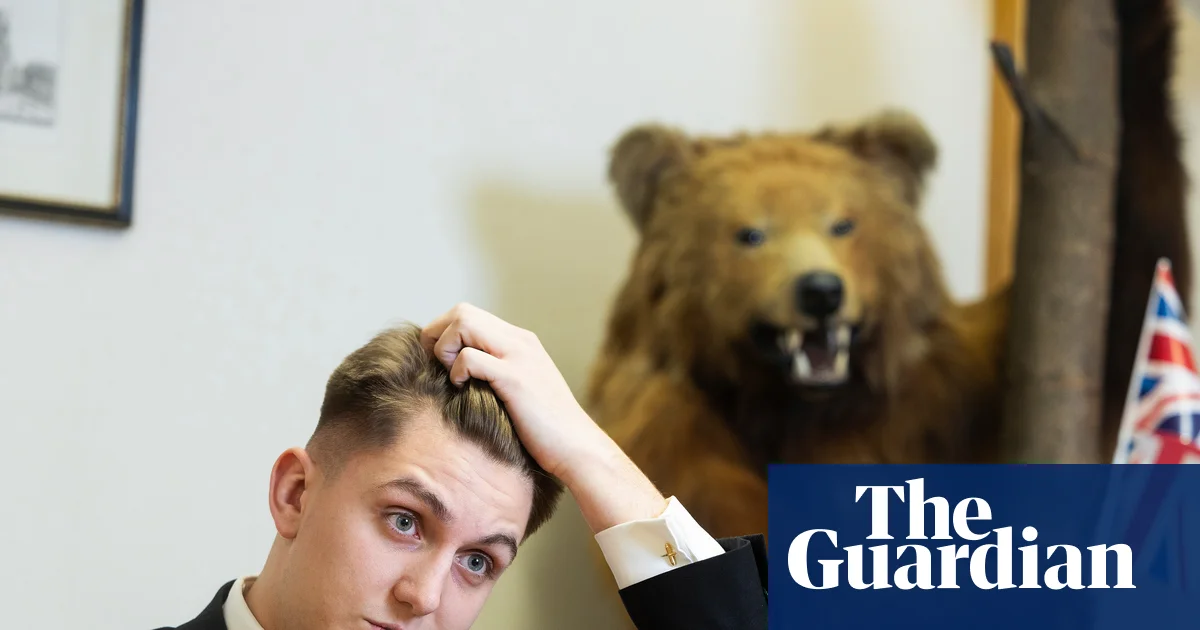
George Finch, who made history last year after he was elected as leader of Warwickshire county council at the age of 19, is no stranger to criticism.
His year at the helm of a minority Reform administration has been dominated by a string of controversies, including three code of conduct investigations and a no-confidence call – which he survived by just one vote.
The latest controversy concerns a dispute over the region’s libraries. In June, Finch claimed he had received “a number” of complaints from people that the county’s libraries had been “promoting contested gender ideology”, prompting Warwickshire Pride to issue a statement, and the launch of the latest misconduct investigation.
However, on Tuesday, the Labour MP Rachel Taylor accused Finch of attempting to “manufacture outrage”, citing data obtained via a freedom of information request that showed zero complaints had been made about books inappropriate for children in Warwickshire libraries since at least March 2024.
In response, Finch said he had “personally spoken” to people who had raised concerns and accused the Labour MP of a “desperate attempt” to “manufacture a political argument”.
It is just one of several public spats that has come to define Finch’s polarising leadership. He told the Guardian he was being targeted because of his attempts to challenge the status quo at the council.
Finch, 20, said the fact he was able to secure the top role at a second local authority, having been elected as leader of Nuneaton and Bedworth borough council in May this year, was further proof he still had the support of local people.
“The establishment will happily throw anyone under the bus to protect themselves. When an animal is dying, it becomes its most ferocious. That is why they’re throwing code of conduct complaints at me. That’s why they produce these vote of no confidences, because they don’t like change,” he said.
Finch has faced renewed scrutiny over his leadership style in recent weeks, after the Green councillor Nicki Scott said council officers were “scared” working under the Reform UK administration. “I have officers contacting me on a weekly basis citing concerns around bullying, harassment and specific and unreasonable attacks on how some officers choose to live their lives,” Scott said during a council meeting in July.
The Green councillor also highlighted comments from Finch in January, in which he referred to Warwickshire as being an “officer-led council”. Finch told Matt Forde’s Political Party podcast: “That’s where you have to… lay down a little bit of a boot on neck-type thing [to say] ‘actually, thanks for your advice, but I am now instructing you to go off and do what I say’.”
Despite repeated calls for the council leader to withdraw his comments, Finch has remained resolute. “I fully stand behind the premise, the implications of those words, because that is what is needed,” he told the Guardian.
Finch also dismissed the bullying claims by Scott as “lies”, describing a survey that he said showed the majority of staff would recommend the council as a place to work. “The rumours, the allegations of bullied staff [are] lies,” he said.
Instead, Finch said he was restoring “confidence and faith back into public service”.
“Officers are there to advise, members decide, that’s how it works. Unfortunately, for too long we’ve had lazy politicians who just accepted the salary and none of the work and allowed officers to run the show,” he said. “People that are established to this don’t like it because they don’t like change. They like their little ivory tower in Warwick.”
The allegations from Scott come in the wake of two solicitor-led investigations that found Finch had breached the authority’s code of conduct, before two council conduct hearings later cleared him of any wrongdoing.
A local Labour MP, Matt Western, said the process had become a “farce and a waste of taxpayers’ money”, adding: “What is the point of bringing in expert independent legal advice to then ignore it because it is not the answer Finch wanted?”
One of the investigations looked at a formal complaint made by the council’s chief executive, Monica Fogarty, after Finch asked her to remove the Progress Pride flag outside the council building – a request she refused.
Nigel Farage and Zia Yusuf criticised Fogarty for the decision at the time, with the leader of Reform UK saying it was “time she looked for a new job”.
The solicitor-led investigation found Finch had breached the code of conduct by failing to “value colleagues and staff and engage with them in an appropriate manner”, but Finch appealed against the outcome, saying he had engaged with the chief executive over email. A council hearing subcommittee, made up of three councillors from Reform, the Conservatives and the Liberal Democrats, decided there had been no breach in a two-to-one vote.
Weeks before, another solicitor-led investigation found Finch had breached the code of conduct by publishing details that “could have jeopardised” the trial of Ahmad Mulakhil, who was this year found guilty of kidnapping and raping a 12-year-old girl.
Finch, who had entered a public dispute with the chief constable of Warwickshire police after he accused the force of a “cover-up”, repeatedly said the details he had shared at the time were already in the public domain. Another subcommittee hearing also cleared him of any wrongdoing.
Finch said most of the complaints he had received were “political”. “They were not based on anything other than ‘we don’t like George’s politics’,” he told the Guardian.
He was equally defensive of his party’s leader, Nigel Farage, who has faced growing scrutiny after the Guardian revealed he had received a £5m gift from the billionaire Christopher Harborne in 2024.
Questions have also arisen regarding Farage’s relationship with the convicted fraudster, George Cottrell. The Guardian reported in July that Cottrell was routinely introduced as Farage’s chief of staff before the 2024 general election despite denials he had any official role, according to a Reform UK candidate.
Asked if he had ever met Cottrell, Finch said: “I can’t recall whether I met him or not.”
Finch drew parallels between the allegations and investigations facing Farage with his own experience as a local council leader, viewing them both as a result of an establishment stitch-up.
“I think the political establishment, like I said before, when an animal is at death’s door, it will do anything to survive and the public see that. They see the way people treat Reform politicians. They see how they are treating me, tried to take me out politically,” he said.
“I think it’s a load of rubbish to be quite frank. The establishment has been trying to take Nigel out for decades. Let’s wait and see what the public and the people of Clacton say.”
