


The first report card on the implementation of the Kunming-Montreal framework was issued at this year’s UN Biodiversity Conference in Yerevan, and the marks were dismal. The problem is not a lack of targets, but a global financial system that pays to destroy nature and penalizes those who protect it.
WASHINGTON, DC—Four years ago, the United Nations Biodiversity Conference in Montreal adopted the Kunming-Montreal Global Biodiversity Framework, hailed at the time as the “Paris agreement for nature.” But the first assessment of the framework’s implementation, released at October’s UN Biodiversity Conference (COP17) in Yerevan, makes for sobering reading. The State of Biodiversity Action report finds that while nearly 90% of countries have set targets to protect 30% of land and sea areas, restore 30% of degraded ecosystems, and halt human-caused extinctions, fewer than half of the assessed targets are on track to be met by 2030.
UN Secretary-General António Guterres called COP17 “our moment of accountability.” But while accountability is long overdue, finding a solution requires accurately diagnosing the problem. The Kunming-Montreal framework is faltering not because governments are indifferent to nature, but because global economic and financial systems reward nature’s destruction and penalize its protection. According to the UN Environment Programme, in 2023, $7.3 trillion—roughly 7% of world GDP—flowed into activities that directly harm nature. For every dollar invested in nature that year, $30 was spent destroying it.
The Kunming-Montreal framework calls for closing the biodiversity finance gap, which amounts to $700 billion annually, by reducing nature-harming subsidies by $500 billion per year and mobilizing $200 billion per year in incremental finance, including $30 billion from external official sources. Well over half of that investment is needed to implement sustainable management practices for farmland, rangeland, fisheries, and forests. The remainder is for ecosystem restoration and preservation.
The issue is bigger than market failures. As David Obura argues in our co-edited volume Nature, People, and Sustainable Development, there is a fundamental mismatch between what we value and what is needed. At best, prices capture nature’s usefulness. To reflect nature’s relational or intrinsic worth requires reframing the problem as not just conservation, which looks like a cost—land tied up and growth forgone—that rich countries foist on poor ones. Credit-ratings agencies, pointing to the risk of slower growth, then downgrade developing countries’ credit ratings.
A far better approach is to emphasize the bioeconomy’s potential, which positions protecting nature as a growth strategy. Around 55% of global GDP—equivalent to $58 trillion—already depends directly on nature. The bioeconomy, which uses biological resources in a regenerative and nature-positive way, is worth about $4 trillion today; unlocking its potential could boost its value to $30 trillion by 2050 and link producers to global supply chains that can steer them toward higher value-added activities.
The problem of underinvestment is most acute in countries with abundant natural resources but limited fiscal space, including Indonesia, Brazil, Peru, Zambia, Ecuador, the Philippines, and Mozambique. These governments often rely on extractive activities such as logging, mining, and plantation agriculture to earn foreign exchange, which tends to go toward servicing their external debt. The resulting ecological damage leaves them more exposed to floods, droughts, storms, and other climate disasters that usually lead to rating downgrades. By contrast, debt frameworks do not properly account for the benefits of building resilience to such shocks.
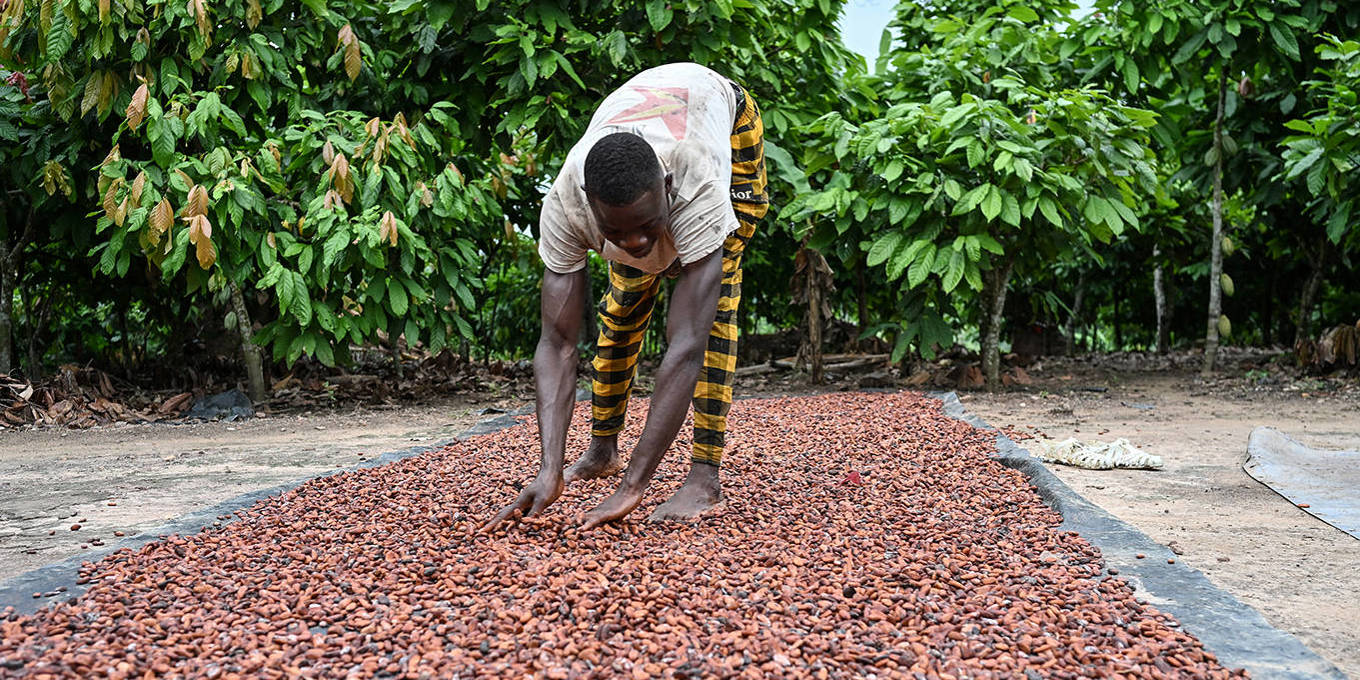
Creating the right incentives is especially important in commodity supply chains. For example, Côte d’Ivoire and Ghana produce nearly two-thirds of the world’s cocoa supply, almost entirely on small farms. But 73–90% of households producing cocoa in these countries earn little income from it, and cannot afford the fertilizer and weed-control costs of replanting aging trees, so they push into forests where it is cheaper to plant new ones.
But with chocolate trading, processing, and manufacturing concentrated in a handful of firms, a few players can have an outsize impact on global outcomes. The European Union, which imports about 58% of the world’s cocoa beans, will begin to apply the Deforestation Regulation to large operators starting in December, making access to the European market for cocoa, coffee, and other commodities conditional on deforestation-free supply chains. But to improve compliance, some of the big traders should be encouraged to finance replanting and traceability efforts, so that smallholder farmers can meet the rules and earn more by doing so.
Protecting nature is also a security imperative, with environmental crime—illegal logging, mining, wildlife trafficking, and fishing—generating an estimated $110–280 billion per year, much of it laundered through the same channels as proceeds from narcotics and illicit finance. Instead of chasing individual loggers, enforcement and asset recovery should target chokepoints like mills, refineries, ports, traders, and financiers, while securing land rights and public finance for nature’s most effective stewards: Indigenous peoples and local communities, whose relationships with nature reflect its relational and intrinsic values.
The lesson of the State of Biodiversity Action report is that adding targets while treating nature as just another economic sector will not work. As the future of climate and nature action are once again negotiated at this month’s UN Climate Change Conference (COP31) in Antalya and in discussions at the UN about the agenda to replace the Sustainable Development Goals after 2030, we must focus on changing the incentives that have stalled progress. That means framing nature as an investment, not a cost—and rewarding, not punishing, those who protect it.
