


- Bolivian President Rodrigo Paz signed an agreement to begin technical studies for a highway connecting the municipality of San Ignacio de Velasco in the Chiquitania region with the Brazilian state of Mato Grosso.
- Brazilian businesspeople looking to buy land in the Chiquitano forest for cattle ranching and soy farming are driving the project.
- Brazilian businessman Eraí Maggi, known as the “soy king,” is a central figure behind this agricultural expansion into Bolivia.
- Experts warn the road will accelerate deforestation in the Chiquitania, the largest tropical dry forest in the Americas, in a country that already ranks second globally in tropical forest loss.
On July 31, politicians and agribusiness leaders from Bolivia and Brazil gathered in the eastern Bolivian city of San Ignacio de Velasco. There, Bolivian President Rodrigo Paz signed an agreement to begin technical studies for a highway connecting San Ignacio de Velasco to Marfil, a point on the border with Brazil. A second section of the road will extend into Brazil toward the municipality of Vila Bela da Santíssima Trindade. Experts told Mongabay the project will cause severe environmental damage, driving deforestation and land-use change to make way for soy fields and cattle ranches on the Bolivian side.
San Ignacio de Velasco lies in the heart of the Bolivian Chiquitania, a region of vast tropical dry forests. The municipality has 67,103 inhabitants, according to the 2024 census. On July 31, its small airfield briefly became an international airport as some 15 private planes landed there. Except for the Bolivian presidential plane, every aircraft belonged to Brazilian businesspeople and politicians. Among them was Eraí Maggi, known in Brazil as the “soy king.”
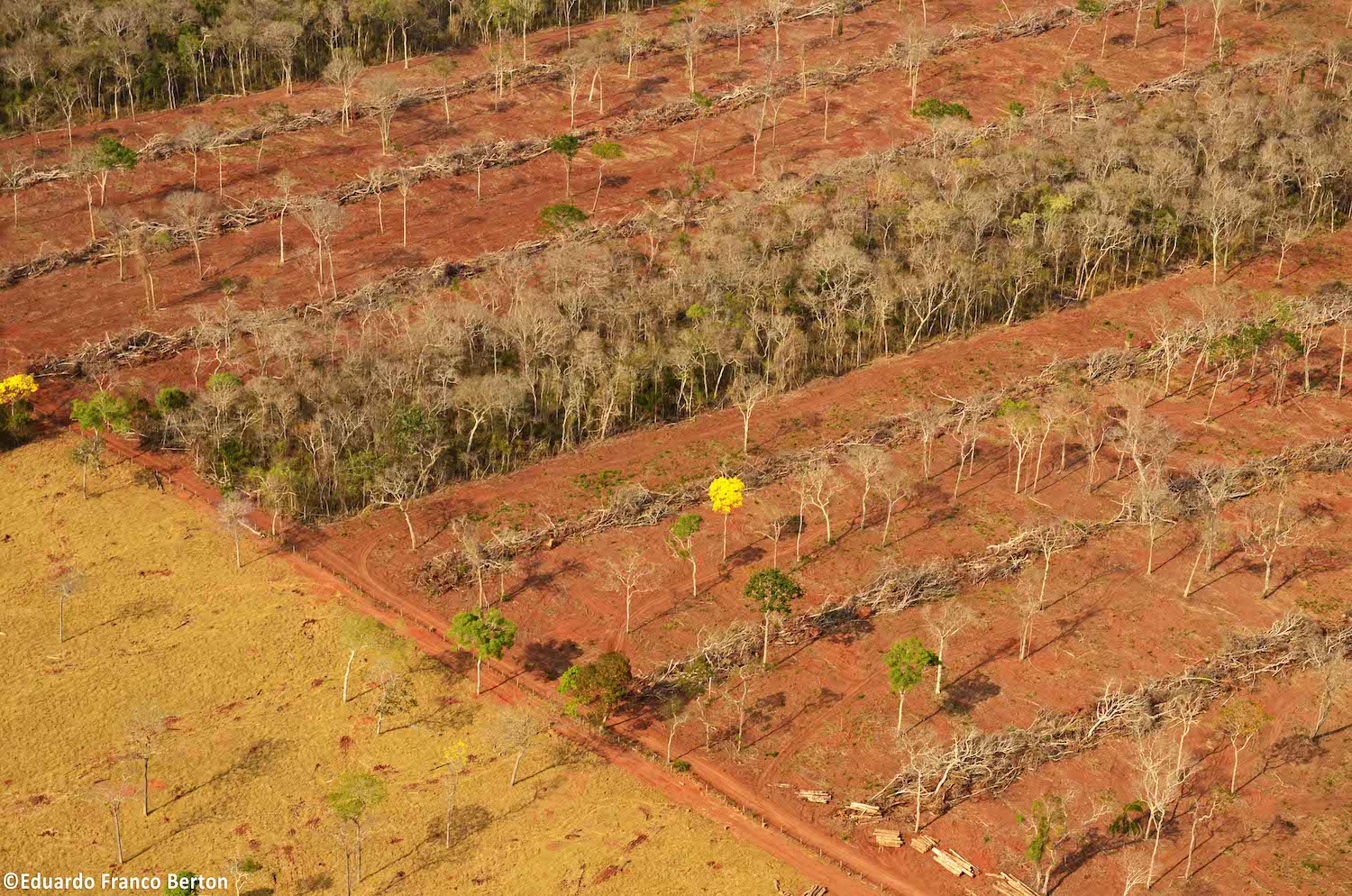
San Ignacio de Velasco, which holds 3.4 million hectares (8.4 million acres) of Chiquitano forest, or 6.2% of Bolivia’s total forest cover, has become the country’s epicenter of deforestation, according to reporting by Nómadas magazine in 2025. The Institute for Socio-Economic Research (IISEC) at the Bolivian Catholic University (UCB) found that between 2017 and 2023, agricultural expansion cleared more than 324,275 hectares (801,301 acres) of forest in the municipality. This means nearly 15% of all deforestation in Bolivia during that period took place in San Ignacio de Velasco alone. Medium- and large-scale corporate properties accounted for 52% of this clearing, while 36% occurred on state-owned land.
Brazil, home to nearly two-thirds of the Amazon Rainforest, ranks first globally in tropical forest loss, according to Global Nature Watch (previously known as Global Forest Watch, or GFW). But deforestation began to slow in the early 2000s and has dropped sharply since 2023, the organization reported. On Aug. 7, Brazil’s Ministry of Environment and Climate Change announced that the country is approaching its lowest annual deforestation rate in decades.
Despite being much smaller than its neighbor, Bolivia recorded the second-highest tropical forest loss in the world in 2025, according to GNW. The organization reported that nearly one-eighth of the country’s forest cover has disappeared since the 1980s.
The biodiverse Chiquitano forest is the largest tropical dry forest in the Americas. This biome is the epicenter of Bolivia’s annual forest fires and agricultural expansion, according to the Tierra Foundation. The foundation says the Chiquitania has lost a larger proportion of its native vegetation than any other area in the Amazon Basin, making it the region’s most threatened ecosystem.

This is the landscape where the Paz administration plans to build the new highway, which will join two existing corridors connecting Bolivia to Brazil via the border towns of San Matías and Puerto Quijarro.
The highway project
Stasiek Czaplicki, a Bolivian economist and co-author of the book Santa Cruz S.A. El mito empresarial y la realidad depredadora (“Santa Cruz S.A. The corporate myth and the predatory reality”), told Mongabay that the government’s highway project is designed to connect Brazilian agribusinesses operating on unpopulated Bolivian land. This, he said, shows the road is meant to drive deforestation for the benefit of corporate farming.
“This is not a highway project designed to integrate population centers; it is built to move merchandise and open up new areas for agricultural expansion in Bolivia,” Czaplicki said, noting that Brazilian businesspeople are leading the charge. “Unfortunately, it brings little benefit to Bolivia because the actors involved do not pay taxes here. Nor do they generate much employment, since highly mechanized monocultures like soy require very little labor.”

Czaplicki added the environmental risks “are high, since this area has long suffered from droughts, fires and climate change. This highway project, which is funded by debt that all Bolivians must pay, will only make these problems worse.”
In a statement sent to Mongabay, Bolivia’s Ministry of Public Works said the highway project will span 135 kilometers (84 miles). “The studies will establish the technical specifications for a road designed to improve connectivity in a region with high agricultural, forestry and livestock potential, where dirt roads currently predominate,” the ministry said, adding the current roads don’t allow for travel during the rainy season and hence drive up transport costs. “In addition, it will facilitate access to national and international markets, reduce logistics costs and strengthen the economic development of local communities.”
The ministry said the project will link the new corridor with Bolivia’s primary highway system and the road network of Brazil’s Mato Grosso state, “strengthening trade and integration between Bolivia and Brazil.” It added the project “will form a new strategic axis of the bioceanic corridor” — the network of roads across South America linking the Atlantic and Pacific coasts — “establishing San Ignacio de Velasco as an international gateway.”
The Paz administration is banking on soy and other cash crops to drive economic growth, while Brazilian farmers are increasingly looking across the border for cheap land and investment opportunities.
The Ministry of Public Works said the signing ceremony was attended by President Paz, Santa Cruz Governor Juan Pablo Velasco, and several Bolivian cabinet ministers. They were joined by a delegation from Mato Grosso led by former governor Mauro Mendes, his former chief of staff Mauro Carvalho, the state secretary for economic development César Miranda, the state secretary for tourism Luiz Carlos Nigro, state legislator Valmir Moretto, the mayors of 10 border municipalities, and more than 50 Brazilian businesspeople from the infrastructure, agribusiness, energy and services sectors.

Among them was Eraí Maggi, founder and principal partner of Bom Futuro, a major Brazilian agricultural company. He’s a cousin of Blairo Maggi, the former Brazilian minister of agriculture, livestock and food supply in the administration of Michel Temer (2016–2019), and owner of Amaggi, another massive Brazilian soy conglomerate.
Bom Futuro is one of the largest companies in the Brazilian soy sector and expects to generate $1.6 billion to $2 billion in revenue in 2026, according to Bolivia’s IISEC, which cited data from Brazilian financial portals. Mongabay emailed Bom Futuro for comment on Maggi’s stance on the highway and the expansion of Brazilian agribusiness in Bolivia, but received no response.
“Why are we looking at Bolivia? Because we had the same difficulties here in Brazil. The very same,” Maggi said at the Brazil-Bolivia Business Forum held in São Paulo in March 2026 and attended by President Paz and several of his ministers.

“I know some people wonder what Eraí is doing in Bolivia,” Maggi said at the event. “And I saw people saying, ‘I see you here and it gives me goosebumps, the price of land is going to skyrocket.’ I felt joy and sadness at the same time, because land is a consequence. Making money is a consequence. And we know what we are doing there.”
A recent report by Bloomberg highlighted this trend, noting that tightening environmental controls in Brazil have pushed agribusiness pressure into Bolivia, turning it into a new deforestation hotspot due to cheaper land and laxer regulations. This shift, which primarily impacts the Chiquitania, is driven by agricultural expansion and local laws that require land clearing to secure land tenure.
The Brazilian push
Valmir Moretto, a Mato Grosso state legislator, told Mongabay that agribusinesses in his region want to bring technology to Bolivia to improve grain cultivation. He expressed full support for the highway project between San Ignacio de Velasco and Marfil, noting that work has already begun on the Brazilian side to connect the border point with Vila Bela da Santíssima Trindade.
“I am working directly to make that old dream a reality: the new international highway that will connect Mato Grosso with Bolivia. This is a historic milestone to strengthen integration between the two countries and open up new development opportunities for our region,” Moretto said.

Moretto added the corridor “will boost agriculture, reduce logistics costs, facilitate international trade and generate more development for western Mato Grosso. We continue to work with commitment, dialogue and results that make a difference for those who live and produce in our state.”
Miguel Vargas, a researcher on lowland Indigenous issues and former director of the Bolivia-based Center for Legal Studies and Social Research (CEJIS), told Mongabay that Brazilian agribusiness is driving the highway project in alliance with agroindustrial sectors in Bolivia and Paraguay.
“I don’t think we should look at it solely as a highway, but rather as part of a regional effort that seeks to generate better conditions for the expansion of agribusiness,” Vargas said, noting that Brazil needs new land to expand monoculture crops, primarily soy, as well as new routes to transport harvests to international markets.
“The impacts will be environmental, but also social. One of the main risks is deforestation. And I am not referring only to the forest that may be lost during the construction of the highway. The bigger problem lies in what could happen afterward, when the highway facilitates entry into new areas and the clearing of land for agricultural and monoculture production,” Vargas said.
Vargas also expressed concern for Indigenous communities, warning that if the corridor is eventually linked to the Roboré–Hito VI section toward the Paraguayan border, agricultural pressure will push into parts of the Chaco region inhabited by the Ayoreo Indigenous people. This includes areas where some groups of the Ayoreo live in voluntary isolation from the rest of the world.
“Therefore, when we talk about the impacts of this highway, we cannot look only at the kilometers it will span or the forest that will be directly affected by its construction. We have to look at what processes it could trigger in the coming years and what its effects will be on the forests, Indigenous territories and the populations living in these regions,” Vargas said.
He added the core of the debate is not whether the highway offers benefits: “Obviously, a highway can improve connectivity, reduce transport times and costs, and facilitate communication between different regions. It is not a matter of denying those benefits. The question is who will primarily benefit from this highway and what costs we will have to assume to obtain those benefits.”
This story was first published here in Spanish on Aug. 18, 2026.
Banner image: Deforestation in the Chiquitania in 2021, the Bolivian region with the largest tropical dry forest in the Americas. Image courtesy of Eduardo Franco.
Brazil taps legal loophole to issue bids for Amazon ‘tipping point’ road
FEEDBACK: Use this form to send a message to the author of this post. If you want to post a public comment, you can do that at the bottom of the page.
Cite this article
Iván Paredes Tamayo (2026). Planned Bolivia-Brazil highway threatens Chiquitania dry forest. Mongabay Conservation news. DOI: https://doi.org/10.66709/news-328580

