


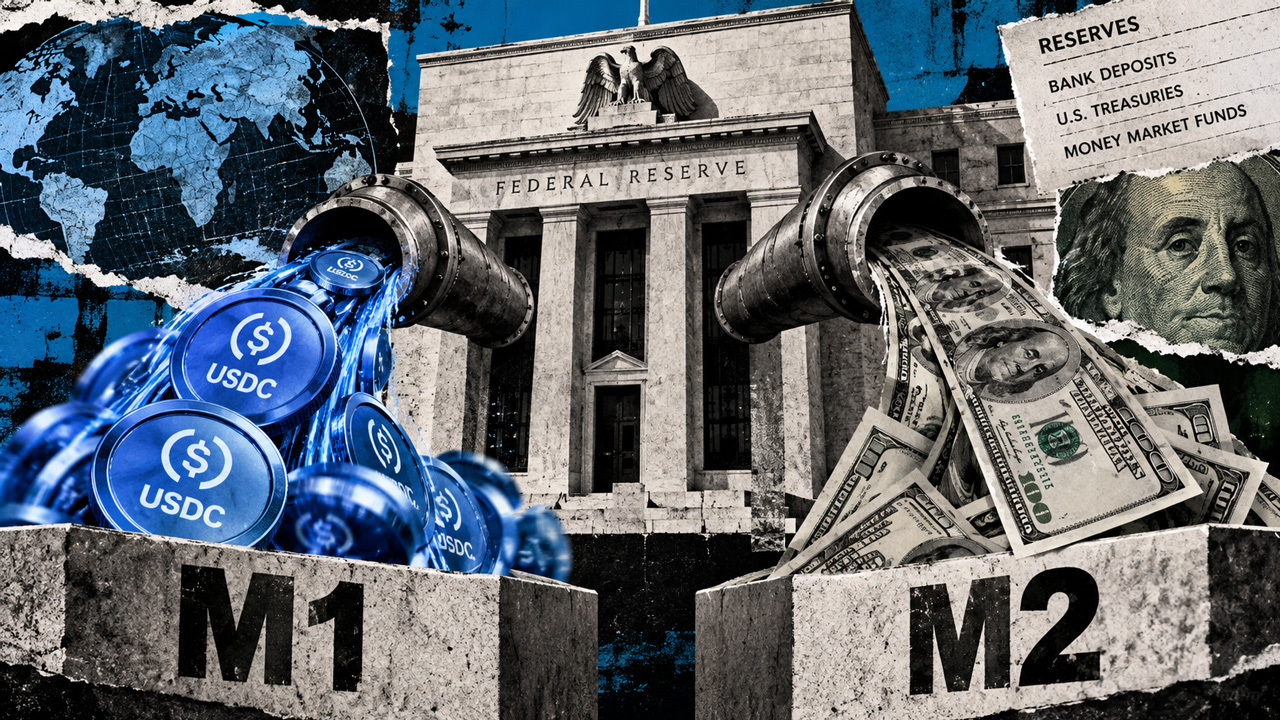
A Federal Reserve staff note published Sept. 4 sketches a route for regulated payment stablecoins to enter M1 or the broader M2 money supply. Its accounting framework requires adjustments before gross circulation could enter either measure.
Payment stablecoins are excluded from the US monetary aggregates today. The new note makes future treatment depend on economic use, alongside adjustments for reserve assets already counted elsewhere and the separation of US circulation from global activity. Otherwise, a larger money-supply figure could partly reflect a new wrapper around dollars the system already measured.
The distinction matters for anyone using M1 or M2 to judge dollar liquidity. A statistical increase driven by reclassification says little about newly created purchasing power.
The note is independent staff research, reflects only its authors’ views, and is not part of a Federal Reserve policy deliberation. Existing definitions remain unchanged, and the analysis presents conditional possibilities.
How stablecoins could fit, and what could be counted twice
M1 is the narrowest official US money measure. It contains currency and highly liquid balances that households and businesses can use for transactions. M2 includes M1 plus less liquid savings-type assets, including small-denomination time deposits and retail money market funds.
The Fed authors apply that functional split to payment stablecoins. If the coins are used predominantly as a stable store of value or as liquidity for crypto trading, non-M1 M2 may be the better fit. If they become a common medium of exchange for household and business payments, their immediate transferability could support an M1 classification.
The framework remains conditional. The GENIUS Act requires permitted issuers to maintain at least 1:1 identifiable reserves and publish monthly reserve information, and leaves M1 or M2 assignment to a separate statistical decision. The Fed says standardized circulation data and a reporting chain suitable for monetary-statistics compilation would still be required.
The central stock-measurement problem sits on the reserve side. Under GENIUS, permitted reserves can include bank deposits, Treasury instruments, and government money funds. The Fed note says some bank deposits and money-fund net assets are already captured in M1 or M2.
If an issuer receives dollars, places part of them in a bank deposit or money fund, and issues stablecoins against that reserve, counting the tokens at face value could add a new line to the aggregate while part of the backing remains in another counted component. That is the same-dollar problem.
Only reserve assets already represented in M1 or M2 create overlap. The overlap depends on the backing composition and the statistical treatment of each reserve asset. The Fed note says the extent must be assessed before any adjustment is chosen.
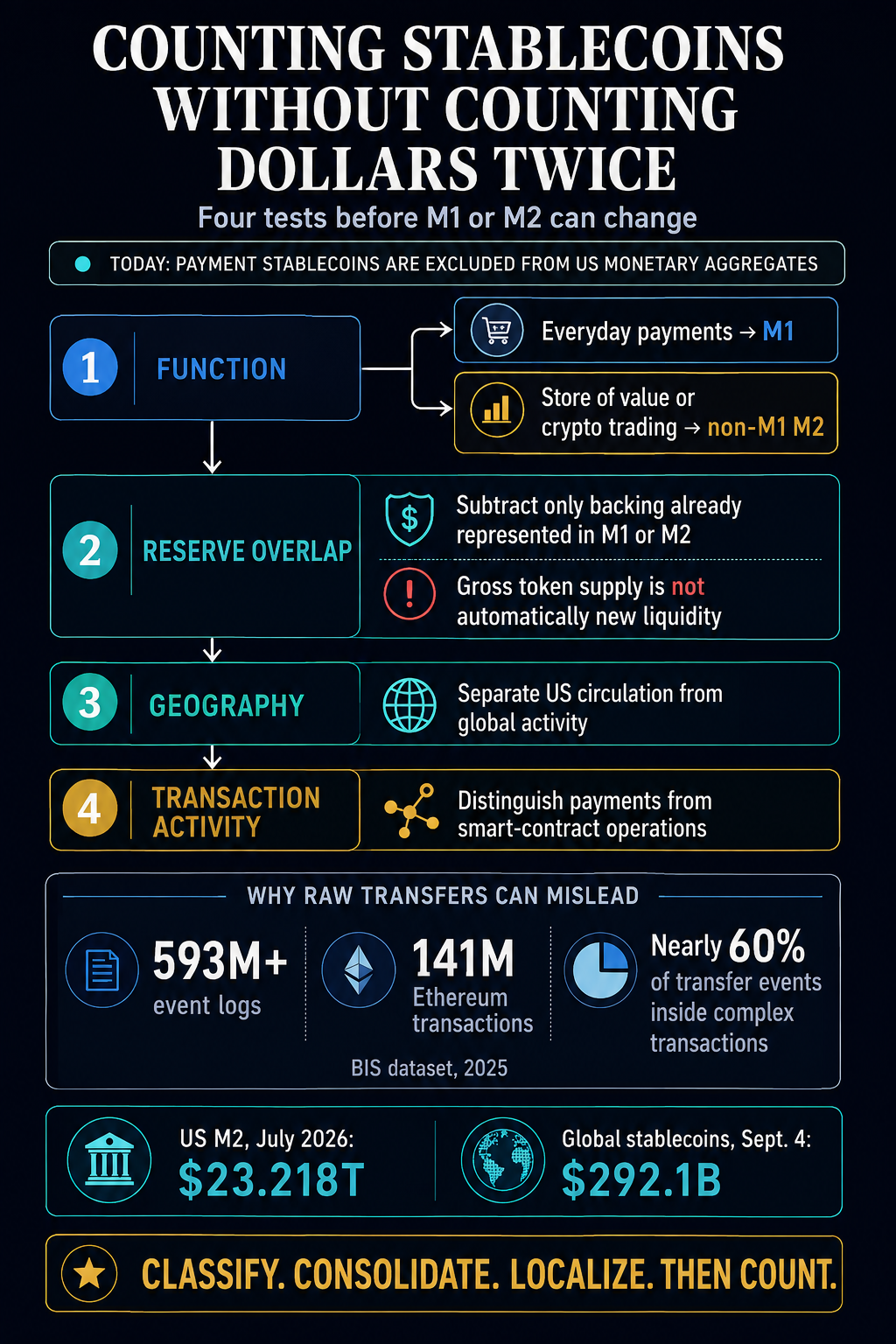
| Question | What it determines | Evidence needed |
|---|---|---|
| Function | Whether the balance belongs with transaction money in M1 or savings-type money in non-M1 M2 | Reliable evidence on predominant economic use |
| Reserve overlap | How much gross issuance is already represented in counted components | Issuer-level reserve composition matched to M1 and M2 definitions |
| Geography | How much circulation belongs inside a US measure | Reporting that can separate US activity from global circulation |
| Transaction activity | Whether observed transfers resemble standalone payments or complex financial operations | Transaction-level classification rather than raw event counts |
USDC shows that a single headline number answers only part of the reserve question. Circle says most of its reserve is held in the Circle Reserve Fund, an SEC-registered government money market fund that can hold cash, short-dated US Treasuries, and overnight US Treasury repurchase agreements. Its July assurance also lists Treasury securities outside the fund, alongside cash held at regulated financial institutions.
Circle’s latest active monthly assurance on the transparency page covered July 31. It reported 71.826 billion USDC in circulation and reserve assets with a fair value of $71.904 billion. Those figures document backing at a point in time. A net addition to M1 or M2 requires a separate consolidation calculation.
A defensible net estimate would have to match the reported reserve categories against the exact money-stock components already counted, remove only genuine overlaps, and preserve backing assets outside the aggregates. The current sources leave that increment unquantified.
The data gaps behind a national money measure
Geography is a separate problem from reserve overlap. A dollar stablecoin issued by a US-regulated company can move globally on a public blockchain, while transaction records generally lack enough geographic information to identify the portion that belongs inside a US measure.
The Fed note says GENIUS applies to US-regulated issuers without distinguishing domestic from international circulation. Additional reporting may therefore be needed to isolate US circulation from global activity. An issuer’s total outstanding tokens map imperfectly onto US-held money.
Economic use requires a separate dataset. The Fed’s functional test asks whether stablecoins behave more like transaction money or savings. Raw blockchain transfer counts are insufficient because a single smart-contract transaction can emit several transfer events.
A Bank for International Settlements working paper published in June analyzed more than 593 million event logs from 141 million Ethereum transactions executed in 2025 involving USDT, USDC, and PayPal USD. Roughly one third of the transactions generated multiple steps or event logs, while nearly 60% of transfer events occurred inside complex transactions.
Those bundles can combine trading, lending, arbitrage, liquidity provision, and settlement. Treating every emitted event as a standalone payment can exaggerate both activity counts and the apparent payment role of stablecoins.
The 60% statistic describes event structure alone. Functional classification under the Fed staff framework requires separate evidence about economic use.
The scale makes these distinctions consequential. CryptoSlate’s Sept. 4 market snapshot listed the global stablecoin category at $292.1 billion across 73 assets. Its USDC market page showed about $74.5 billion of market capitalization and 74.51 billion tokens in supply.
Those global market figures say nothing about US-resident ownership or usage. They also differ in date and purpose from Circle’s July 31 assurance, so the values should not be treated as interchangeable observations.
For comparison, FRED reported seasonally adjusted US M2 at $23.218 trillion for July 2026, updated Aug. 25. That establishes the scale of the official aggregate while leaving the required stablecoin net-addition adjustment unresolved.
The Fed staff framework therefore points to three different accounting jobs before any classification change: determine how the tokens function, consolidate reserve assets already represented in the aggregates, and isolate the circulation relevant to the United States. Transaction-level analysis informs the first job; reserve and residency data remain essential for the other two.
Stablecoins could eventually make M1 or M2 more complete. Skipping those adjustments would blur already-counted balances with genuinely new dollar liquidity.
