


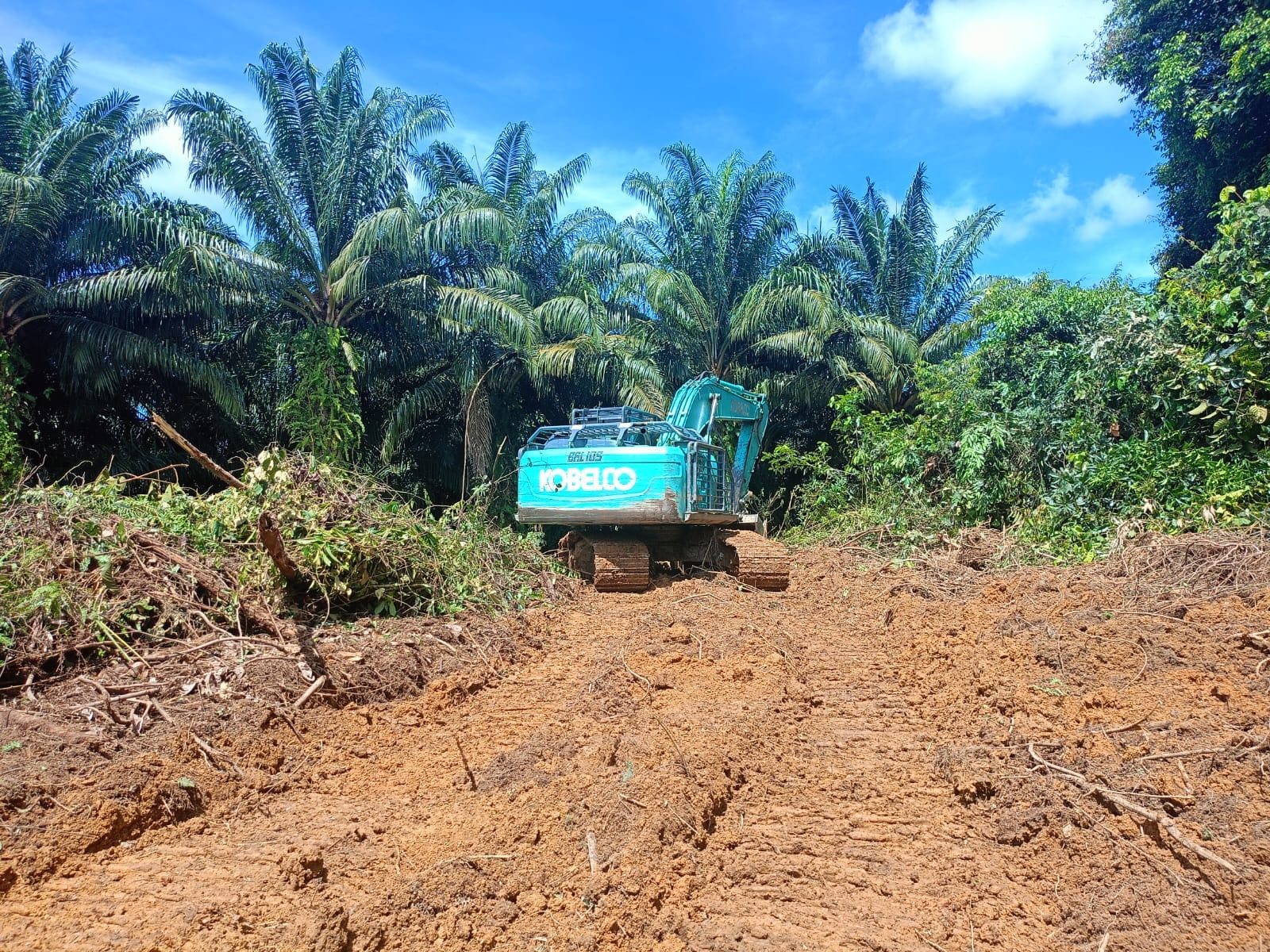
- Two palm oil companies have resumed clearing forest in a long-disputed Indigenous community in Indonesian Borneo, more than a decade after international pressure halted operations.
- The Dayak Benuaq community of Muara Tae says the companies are clearing its ancestral land without its consent, while the companies maintain they legally acquired the land from a neighboring village.
- Community members say the renewed clearing is destroying regenerating forest and farms central to their livelihoods, despite years of advocacy, international recognition, and an unresolved complaint to the RSPO, the top certifier of sustainable palm oil.
- Advocates say the dispute exposes persistent weaknesses in Indonesia’s recognition of Indigenous land rights, allowing companies to rely on administrative boundaries that communities say override customary ownership.
JAKARTA — Two palm oil companies embroiled in a long-running land dispute with an Indigenous community in Indonesian Borneo have resumed the clearing of rainforest and other land to expand their plantations for the first time in more than a decade.
In June 2025, the Indigenous Dayak Benuaq community of Muara Tae reported that the two companies — PT Borneo Surya Mining Jaya (BSMJ), owned by Singapore-listed First Resources, and PT Munte Waniq Jaya Perkasa (MWJP), a subsidiary of Malaysia-owned TSH Resources — had restarted land clearing and evictions in what the community says is its ancestral territory.
The latest activities mark a new chapter in one of Indonesia’s highest-profile land conflicts involving the palm oil industry, which Mongabay covered in an in-depth report in 2015.
The dispute dates back to 2011-2012, when BSMJ and MWJP began bulldozing rainforest in an area claimed by Muara Tae, a village in West Kutai district, East Kalimantan province.
The companies say they bought leasehold rights from residents of Muara Ponaq, a village next to Muara Tae. But Muara Tae has contended the companies colluded with individuals in Muara Ponaq who fraudulently signed away hundreds of hectares of Muara Tae’s communally held land, in exchange for hundreds of millions of rupiah.
The district government facilitated the transactions by redrawing the Tae-Ponaq border, increasing the latter’s territory at the expense of the former. The district chief at the time, Ismael Thomas, was later convicted of corruption in a separate case related to his time in office.
“The companies have taken advantage of the administrative boundary established by the West Kutai district head in 2012, allowing certain individuals from Muara Ponaq to freely claim the customary land of Muara Tae residents and sell it to the company,” Masrani, who was the Muara Tae village chief during the previous peak of the dispute, told Mongabay in a recent interview.

The conflict is one of hundreds if not thousands of land disputes between companies and communities in Indonesia, where Indigenous and other rural peoples tend to lack papers validating their claims to land they have held for generations.
The conflict drew international attention in 2015, when the United Nations Development Programme awarded Muara Tae the Equator Prize in recognition of the community’s efforts to protect its forests despite mounting pressure from plantation expansion.
Around the same time, the villagers also filed a complaint with the Roundtable on Sustainable Palm Oil (RSPO), which certifies oil palm plantations as sustainable, alleging that First Resources, an RSPO member, grabbed their land without their consent.
Following years of protests, international scrutiny, and the RSPO complaint process, the companies stopped clearing land in the disputed area around 2014.
But according to the community and supporting NGOs, that pause ended last year.
Spatial analysis by technology consultancy TheTreeMap, requested by Mongabay, identified 104.5 hectares (258 acres) of forest and other land cleared within BSMJ’s concession between January and June 2026.
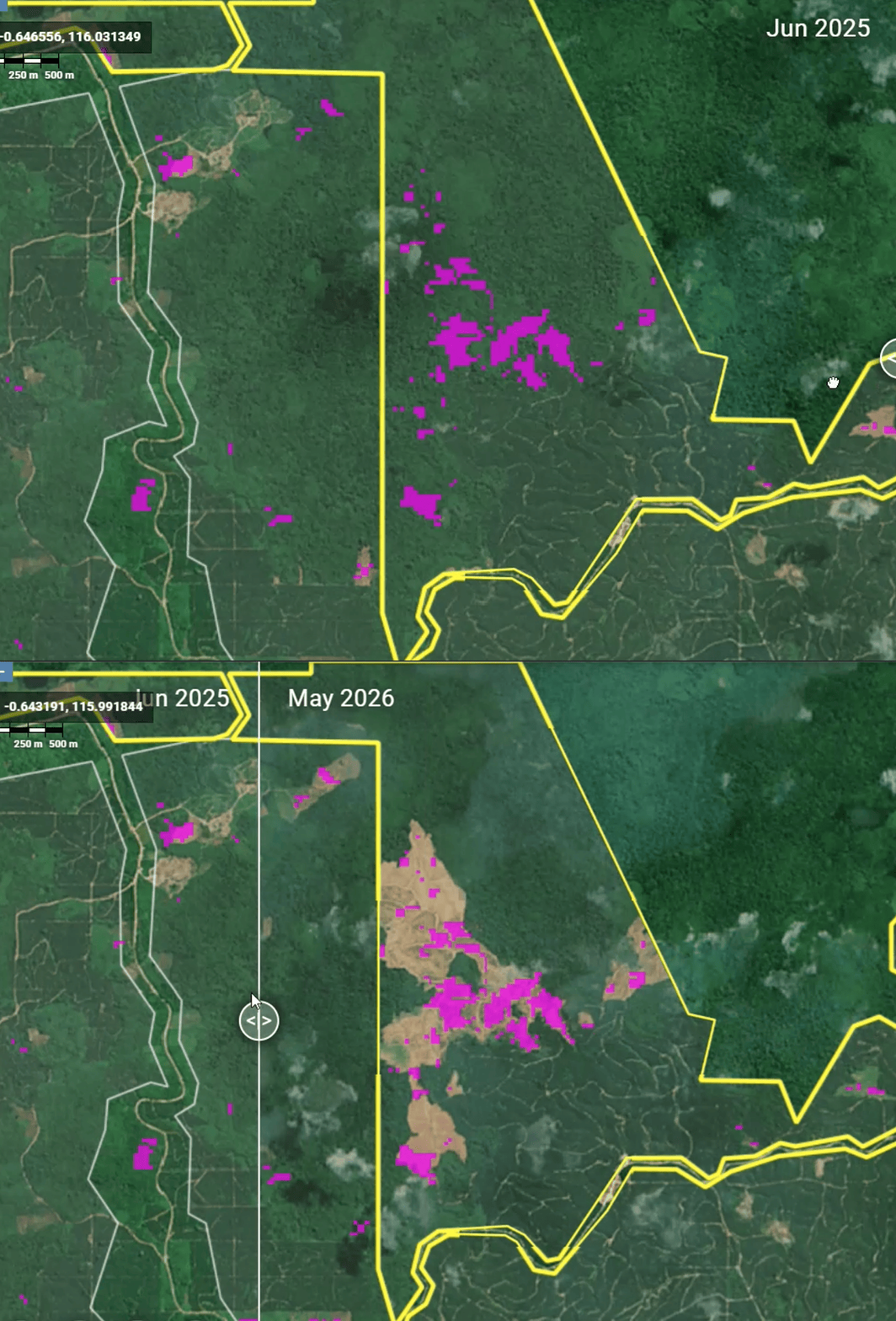
Masrani said the community first discovered renewed clearing in June 2025, with police coming to protect BSMJ’s bulldozers shortly after villagers arrived on the scene to protest.
“We suddenly found that they were clearing land in the area that we had been defending since 2012,” he said.
“Of course we were afraid — we are ordinary villagers,” he added, referring to the police presence. “We could no longer continue our protest because we did not want clashes or misunderstandings on the ground.”
Villagers managed to halt the work later that month, he said, only for BSMJ to return in June 2026 and resume operations in the same area.
MWJP has also resumed clearing since last year, with 430 hectares (1,063 acres) of land clearing identified within its concession this year alone.
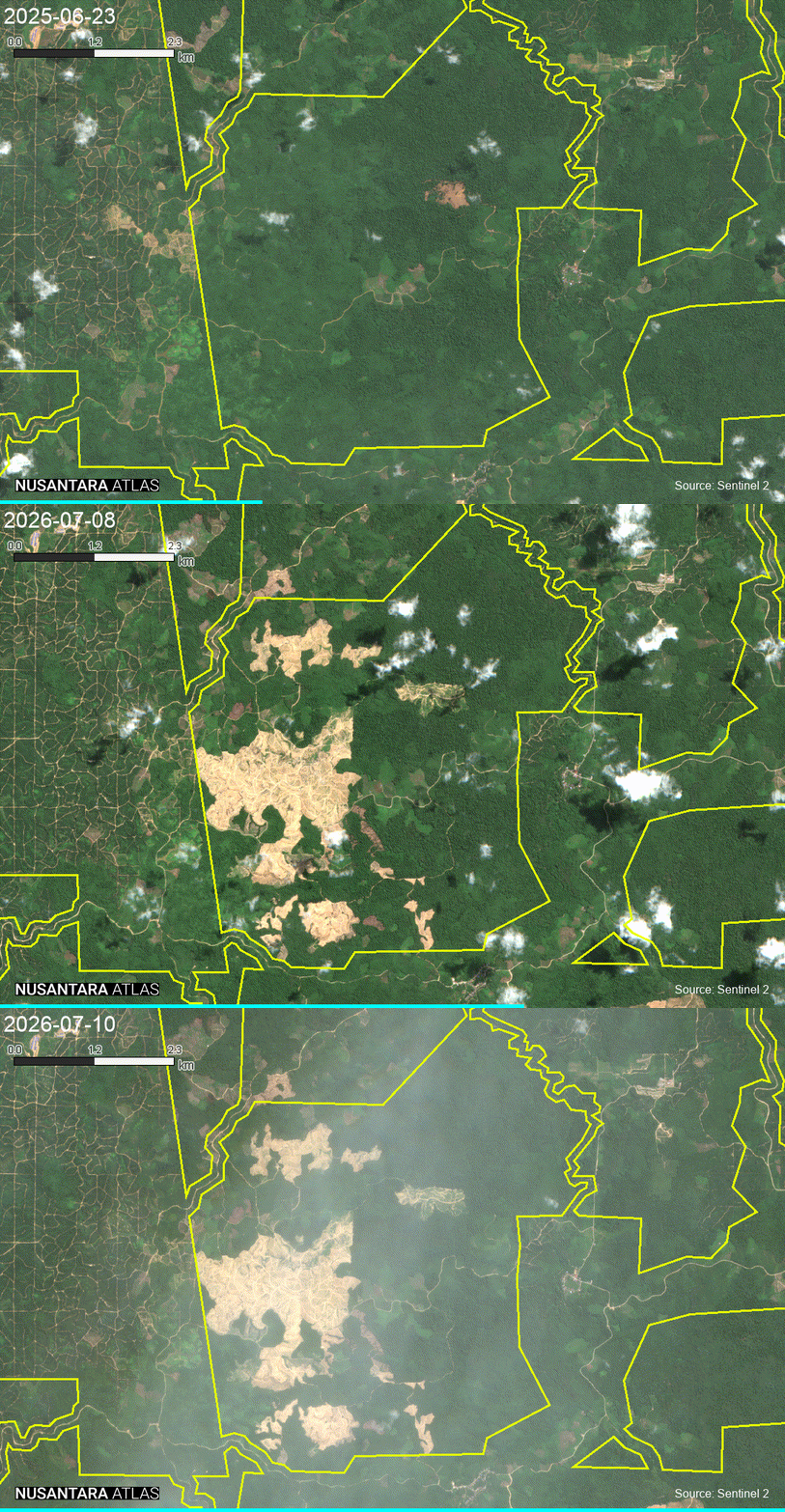
Masrani said the renewed clearing shows, in his view, that neither the companies nor the government respect the community’s rights or the international recognition Muara Tae has received.
“The awards we have received have meant nothing,” he said. “They have not been valued at all, and it seems that even the district government treats them as though they do not exist.”

Typology of forests
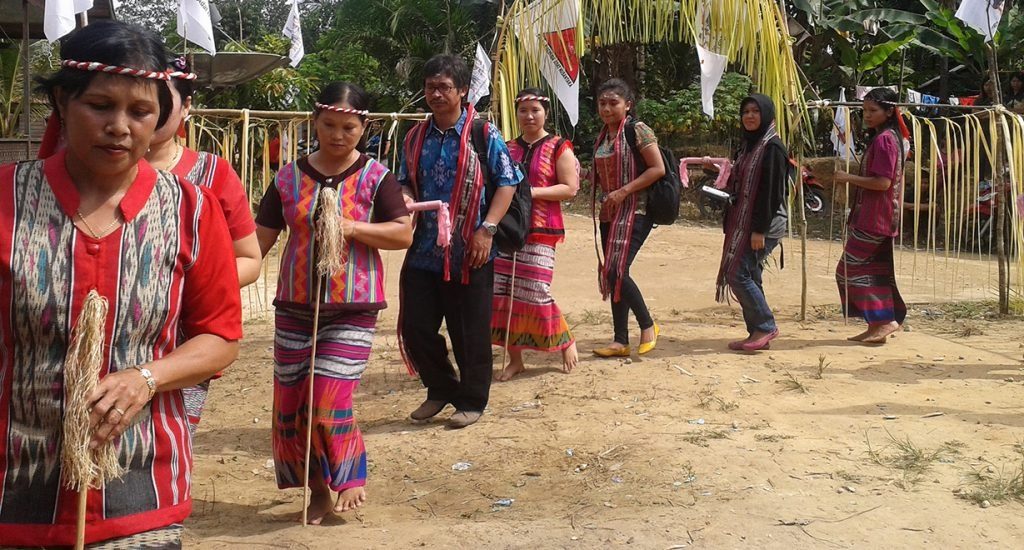
Masrani said the forests they’re defending are central to villagers’ livelihoods and culture.
The community relies on the forests for trees and other plants used in traditional medicine, house construction, and customary ceremonies, he said.
“Once the land is cleared, all of that is gone,” Masrani said. “We have protected this forest for many years. The trees we cared for over decades had already grown very large — some were about 1 meter [3.3 feet] in diameter. The companies have taken them all.”
Besides forested land, the companies have also demolished farms planted with durian, cempedak, rattan and rubber, he said.

First Resources said in a statement posted to its website on July 16 that BSMJ had not cleared any land identified by RSPO assessors as “high-conservation value” or “high-carbon stock,” which RSPO member companies must set aside for protection if they want to sell their palm oil under the body’s green label.
However, the Environmental Investigation Agency (EIA), a U.K.-based NGO that supported the Muara Tae community during its engagement with the RSPO, has alleged in a series of reports published in 2015 and 2019 that the assessments were highly flawed or even fraudulent, part of a broader issue with “substandard” RSPO assessments enabling rainforest clearance and land grabbing under the body’s lax oversight.
According to Masrani, some of the areas BSMJ is now clearing consist of regenerating secondary forest that the Muara Tae community has managed for more than 50 years. The trees it has torn down include meranti hardwoods, some with trunk diameters exceeding 50 centimeters (20 inches).
“During our generation, we protected those trees and allowed them to grow,” Masrani said. “As a result, the area had once again come to resemble a natural forest.”
First Resources’ response
First Resources denies grabbing Muara Tae’s land. It said in its statement that it “continuously applies the principle of FPIC” — free, prior and informed consent of affected communities — “in land acquisition processes.”
“Prior to any land acquisition, the Company verifies land ownership based on supporting evidence for each individual land parcel,” it said.
“No individual landowner’s rights were disregarded or overlooked during the land acquisition process, as compensation was provided directly to the verified landowner of each land parcel.”
However, numerous irregularities raised in Mongabay’s previous reporting call those claims into question.
According to Masrani’s side, it was only after First Resources failed to convince Muara Tae to sign over its land that it approached Muara Ponaq, asking individuals there to lay claim to the same area.
After Muara Tae attempted to block the land clearing, with residents sleeping in the forest for months to keep watch for bulldozers, Ismael Thomas, the district chief, issued a decree removing Masrani from his elected position as village chief. The decree cited a petition purportedly signed by Muara Tae residents asking that Masrani be stripped of office, but villagers told Mongabay their signatures had been forged.
The district government made little if any effort to fact-check the competing claims from Tae and Ponaq that their village, and not the other, had inhabited the disputed area for generations, Mongabay found.
Mongabay sought to test the competing claims by asking each side to demonstrate their knowledge of the disputed area. Only Muara Tae obliged, with Masrani’s father bringing a reporter on a tour of ruined houses, old farms, fruit trees, and hidden burial sites dotting the territory. The Ponaq side spoke to Mongabay but declined to take a reporter into the disputed area, claiming there was nothing there to support their position.
Eko Cahyono, a senior researcher at the Sajogyo Institute, a nonprofit focused on agrarian rights, said the dispute reflects how Indonesia’s legal system places Indigenous communities at a structural disadvantage.
“How can the community be said to have no rights simply because the state has never formally recognized them?” he told Mongabay. “The situation is fundamentally unequal. Corporations receive legitimacy from the state through permits, while Indigenous communities are treated as having no rights simply because they lack formal state recognition. That is the core problem.”

RSPO
The RSPO says it has worked to improve its systems for identifying conservation set-asides and fielding complaints, though it acknowledges it never resolved the dispute between Muara Tae and First Resources.
Muara Tae withdrew from the RSPO’s complaints process in 2015 after years of back and forth that, it said, never amounted to anything, with the RSPO reluctant to take action against the firm despite ample evidence it had violated the body’s procedures.
A routine RSPO audit determined in 2023 that BSMJ was in compliance with RSPO standards, though the Muara Tae dispute had never been resolved.
Another routine audit conducted in February 2025, before the latest clearing allegations emerged, referred to the long-standing Muara Tae dispute, but did not conclude that BSMJ had breached the RSPO’s FPIC requirements. However, auditors did flag a nonconformity after finding the company had failed to involve Muara Tae and several other affected villages when updating its social management and monitoring plans. Instead, the company consulted only Muara Ponaq and Lembonah, another village in the area.
As a result of the nonconformity, the auditors required BSMJ to update its social management and monitoring process to include all affected villages.
RSPO told Mongabay that BSMJ had submitted corrective action plans, which were subsequently evaluated during the next surveillance audit completed in April 2026. The audit report was submitted to the RSPO on July 20, 2026, and is expected to be published once the review process is complete.
Despite the finding, the RSPO did not suspend BSMJ’s certification, as the February 2025 audit found no new land clearing or land compensation processes in the preceding years.
Following a July 8 mediation session convened by the Jempang subdistrict government and attended by representatives of Muara Tae and Muara Ponaq, the subdistrict head sent letters to both companies urging them to suspend their activities until the dispute is resolved.
Ziadatunnisa Ilmi Latifa, a campaigner with Kaoem Telapak, an environmental group, said the letter is unlikely to halt operations because it is only a recommendation, not a binding order.
She also said the mediation itself was limited because the companies were not involved.
“That is why it is important that this dispute not be viewed merely as a land dispute between residents, but as a threat to Indigenous customary territory,” Ziadatunnisa said.
Masrani said BSMJ has never meaningfully engaged with the Muara Tae community.
“It argues that it already acquired the land from Muara Ponaq,” he said. “They tell us that this is a matter between us and Muara Ponaq.”
The community sent another letter to BSMJ on June 3, asking it to suspend its activities, Masrani said.
“They completely ignored it,” he said. “Instead of slowing down, they intensified their operations.”
Abdon Nababan, of the Asia Indigenous Peoples Pact, called for a government review of the companies’ permits, arguing that the concessions should never have been granted without the community’s consent.

Activists are also urging the West Kutai district government to revisit the 2012 district head’s decree that placed part of Muara Tae’s customary territory within Muara Ponaq’s administrative area.
Because Muara Tae’s customary territory has never been formally recognized by the state, the administrative boundary established by the district head became the practical basis for land administration.
Muara Tae says the decree concerned only village administration and could not extinguish customary rights. But it placed part of the disputed area within Muara Ponaq’s administrative jurisdiction, allowing BSMJ to negotiate land acquisition through people recognized by the Muara Ponaq village administration rather than through Muara Tae.
“The decree has become one of the biggest obstacles to our advocacy because it is always used as the justification for claiming that the land being cleared does not belong to Muara Tae,” Ziadatunnisa said.
Abdon said the decree established only an administrative boundary and should never have been used to determine customary rights.
He urged the current West Kutai district head to clarify that the decree has no bearing on Indigenous land ownership.
The current West Kutai district head is the son of Ismail Thomas, the former district head who issued the contested decree and drew the boundary between Muara Tae and Muara Ponaq.
In 2024, Ismail was convicted in an unrelated corruption case involving falsified mining documents connected to a separate mining dispute. Prosecutors had sought a five-year prison sentence, but the court sentenced him to one year and a fine.
Masrani said he has little confidence that the district government will intervene.
“Back in 2011, the district government openly supported the company’s activities and sided with those carrying out the land acquisitions,” he said. “That has left us confused and traumatized because it seemed there was never any intention on the part of the district government to help the community.”
Instead, he said, the villagers hope the national government or the international community will help bring the conflict to an end.
Today, the dispute continues to take a heavy emotional toll on the community.
“We no longer feel safe walking through the forest,” Masrani said. “We constantly worry about threats from the neighboring village. If we have to travel through vulnerable areas of the forest, we no longer dare to go alone.
“Because of this situation, we no longer have time to build our family’s livelihood. All of our energy has been consumed by dealing with this conflict. It has been devastating to our lives.”
If the conflict remains unresolved, Masrani said, he fears the community could eventually lose not only its land, but its future.
“The villagers are left with only tiny pieces of land,” he said. “Our greatest fear is that once all of our territory is gone, our children and grandchildren will no longer have a future here. We will become nothing more than laborers.”
Banner image: PT BSMJ carried out another land clearing on June 18, 2026.
Documentation: Contributed Photo.
FEEDBACK: Use this form to send a message to the author of this post. If you want to post a public comment, you can do that at the bottom of the page.
Cite this article
Hans Nicholas Jong, Niken D. Sitoningrum (2026). Palm oil expansion reignites decade-old Indigenous land conflict in Indonesia. Mongabay Conservation news. DOI: https://doi.org/10.66709/news-325017

