


Welcome to Foreign Policy’s South Asia Brief.
The highlights this week: Supporters of former Pakistani Prime Minister Imran Khan take to the streets, India’s chief election commissioner faces protests calling for his resignation, and the economic cost of Nepal’s deadly floods mounts.
Have feedback? Hit reply to let me know your thoughts.
Khan Supporters March on Islamabad
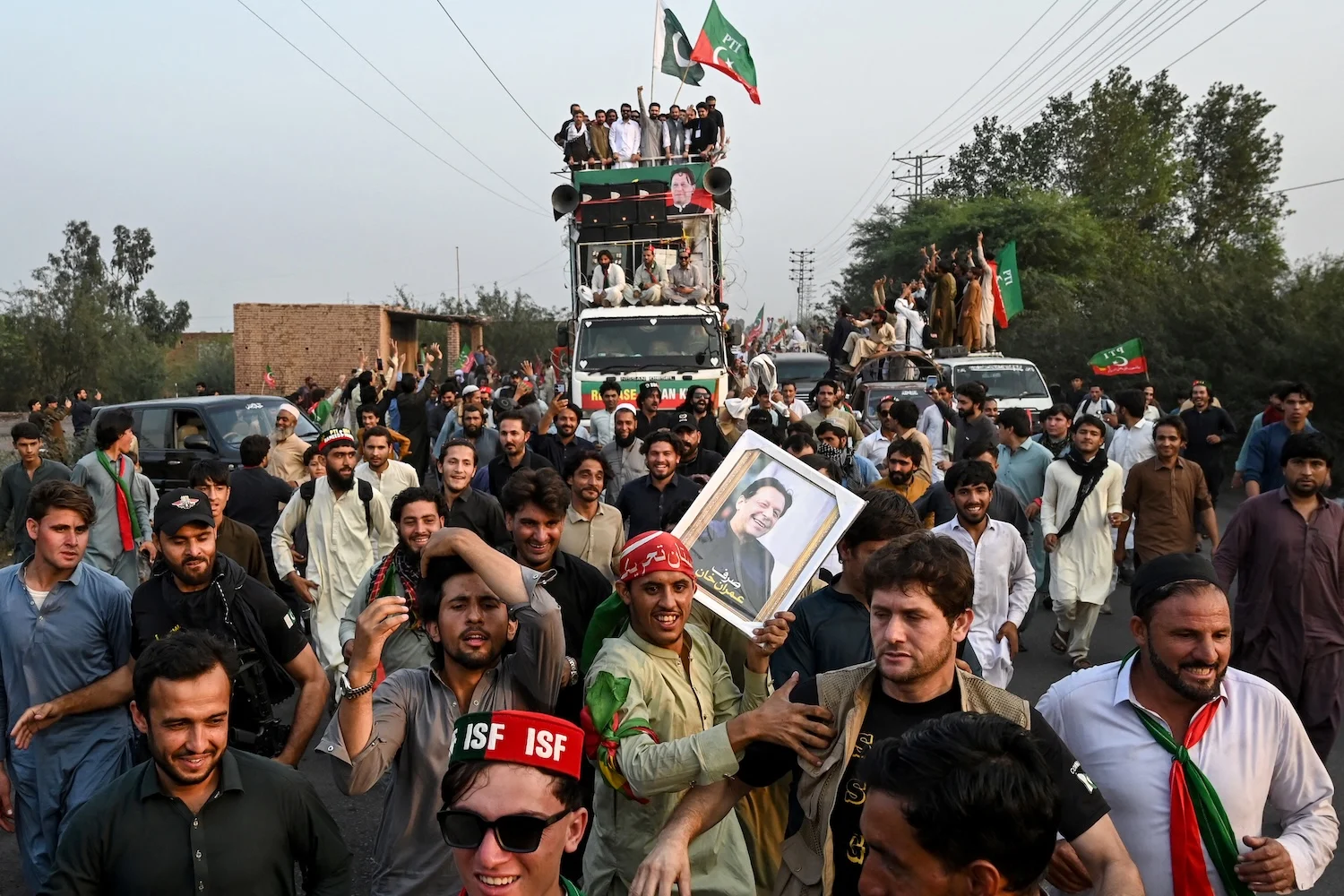
Pakistan’s government is facing one of its most serious political challenges in months as supporters of jailed former Prime Minister Imran Khan march toward the capital, Islamabad.
Supporters of Khan’s Pakistan Tehreek-e-Insaf (PTI) party, the country’s main political opposition, began a so-called long march in Khyber Pakhtunkhwa province on Sunday. Thousands are aiming to arrive in Islamabad later this week, putting pressure on the government to free Khan, who has been imprisoned for more than three years.
Khan’s allies slam the charges against him, including corruption, as politically motivated. Though large protests followed Khan’s arrest in August 2023 as well as the widely criticized February 2024 elections, the streets have been relatively quiet since. Repressive conditions and the arrest of many PTI leaders have made mobilization difficult.
When protests have gone ahead, including in Islamabad in November 2024, the state has responded with force. But Khan’s large support base has grown increasingly angry as the popular former cricketer languishes in prison.
According to Khan’s family, his health is worsening. Pakistan flouted a Supreme Court ruling ordering him to be transferred to a private medical facility for examination in August, instead bringing him to a public hospital for only a brief stay. Family members also say they are not allowed to visit Khan; his two U.K.-based sons say the government has refused to process their visas.
As a result, Khan’s supporters are now willing to mount a major campaign, risking getting tear-gassed, arrested, and jailed. Government negotiations with the PTI to avert the march failed, and on Tuesday, Pakistani Prime Minister Shehbaz Sharif issued a public plea to protesters not to come to Islamabad.
It’s easy to understand why Pakistan’s leadership doesn’t want protesters converging on the capital. They don’t want to have to decide whether to respond with force, risking a political crisis at a moment when the country faces so many complex challenges. These include energy shortages, a hot border with India, conflict with Afghanistan, and mediation in the Iran war.
In particular, Pakistan takes great pride in how its mediation efforts have elevated its global image. The optics of its security forces turning on peaceful protesters would be dreadful. This explains why the government has taken aggressive steps to deter marchers from entering the capital, from closing off roads to erecting massive shipping-container blockades.
In a country with a long history of political instability, the current confrontation between the state—especially the powerful military—and the opposition is especially serious. The government is unlikely to go easy on protesters if they reach Islamabad.
Khan lost power in 2022, after a parliamentary no-confidence vote for which he implicated the Pakistani military and the U.S. government. (Both have denied the accusations.) Khan then became witheringly critical of the military leadership, calling out some top officials by name. After he was briefly arrested in May 2023, protesters attacked military facilities in several cities.
Islamabad’s conundrum goes beyond the protests, however. As long as Khan stays in prison, there is a risk he could die there. His sister Uzma Khan said he warned her during his August hospital visit that he could become like Mohamed Morsi—the former Egyptian president who died in custody.
If Khan suffered that fate, even if by natural causes, his support base would blame the state, which could result in massive, destabilizing protests. Consequently, it wouldn’t be surprising if Pakistani officials had at some point offered Khan a deal in which he could go into exile or house arrest if he stayed quiet. Never one to defer, the former leader is unlikely to accept such an offer.
Khan may be behind bars, but he continues to be a sharp thorn in the government’s side.
What We’re Following
Indian election commissioner under fire. Protests have broken out across India calling for Chief Election Commissioner Gyanesh Kumar to resign, driven by public anger over changes to voter rolls. A recent Indian Express report found that the revision campaign, which began in 2024, was rife with improprieties and that other election commissioners’ complaints went ignored.
The Cockroach Janta Party, which burst into prominence over the summer when it staged large protests over education policy and forced Education Minister Dharmendra Pradhan to step down, is at the forefront of the campaign. This week’s protests, and the Cockroach movement on the whole, are a gift to a weak Indian opposition.
The Indian National Congress party and others in the opposition lack strong and charismatic leadership, and they have struggled to dent the popularity of Prime Minister Narendra Modi—or to capitalize on his vulnerabilities, such as entrenched youth unemployment. But angry young protesters have put Modi on the defensive, emboldening his critics.
The Congress party has been careful not to directly associate itself with the Cockroach movement, instead holding its own, separate protests. Still, it is clearly happy to ride on the Cockroach Janta Party’s coattails: Congress leader Rahul Gandhi was detained during a protest on Wednesday for the second time in as many days.
Pakistan to deploy under Mecca pact. On Monday, Pakistan, along with Turkey, announced that it would deploy troops to Saudi Arabia to help counter attacks by Houthi rebels. The three countries signed the Mecca Joint Defense Agreement in August, releasing statements using NATO-like language to insist that an attack on one member will be seen as an attack on all three.
There are few public details about the scale and scope of the military aid; a joint statement published by Pakistan’s foreign ministry simply said the three countries would “provide the agreed military forces and capabilities and ensure their rapid deployment.”
Nonetheless, the announcement is significant. Critics had noted previously that the Mecca pact had not been invoked, despite Saudi Arabia being targeted by the Houthis and Pakistani being targeted by the Taliban. For Pakistan, the decision carries some risk: It doesn’t want to be dragged into a Middle East war, and it risks losing credibility in the eyes of Iran as a neutral mediator.
The economic impact of Nepal’s floods. A World Bank report this week laid out the economic cost of the massive flooding in Nepal in August. Energy infrastructure was a major casualty: More than 10 percent of Nepal’s installed hydropower and solar capacity, including 12 hydropower projects, was damaged or destroyed.
Around two-thirds of a key 50-mile trade corridor was damaged, with nearly half of it washed away completely. The report also warns of possible hits to the tourism economy. The World Bank forecasts that Nepal’s real GDP growth for fiscal year 2027 will fall to 3.7 percent, compared with a projected 3.9 percent for fiscal year 2026.
This is all bad news for an economy already reeling from unemployment, brain drain, and corruption, among other problems.
FP’s Most Read This Week
Under the Radar
Pakistan reported its sixth new case of polio this year on Monday, just days after the fifth case was reported. Both cases come after the country completed a large vaccination campaign on Sept. 27.
Though the numbers are small, the conclusion is sobering: Pakistan, one of only two countries in the world with endemic polio, is still struggling to fully eradicate an illness that the rest of the world vanquished many years ago.
Pakistan’s persistent polio problem is also a reminder of the public health challenges faced by the wider region—from evergreen cases of tuberculosis and dengue fever to recent serious outbreaks of HIV in Pakistan and measles in Bangladesh.
To be sure, there have been some health success stories in South Asia, including Sri Lanka’s effective efforts to curb dengue fever this year. But in an indication of the scale of the challenge, even Sri Lanka saw its yearly figure of dengue cases surpass 100,000 last month.
