


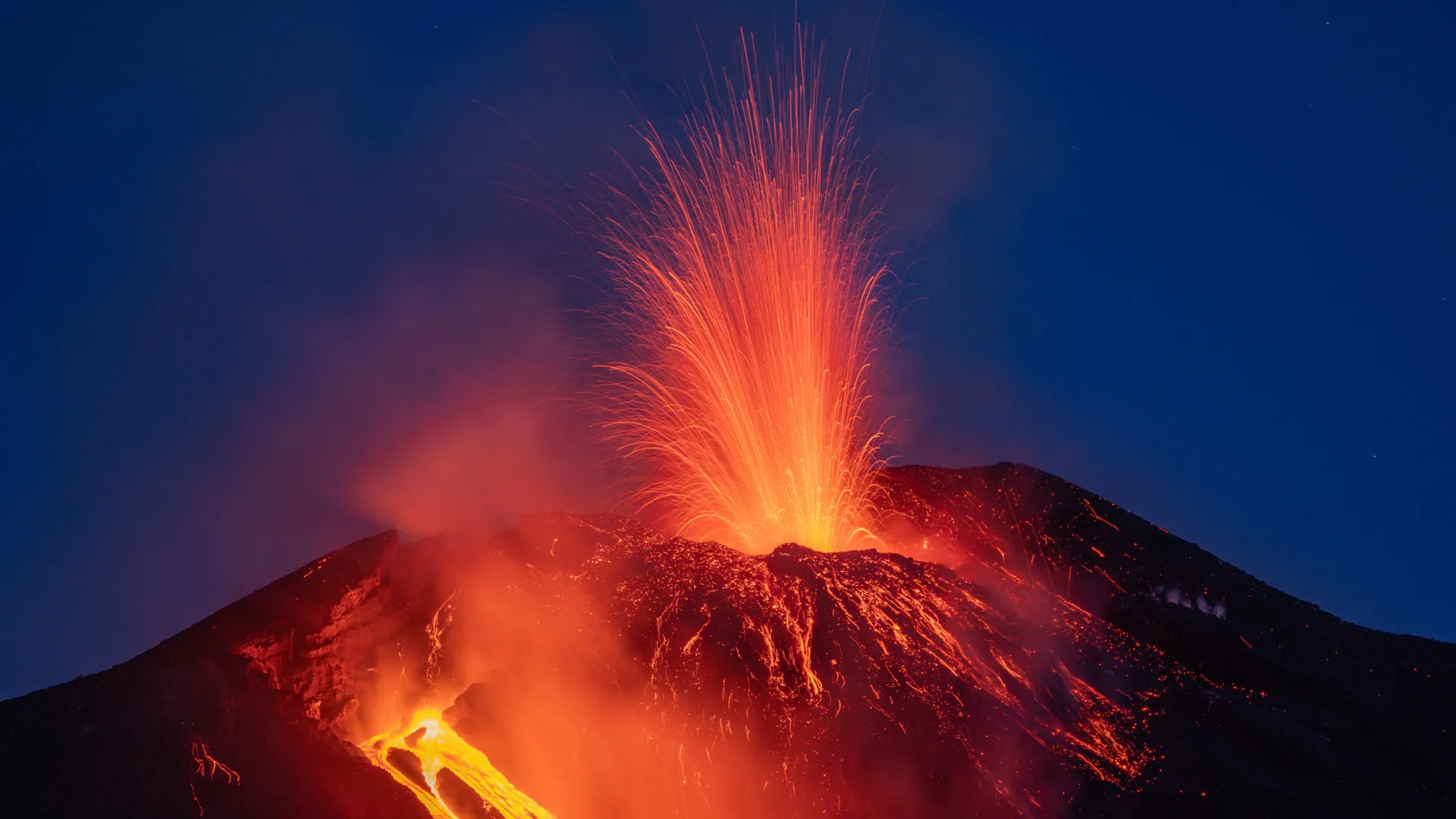
Volcanoes are fed by enormous underground networks of magma and gas, but those systems do not always behave the same way. Even a single volcano can produce eruptions through very different processes.
A Cornell-led research team has now shown just how dramatically those pathways can vary at Mount Etna in Italy. By reconstructing two major eruptions from the volcano’s past, the scientists found that magma followed very different routes and moved toward the surface at very different speeds.
Understanding those differences, along with the techniques used to uncover them, could help scientists improve models used to estimate the risks posed by future eruptions.
The findings were recently published in Geochemistry, Geophysics, Geosystems. The first author is former postdoctoral researcher Maxim Gavrilenko.
The project was led by Esteban Gazel, the Charles N. Mellowes Professor in the Department of Earth and Atmospheric Sciences in the Cornell Duffield College of Engineering. His research focuses on how volcanoes work, particularly what causes some eruptions to become explosive and which processes control their behavior.
What Makes a Volcano Explode?
A volcano’s explosiveness depends on several factors, including how easily its magma flows and the amount of volatile material trapped inside it. These volatiles are gases that can separate from magma as pressure changes.
“Imagine a bottle of soda. If you open that bottle without agitating it, you can drink it, but if you shake it up, all the bubbles get separated really fast, and you have an explosion,” Gazel said. “Volcanoes work in a similar way, and my lab is trying to quantify these processes.”
Two of the most important volcanic volatiles are water and carbon dioxide. Scientists long considered water the main volatile responsible for driving eruptions. In 2023, however, Gazel’s group showed that carbon dioxide can also trigger explosive volcanic activity.
The researchers reached that conclusion using a technique they pioneered with Raman spectroscopy. The method allows scientists to examine crystals that formed inside magma and measure microscopic gas bubbles trapped within them. These bubbles are only about 1 to 10% the thickness of a human hair.
“That technique gives us the density of CO2, and using a state equation we can transform that density into pressure, and pressure can be transformed into depth,” Gavrilenko said. “Then we apply those techniques to these explosive eruptions, and we are able to reconstruct the plumbing system with an unprecedented precision.”
Reconstructing Mount Etna’s Hidden Plumbing
The team chose Mount Etna because it offered a relatively simple system dominated by volcanic gases. Although Etna is considered relatively gentle compared with many volcanoes, its history includes several highly violent eruptions.
One of its largest known eruptions occurred in 122 B.C. That event was both “mafic” and Plinian. Mafic magma has relatively low viscosity and is rich in magnesium and iron. Plinian eruptions represent the most explosive class of volcanic eruptions and are named after Pliny the Elder, who described the eruption of Mount Vesuvius in 79 A.D.
Collaborators and co-authors Terry Plank of Columbia University and Bruce Houghton of the University of Hawaii, Manoa, traveled to Mount Etna to systematically collect samples.
By sequencing and measuring crystals formed in the magma, the researchers reconstructed what happened during the 122 B.C. eruption. Their analysis showed that magma began rising from a depth of about 22 km.
Instead of racing directly to the surface, however, the magma moved upward slowly and then stalled at a much shallower depth of 2 to 5 km. It remained there for several weeks, gradually releasing gas before finally erupting.
Another Eruption Took Only Hours
The researchers then compared their new measurements with data from another Mount Etna eruption known as the Fall Stratified event, which occurred nearly 4,000 years ago.
That eruption followed a dramatically different path.
In this case, magma rose rapidly from much deeper in the mantle, beginning roughly 24 to 30 km below the surface. Instead of lingering for weeks, it traveled upward and erupted within a matter of hours.
The researchers found that this rapid ascent was associated with a much higher concentration of carbon dioxide.
“Some volcanoes are only high CO2, mostly in oceanic islands, and some volcanoes are mostly controlled by water, such as the ones in subduction zones. Etna is one of the few volcanoes in the world where you have the two volatile species competing,” Gazel said. “This shows that at a certain threshold of CO2, the eruption will come from very deep and really fast, but when you have a higher threshold of water, then the process is controlled at shallow levels.”
The findings suggest that the balance between carbon dioxide and water can strongly influence how an eruption develops. Higher levels of CO2 can drive magma rapidly upward from deep underground, while water can become more important when magma spends more time at shallower depths.
A New Tool for Volcano Risk Assessment
Gazel’s team is now using the same approach to study volcanoes in Chile, Hawaii and many other regions.
“Ideally this should be done in every volcano on the planet,” he said. “This is data we need for physical models of eruptions that are the base of risk assessment.”
By determining where magma begins its ascent, how quickly it moves and which gases are driving that movement, researchers may be able to build more realistic models of how dangerous eruptions unfold.
Mythology Beneath Mount Etna
Mount Etna also carries a cultural history that stretches far beyond modern volcanology.
In Greek mythology, the volcano was associated with the burial of the giants Typhon and Enceladus after they were defeated by the Olympian gods. Gazel sees an intriguing parallel between those ancient stories and the underground structures revealed by his team’s research.
“There may be the two giant mythological monsters under Etna,” Gazel said. “And if you look at the plumbing system of the Plinian eruption, it’s like Typhon, because it’s elongated and serpentine, and the other one is Enceladus, because it’s kind of smaller. If you work in Etna, it’s hard not to be connected to history, classical work and great food.”
Co-authors include postdoctoral researchers Kyle Dayton and Ellyn Huggins; and Anna Barth of University of California, Berkeley.
The research was supported by the National Science Foundation.
