


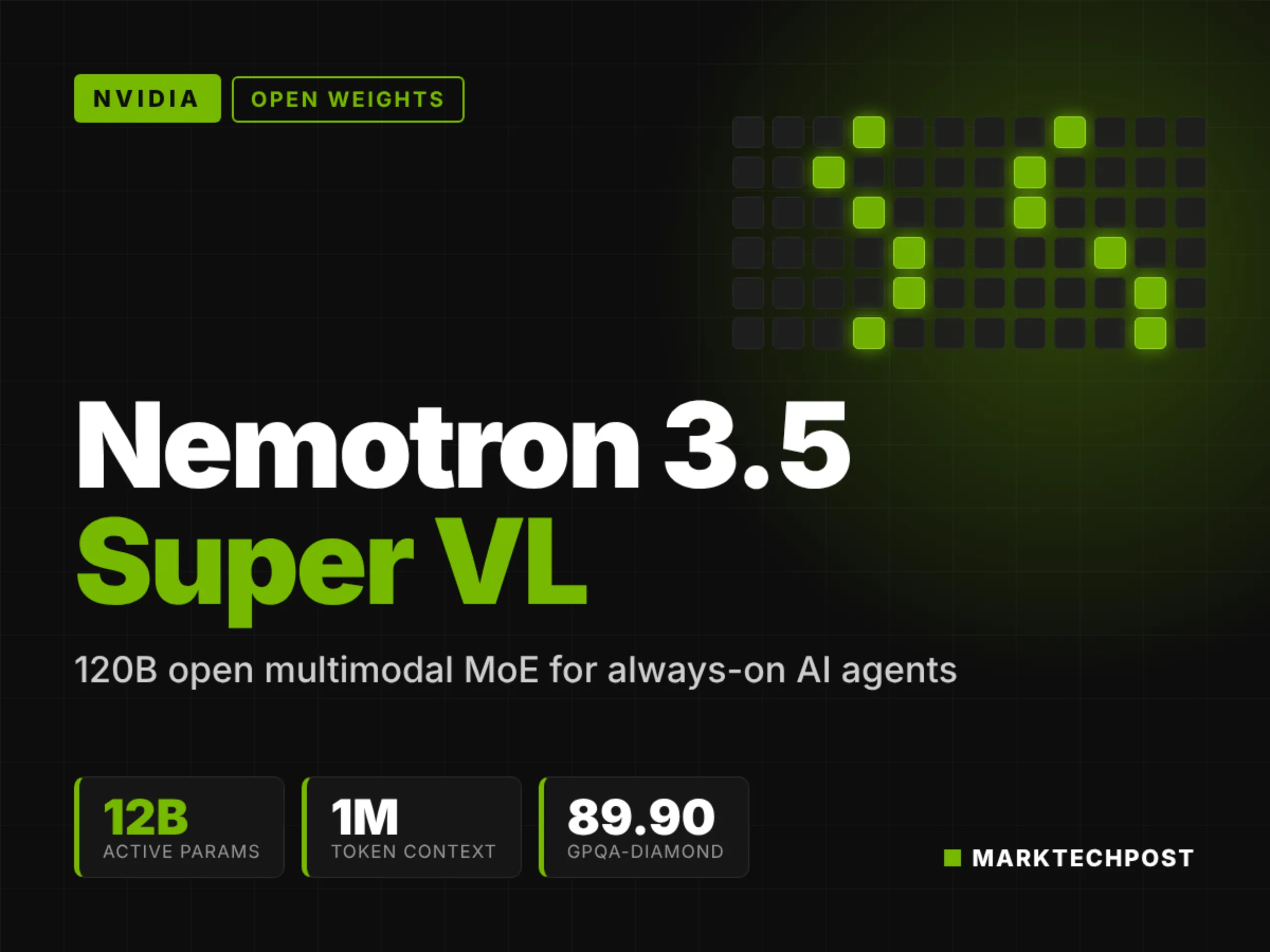
NVIDIA just released Nemotron 3.5 Super VL, an open vision-language model built for always-on enterprise agents. Nemotron 3.5 Super VL is a 120B-parameter mixture-of-experts model from NVIDIA that activates 12B parameters per token. It reads text, images, documents and video, then reasons, calls tools and writes code in one model. For developers, 1 open checkpoint replaces a separate text model along with a separate vision model. NVIDIA also shipped 2 edge models, Nemotron 3.5 Bolt 74B-A9B and Bolt E4B.
TL;DR
- Size: 120B total parameters, 12B active (MoE). Context up to 1M tokens.
- Runs on: 1x DGX Spark, 1x H200, 2x H100 or 1x GB200 with the NVFP4 checkpoint. A BF16 checkpoint is also published.
- Performance: Strong reasoning, agentic coding and document vision. NVIDIA claims up to 5x higher single-GPU throughput than open peers.
- Best: 89.90 on GPQA-Diamond (NVFP4).
- Worst: 17.78 on tau3-bench banking (NVFP4).
What is Nemotron 3.5 Super VL?
It is an open multimodal agent model. Weights ship under the OpenMDW-1.1 license. NVIDIA also released open datasets, training recipes and RL environments in NeMo Gym.
The model card lists text, image and video inputs with text output. Video is limited to MP4 clips up to 2 minutes. Reasoning can be toggled on or off through the chat template.
How does the architecture work?
The backbone interleaves Mamba-2, mixture-of-experts and attention layers. Each MoE layer holds 512 routed experts. A C-RADIO vision encoder and a connector feed images, document pages and video frames into the language backbone.
Speed comes from four techniques:
- Multi-token prediction: a native drafter proposes several tokens, verified in 1 forward pass.
- LiLiCorr: a speculative drafter for DGX Spark, up to 2.3x faster token generation.
- NVFP4 with quantization-aware distillation: 4-bit weights and activations on Blackwell, 4-bit weights with 16-bit activations elsewhere.
- Context reuse: prefix caching keeps both attention caches and Mamba states across agent turns.
The model was distilled from Nemotron 3 Ultra. NVIDIA team states that it trained on about 26 trillion tokens. Post-training used roughly 3.8 million samples plus RL across dozens of environments. Continued pretraining added 10B Indic tokens.
How does it perform on benchmarks?
All scores below are NVIDIA-reported, from the NVFP4 checkpoint on the model card.
| Area | Benchmark | Score |
|---|---|---|
| Reasoning | GPQA-Diamond | 89.90 |
| Coding | SWE-bench Verified | 71.07 |
| Coding | Terminal-Bench 2.1 | 60.80 |
| Web agent | BrowseComp | 77.5 |
| Instruction following | IFBench | 71.50 |
| Charts | CharXiv reasoning | 79.88 |
| Documents | MMLongBench-Doc | 62.82 |
| Computer use | OSWorld-Verified | 52.3 |
| Long-horizon agent | tau3-bench banking | 17.78 |
On agent harness evals, Super VL beats Nemotron 3 Ultra. It scores 63.44% on Hermes Bench versus 56.33%. On LangChain evals it scores 87.05% versus 84.3%. Ultra carries about 4.6x more total parameters.
NVIDIA team reports over 600 output tokens per second on Artificial Analysis agentic tasks via a Baseten endpoint. Its chart marks a 5x speed gap over Inkling Small.
