


Turbulence is all around us, from milk swirling into a cup of coffee to powerful storms churning through the atmosphere and oceans. But turbulence also occurs throughout space, where it behaves in ways that scientists are still struggling to understand.
Unlike the air and water on Earth, much of the matter in space consists of electrically charged particles in a state (known as the plasma state). These particles interact strongly with magnetic and electric fields, creating turbulence that is fundamentally different from what we experience on Earth. Space plasma is also so thinly spread that particles rarely collide with one another, making its behavior even more unusual.
Scientists have long struggled to explain how turbulence develops under these conditions and how energy is distributed among its constantly changing fluctuations. Now, an international research team has uncovered a surprising clue: hidden within the seemingly random motion of space plasma is a distinct magnetic pattern that reverses direction at very small scales.
The discovery, published in The Astrophysical Journal Letters, reveals a previously unobserved phenomenon that could improve our understanding of the solar wind and the turbulent conditions that influence space weather.
NASA’s Parker Solar Probe Reveals a Hidden Magnetic Reversal
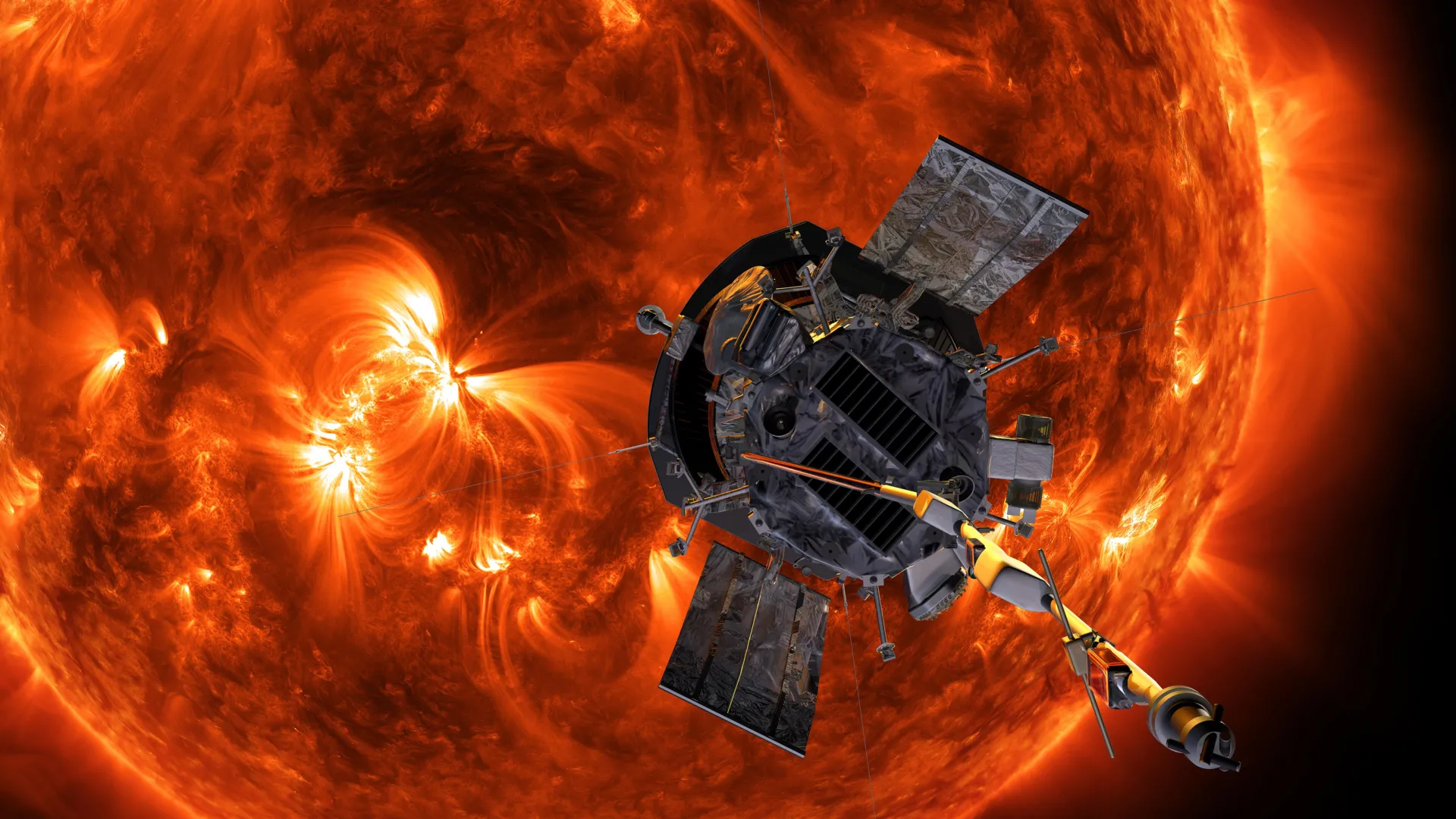
Researchers from the Technische Universität Braunschweig and the University of Tokyo, working with Tohoku University, Kyushu University, Osaka University, and other international institutions, identified the phenomenon using observations from NASA’s Parker Solar Probe.
The collaboration brought together scientists from ten countries, including researchers at the Institute of Theoretical Physics at Technische Universität Braunschweig.
By analyzing highly precise measurements of magnetic fields and particles, the team discovered that turbulent magnetic fields reverse their direction of rotation at a particular range of wavelengths. This marks the first direct observation of such a reversal in space turbulence.
Even more surprisingly, the reversal becomes more pronounced and shifts toward longer wavelengths as the solar wind travels farther from the Sun.
The change occurs at a critical boundary where the behavior of plasma shifts from the collective movement of a flowing fluid to the dynamics of individual particles. This connection suggests that the magnetic reversal may provide an important new way to understand how turbulence operates across different physical scales.
Finding Order in the Chaos of Space Turbulence
At larger scales, plasma moves much like a fluid. Swirling structures called vortices and electromagnetic waves create increasingly complex fluctuations, producing the turbulent conditions found throughout space.
Although these movements appear random, the researchers discovered that the rotation of the magnetic fields follows a consistent pattern.
When viewed along a direction pointing outward from the Sun, magnetic fields at larger scales tend to rotate counterclockwise. At much smaller scales, however, the preferred rotation switches to clockwise.
This reversal occurs precisely where plasma stops behaving primarily like a fluid and begins exhibiting behavior governed by individual particles.
The finding is particularly striking because it reveals a clear, organized feature within a system otherwise dominated by seemingly unpredictable fluctuations.
“We see a clear structure in the spectrum, even though the turbulence represents unstructured motions,” says Dr. Masatomi Iizawa (TU Braunschweig), the study’s first author.
Dr. Yokoi (University. of Tokyo) emphasizes the broader importance of the discovery, stating, “The results are of great significance for both plasma physics and astrophysics.”
Why the Discovery Matters for Solar Storms and Space Weather
Although the magnetic reversal occurs at extremely small scales, understanding it could have far-reaching consequences for space physics.
Plasma turbulence is a major feature of many environments throughout the universe, including Earth’s magnetosphere, the solar wind, regions affected by solar eruptions, interplanetary space, and the disks of material surrounding astronomical objects known as accretion disks.
It also influences the shock waves and clouds of magnetic material that travel through interplanetary space following eruptions on the Sun.
These disturbances can play an important role in geomagnetic storms, making plasma turbulence a critical factor in efforts to predict space weather.
By showing how an organized magnetic pattern emerges as turbulent plasma transitions from fluid behavior to particle behavior, the new research provides an important piece of a longstanding physics puzzle. The findings could ultimately help scientists better understand the complex processes that govern the solar wind and improve the physical models used to forecast geomagnetic storms.
