


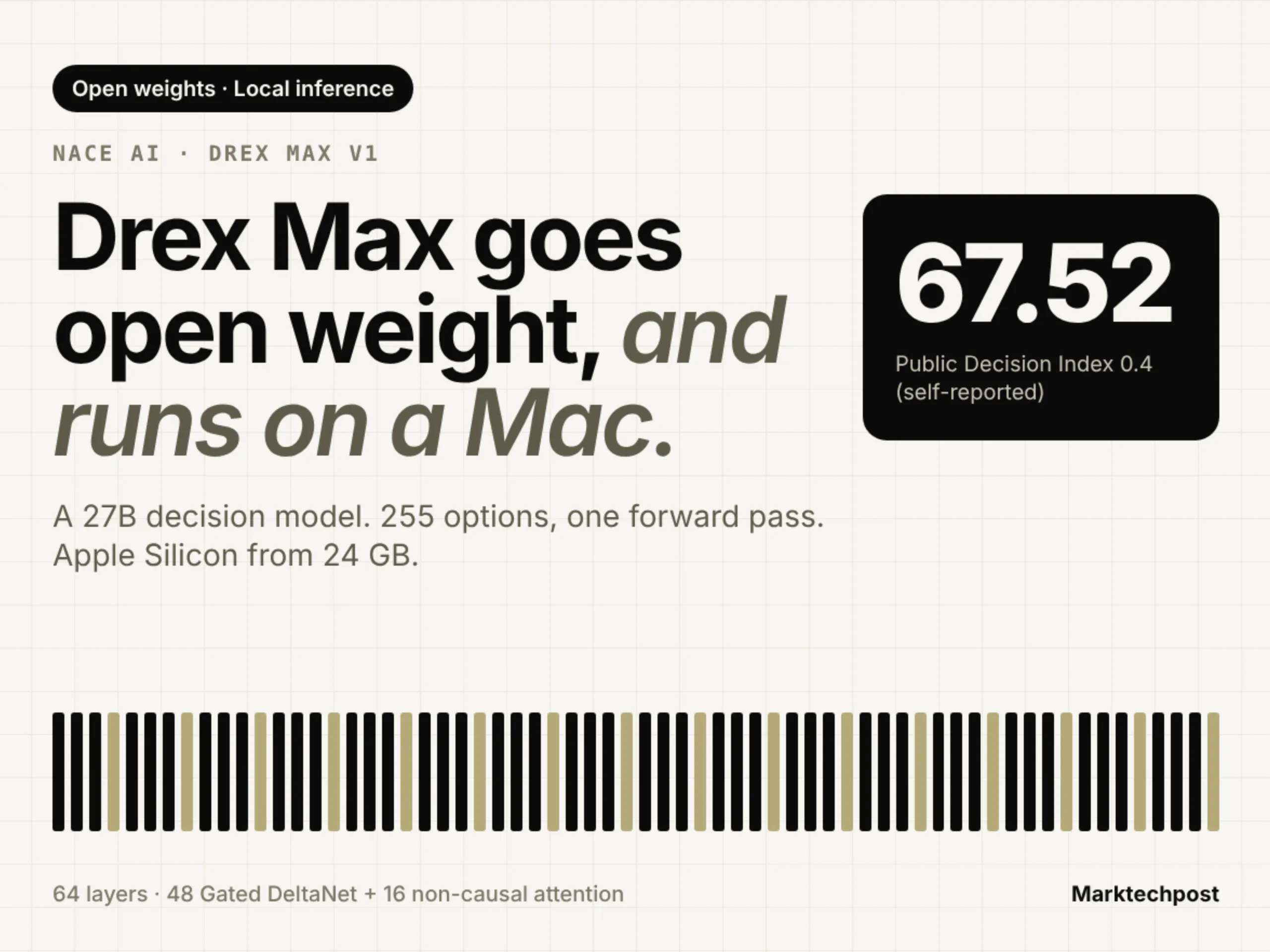
Nace AI has released Drex Max v1 as open weights. Drex Max is its most capable decision model, and it now runs on your own hardware. The release ships bf16 weights, a Q8_0 GGUF, an affine Q4 checkpoint and forks of llama.cpp and Ollama. For developers, Drex Max open weights mean routing, classification and policy checks can stay on a local machine.
TL;DR
- Size: Dense 27B parameters, 262,144-token window (16,384 by default), up to 255 options per question.
- Runs on: NVIDIA GPU with Python (H100 bf16, or L40S 48 GB in 8-bit). Apple Silicon Macs with 24 GB+ (affine Q4) or 48 GB (Q8_0 GGUF). CPU via llama.cpp and Ollama.
- Performance: 67.52 on the public Decision Index 0.4, 6.27 points ahead of Drex v2.0 (self-reported).
- Best: 97.3 skill on InfographicVQA. Tools area reaches 81.9. A top-tier decision model you can now run offline on a Mac.
What is Drex Max?
Drex Max is a decision model from Nace.AI that answers typed questions about a given context. You pass a state (text, JSON or images) plus named questions. The model returns a probability for every option in one forward pass. Nothing is generated.
Questions come in 3 types: choice among named options, yes/no, and an ordinal score. That makes it a fit for agent routing, ticket triage and guardrail checks. The hosted version is presented at routing, classification and policy checks.
How does Drex Max work?
The model card describes a dense 27B backbone with 64 layers. 48 are Gated DeltaNet linear-attention layers that run left to right. The other 16 are full-attention layers, placed every fourth layer, and they are non-causal. Every token can attend to the whole sequence.
Images pass through a native vision tower and are visible to every question in a request. A 255-way readout head then turns the last hidden state into option probabilities. The config lists a qwen3_5 model type with a 262,144-position window.
