


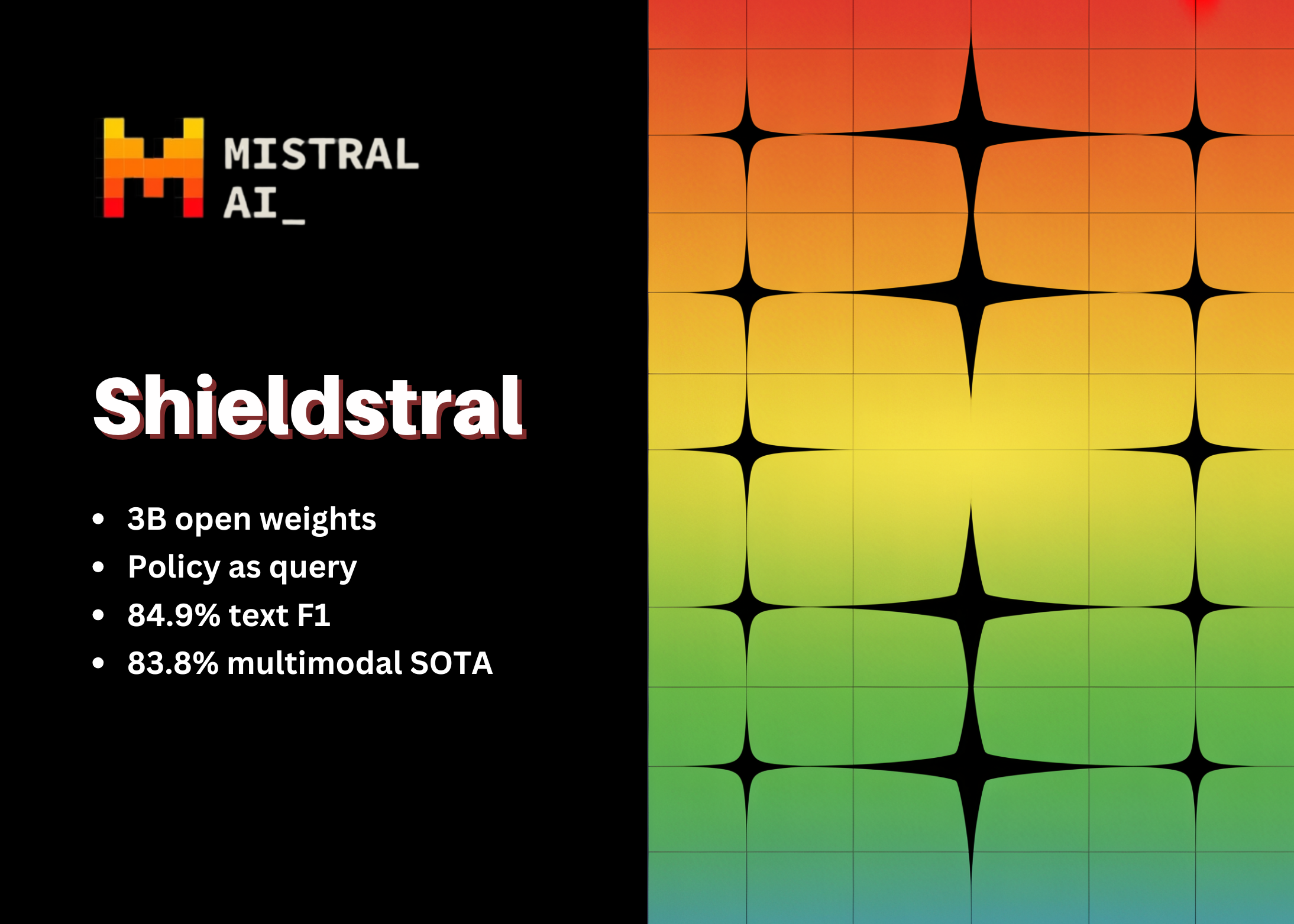
Mistral AI has released Shieldstral 1.0 3B, an open-weights, policy-adaptive multimodal safety classifier that treats content moderation as a single yes/no question rather than a fixed taxonomy of harm categories. Most guardrail models bake their category list into the weights, so re-targeting one to a new deployment context means retraining — and the same content can be acceptable on a cybersecurity research tool while being harmful on a mental-health platform. Shieldstral inverts that: operators write the policy as a plain-language question at inference time, and the model returns a calibrated safety score from a single forward pass. Built on Ministral-3-3B-Base-2512 with a native Pixtral vision encoder and released under Apache 2.0, it reports 84.9% average F1 on text safety — matching GPT-OSS-Safeguard-20B — and 83.8% on multimodal safety, ahead of every baseline Mistral evaluated.
Is it deployable?
Yes, and locally. Shieldstral-1.0-3B fits in 16GB of VRAM in BF16, runs on a single GPU, and is licensed Apache 2.0 for commercial and non-commercial use. Serving paths are already in place: vLLM (≥0.26.0, recommended), llama.cpp via GGUF conversion with Q8_0/Q5_K_M/Q4_K_M quantization, SGLang, and Transformers — with fine-tuning supported through Axolotl. The classifier emits one token, so latency and cost sit far below reasoning-based guards like GPT-OSS-Safeguard-20B.
- Which level of company: the 16GB footprint puts it within reach of seed-stage AI product teams that cannot justify a moderation vendor contract, while the open license and self-hosting story suit mid-market and enterprise teams that need guardrails inside a VPC or on-prem for data-residency and audit reasons. Multi-tenant SaaS vendors get a specific win — one checkpoint can enforce a different policy per customer.
- Industries: consumer social and UGC platforms, ed-tech and child-safety surfaces, healthcare and mental-health apps, fintech and insurance support automation, gaming and voice chat, marketplaces and ad/creative review, and public sector deployments with sovereignty requirements.
- Applications: user-prompt moderation, model-response moderation, refusal classification, image-plus-caption review for ads and memes, training-data and RAG-corpus curation, output gating in agentic pipelines, and per-tenant policy enforcement. Because the output is a continuous score rather than a label, teams can tune the threshold per surface or route borderline scores to human review instead of hard-blocking.
Moderation as a binary question
Shieldstral reduces moderation to one yes/no question. A fixed system message establishes the task; the user message carries three fields: (evaluation context and strictness),
At inference the model unembeds only toward the yes and no token IDs and softmax-normalizes them into a continuous score, thresholded at τ=0.5. That collapses prompt classification, response moderation, refusal detection, and toxicity detection into one problem — and it means the policy lives entirely in the prompt. Mistral’s guidance is one policy per call; for a broad safe/unsafe verdict, list the categories in and ask a single wide
The data recipe
The claimed advantage comes from data, not scale: roughly 54.1M samples — 45.2M open-source text, 4.4M synthetic contrastive text, 4.5M multimodal. A template-based unification layer converts every dataset into the same instruction–query–document format via per-dataset processors, with randomized phrasings and calibrated strictness (strict for adversarial jailbreaks, lenient for response-quality data).
The more interesting piece is contrastive generation. An LLM rewrites safe text into an unsafe variant that violates a target category but deliberately not its sibling, producing a positive and a hard negative over identical content in one call. That teaches the model which policy is violated rather than a coarse safe/unsafe split. Image data — which cannot be synthesized the way text can — is supplemented with general-purpose image datasets as negatives, query mutation across a 14-subcategory visual taxonomy, and vision–language reranker filtering.
Training is LoRA fine-tuning followed by a three-way SLERP merge: 0.6 public+generated, 0.3 public-only, 0.1 Ministral-3B-Instruct.
Results
On text safety, Shieldstral reports 84.9% average F1, tying GPT-OSS-Safeguard-20B (84.9%) as the smallest model in the comparison, with wins on ToxicChat (84.1), HarmBench (99.4), and Aegis v2 response (87.2). On multimodal safety it reports 83.8% overall versus 77.6% for OmniGuard-7B, leading VLGuard (97.7) and UnsafeBench (81.8); LlavaGuard-7B still leads its namesake benchmark at 81.4.
On the adaptability benchmark — built on a deliberately divergent taxonomy of 12 super classes, 26 subcategories, and 52 leaf categories with 90 fixed queries, where no leaf maps one-to-one to training — Shieldstral scores 91.3% F1, behind GPT-OSS-Safeguard-20B (94.1%) and Nemotron-3.5-Safety-4B (91.8%), but without generating a reasoning trace. Refusal detection lands at 91.5% overall against 93.7% for GPT-OSS-Safeguard-20B.
Where it is weaker: multilingual prompt classification lags on Arabic and Indonesian and on RTP-LX prompts (70.3 vs 86.1 for Nemotron-3.5-Safety-4B). Mistral also flags reduced reliability on adversarial or obfuscated inputs and very long documents. Trained context is 32k tokens across 12 languages.
