


Welcome to Foreign Policy’s Southeast Asia Brief.
The highlights this week: The ASEAN foreign ministers’ meeting takes place amid geopolitical turmoil, concerns about the governance of Indonesia’s president intensify, and we look at what’s new in Trump’s latest round of tariffs.
ASEAN Summit Dominated by Middle East
Last week’s meeting of the foreign ministers of the Association of Southeast Asian Nations (ASEAN) in Manila took place against a backdrop of continued turmoil.
The South China Sea and the war in the Middle East overshadowed proceedings as both China and the United States continued their track record of shooting themselves in the foot.
On July 20, a clash at the Second Thomas Shoal between China’s coast guard and Philippine navy left a Filipino sailor injured. The Philippines alleges that he was struck on the head with a wooden baton. China alleges that the Filipinos struck first and were trying to ram the Chinese boat.
When Chinese Foreign Minister Wang Yi landed in Manila on Wednesday, he and Philippine Foreign Secretary Maria Theresa Lazaro exchanged diplomatic protests over the matter. Lazaro also protested a video released earlier this month by Chinese media that depicted the Philippines as a monkey.
Despite this acrimony, the summit’s joint communiqué struck an optimistic note on efforts to finally conclude a code of conduct (COC) for the South China Sea. The ministers wrote that they “looked forward to continued efforts” to “conclude the negotiation of an effective and substantive COC” within the year.
Then Thursday and Friday saw incidents at the Scarborough Shoal, where the Philippines accused China of firing a water cannon at Philippine fisheries boats.
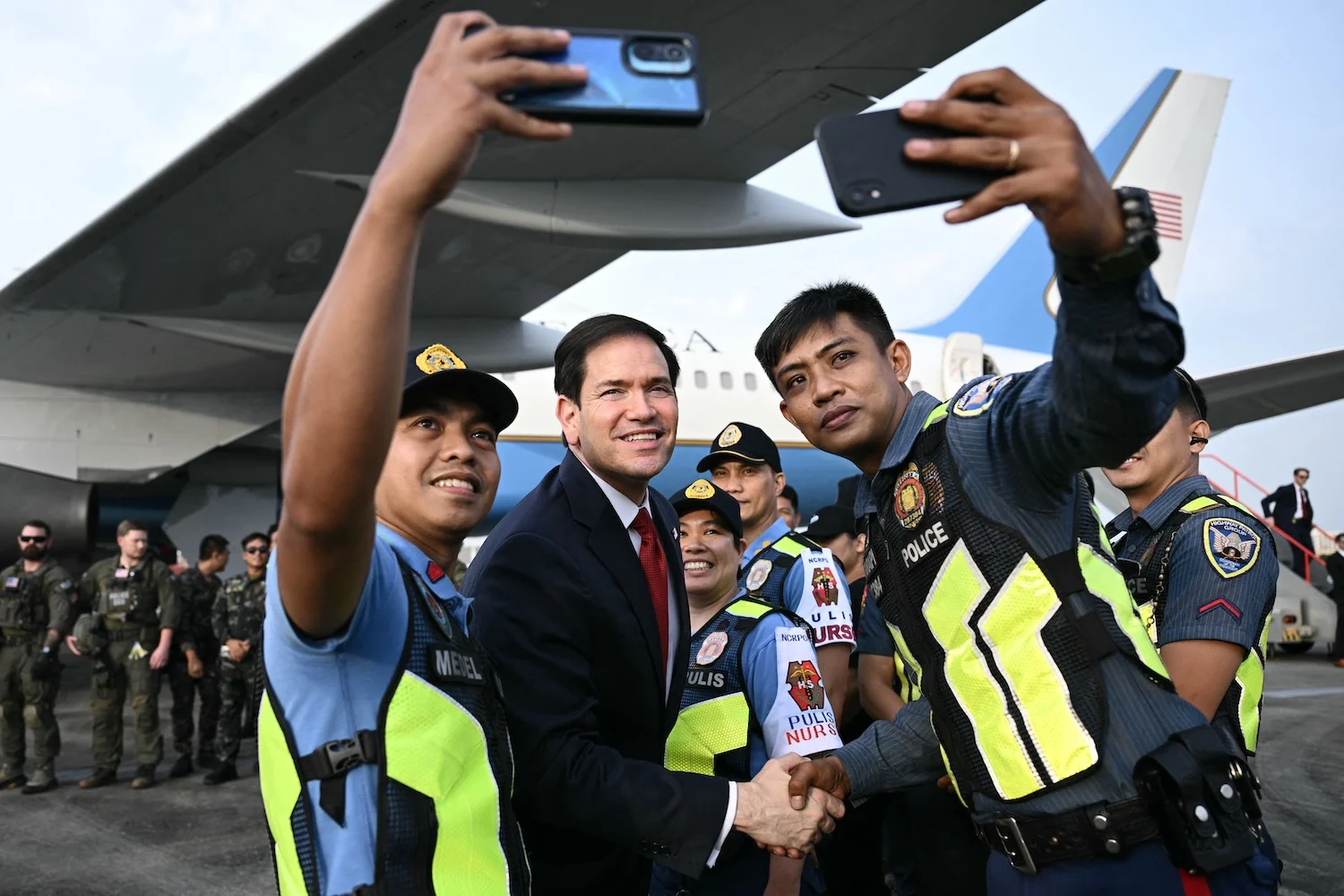
Following the first incident, the United States released a statement condemning “China’s dangerous and aggressive actions.” U.S. Secretary of State Marco Rubio met with Wang on the sidelines of the summit. Afterward, he told reporters he had reiterated the U.S. commitment to its alliance with the Philippines.
In a call on Thursday between U.S. President Donald Trump and Philippine President Ferdinand Marcos Jr., the former assured the latter that he would raise the issue with Chinese President Xi Jinping when they next met.
In an op-ed in Philippine media, Rubio also warned of “dire new threats” if the waters of the South China Sea “fall under the control of a power willing to use commerce as a geopolitical weapon.” He also pitched the United States as a technological partner, saying the region was a “central focus” of the “American AI Exports Program.”
However, Rubio’s efforts to depict the United States as a responsible partner for ASEAN were undermined by U.S. actions. The reopening of hostilities with Iran has once again caused turmoil in energy markets, to which Southeast Asia is highly exposed.
After all this came the latest round of U.S. tariffs, which hit seven of ASEAN’s 11 members (see more below). This jarred with Rubio’s upbeat message of productive partnership between Washington and the region.
The summit’s joint communiqué expressed “serious concern” over the renewed conflict in the Middle East and flagged its effects on the region’s energy and food. (It also expressed “grave concern over the dire humanitarian situation in Gaza.”)
This was followed by an ASEAN-China joint statement on the issue. The statement declared support for negotiations; affirmed the importance of sovereignty and freedom of navigation; and called for ASEAN and China to cooperate on energy policy in regional power interconnectivity, energy supply chains, and civilian nuclear power.
China wasn’t the only game in town, though. Japan has also talked up its regional energy security initiatives as it continues to try to play a more active role balancing China in the region.
War in the Middle East, not the South China Sea, seems to have dominated the agenda. Afterward, Singaporean Foreign Minister Vivian Balakrishnan flagged the effects of Strait of Hormuz and Red Sea turmoil on trade, as well as the implications for international law, as the central issues of the meeting.
He also noted that artificial intelligence—and ASEAN’s access to it amid superpower rivalry—was another key area of discussion.
ASEAN’s wrangling over Myanmar also continued. But I’ll get into that properly in a couple of weeks, when junta leader Min Aung Hlaing pays an official visit to Bangkok.
Five dead in deep south. Five Thai security personnel were killed and six civilians, including a 3-year-old girl and a 10-year-old boy, were wounded by persons unknown in an attack last Wednesday. The attack took place in the province of Narathiwat in Thailand’s deep south, where the majority Malay Muslim provinces are home to a long-running insurgency.
The Thai military declared martial law in the province on Friday and is still hunting for the perpetrators. Exactly who carried out the attack remains a mystery. A number of separate insurgent groups operate in the area, and none have yet claimed credit.
The attack came one day after another attack in the province in which a car bomb injured a police officer. The conflict in the deep south between the Thai state and local insurgents has claimed more than 7,800 lives since 2004, according to conflict monitor Deep South Watch.
This attack could disrupt the latest push for peace. Prime Minister Anutin Charnvirakul has pledged to revive negotiations with the largest insurgent group, Barisan Revolusi Nasional. And in July, the BRN declared that it was committed to the peace process.
Peace talks facilitated by Malaysia started in 2013 but have yet to yield any clear results. Anutin’s attempts to inject momentum, appointing the head of the National Intelligence Agency as chief negotiator, have struggled. And plans to restart talks with the BRN in June also seem to have stalled.
Anutin condemned Wednesday’s attack while also urging faster progress on peace talks.
Turmoil at the top. Two separate developments will intensify concerns about the governance of Indonesian President Prabowo Subianto. On Saturday, the Indonesian Attorney General’s Office detained its former top corruption buster, Febrie Adriansyah, on allegations of corruption. On Monday, Bank Indonesia chief Perry Warjiyo unexpectedly announced his resignation, citing personal reasons.
The Febrie scandal broke in early July, when police raided residences connected to him and seized an estimated 476 billion rupiahs ($26.4 million) in a mix of gold and cash. These were allegedly the proceeds of bribes to not properly pursue corruption cases.
Then things got political. Army units began guarding Febrie’s properties from police raids. The case began to look like part of an ongoing power struggle between the two security services and within the president’s inner circle.
For a while, it looked like Febrie might be dismissed but not prosecuted. The prospect of this sparked outrage and student-led protests. Now, it looks like Febrie is maybe back on the hook. And on Monday, a man who reportedly managed Febrie’s household was found mysteriously dead.
Meanwhile, Bank Indonesia has long been a bastion of technocratic competence. After the sudden resignation of Warjiyo, all eyes are on who will be next appointed to the post. The appointment of Prabowo’s nephew, Thomas Djiwandono, who became deputy governor in February, would be a bad sign.
Last year saw the abrupt dismissal of then-Finance Minister Sri Mulyani Indrawati, widely respected as an independent technocrat. Her replacement, Purbaya Yudhi Sadewa, has had a rocky tenure, with many observers suspecting that his appointment hinged on his being less likely to resist the president’s ambitious spending plans.
A Thai soldier stands guard near the barbed-wire fence along the Thai-Cambodian border in the Pong Nam Ron district in Chanthaburi, Thailand, on July 22.Peerapon Boonyakiat/SOPA Images/LightRocket via Getty Images
In April, Thailand’s military started building a fence along the now-closed border with Cambodia. It has now completed the first section at Pong Nam Ron district in the province of Chanthaburi.
FP’s Most Read This Week
What We’re Reading (and Watching)
A requiem for Nguoi Lao Dong, the Vietnamese state-run paper that campaigned for workers’ rights, by Joe Buckley in New Mandala.
“I continue to treat them the same as my own family.” An extraordinary report by AFP on the persistence of caste-based slavery on the Indonesian island of Sumba.
Patronage, martial arts groups, and crime. Carmeneza dos Santos Monteiro and Geordie Fung paint a grim picture of the trajectory of East Timor’s politics, in the Interpreter.
In Focus: What’s Different in Trump’s Latest Tariffs
Trump has announced a new round of tariffs. Of the 60 countries hit, seven are in Southeast Asia: Cambodia (10 percent), Indonesia (10 percent), Malaysia (10 percent), the Philippines (12.5 percent), Singapore (12.5 percent), Thailand (12.5 percent), and Vietnam (12.5 percent).
The U.S. Supreme Court struck down most of Trump’s first round of tariffs, and a second batch expired—though some tariffs, including those on aluminum, copper, lumber, trucks, and cars, still remain.
This latest round of levies comes due to the target countries’ supposed failures to stop the import of goods made using forced labor, based on Section 301 of the Trade Act of 1974. These tariffs are likely to also be struck down. But until then, countries will have to deal with them.
The good news for those affected is that the latest tariffs are less burdensome, as they are lower than those announced in 2025 and contain a wide range of exemptions. These include oil and gas, fertilizer, a wide range of agricultural products, some pharmaceuticals and their raw materials, and some types of semiconductor manufacturing equipment.
There are some important exemptions for specific countries, too.
Indonesia and Malaysia both get tariff exemptions on palm oil and related products. This is a key export for both countries, with Indonesia exporting more than a billion dollars’ worth to the United States every year. (Cambodia also gets an exemption but barely produces any in comparison.)
All three also get exemptions for tropical woods and various types of wooden boards, which are worth a few hundred million dollars each.
These exemptions add up to a lot. Just one-third of Malaysian and Singaporean exports to the United States will actually be tariffed. (No estimates for the other countries have emerged as yet.)
Some weird variations are also entertaining. Cambodia and Indonesia can both export live primates, reptiles, parrots, and unwashed human hair (ewww) tariff-free to the United States. But Indonesia alone in Southeast Asia has tariff exemptions for “live whales, dolphins and porpoises; manatees and dugongs, seals, sea lions, and walruses.”
Sharp readers will no doubt suspect that the dark flipper of Big Cetacean is behind this…
