


by Paul Kiefer / Wisconsin Watch, Wisconsin Watch
August 6, 2026
Click here to read highlights from the story
- Microsoft’s new 15-year electric service contract with We Energies includes outdated language limiting where power plants serving its Mount Pleasant data center could be located.
- The Public Service Commission rejected the geographic restriction, which would have limited Microsoft’s access to wind energy from neighboring states.
- We Energies says the commission’s order — not the outdated contract language — will govern Microsoft’s power purchases.
- Consumer advocates question why We Energies asked Microsoft to sign a contract that didn’t reflect regulators’ decision.
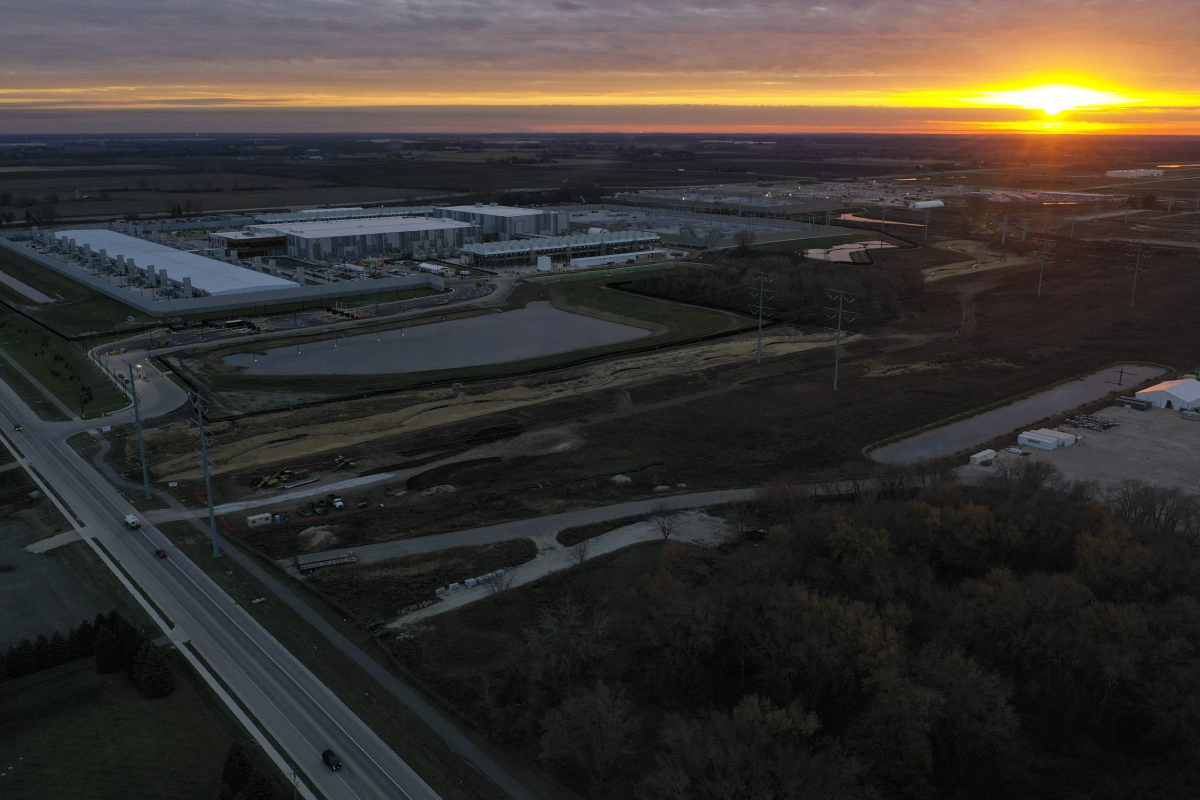
Microsoft’s new 15-year electric service contract for its Mount Pleasant data center includes a provision Wisconsin regulators previously rejected.
Signed last month, the agreement with We Energies specifies that power plants built or purchased to serve data centers must be located in eastern Wisconsin or Michigan’s Upper Peninsula. But Wisconsin’s Public Service Commission (PSC) voted in May to remove those geographic constraints, which critics argued would cut off Microsoft’s access to abundant wind power generated elsewhere in the Midwest and Great Plains.
We Energies says it will follow the commission’s order — as opposed to the contract’s language — while it works with the commission to resolve the discrepancy. In the meantime, some observers question how an outdated version of a high-stakes contract made it this far.
Where should data centers look for power?
The mismatch traces back to one of many disagreements that arose during the PSC’s deliberations on a new rate structure for large data center customers: Should those facilities rely on nearby plants alone or be free to tap energy sources elsewhere?
The PSC-approved rate structure allows large data center operators to “subscribe” to new power plants, picking up the bill for purchasing or constructing them in exchange for the right to use the electricity they generate and revenue from selling surplus electricity on the wholesale market.
We Energies argued that those plants should be located as close as possible to the data centers they would serve.
Longer distances would increase the risk of grid failures disrupting data center operations, WEC Energy Group Director of Planning Jody Arendt told the PSC in January. WEC Energy Group is We Energies’ holding company.
The local power plants would be within the territory of the American Transmission Company (ATC), a transmission utility in which We Energies owns a majority stake — a relationship that could simplify coordinating repairs and upgrades, Arendt said.
Ratepayer advocates and clean energy groups criticized the plan, arguing it would limit data centers’ access to wind energy.
Electricity generated by onshore wind farms is, by some measures, cheaper than electricity generated by new natural gas plants. The Midwest’s regional grid operator has approved billions of dollars in grid upgrades over the past five years, in part to streamline transmitting wind energy from regions with high winds to population centers and industrial hubs.
We Energies fully or partially owns a half-dozen planned and operational wind farms in Wisconsin, including the new Badger Hollow wind farm in Iowa and Grant counties. But neighboring states — especially Iowa and Minnesota — have far higher average wind speeds and generate vastly more wind power.
“Any Wisconsin customers should be able to benefit from lower cost resources like the wind profile in southern Minnesota,” Wisconsin Citizens Utility Board Executive Director Tom Content wrote in an email to Wisconsin Watch.
The PSC ultimately sided with CUB and clean energy groups, striking the location constraints from the data center rate structure it approved in May.
“Over-indexing on a smaller geographic area comes with its own risks,” said Commissioner Marcus Hawkins, adding that planned grid upgrades could resolve some of the challenges of powering data centers from afar.
Outdated contract
With the rate structure approved, We Energies sent Microsoft a contract to implement the new rate structure.
Microsoft asked the PSC in June to reopen the case, in part to address “multiple errors or inconsistencies” in We Energies’ contract — including the provision limiting new power plants to eastern Wisconsin and the Upper Peninsula.
We Energies offered to drop the line, among other “ministerial changes that could streamline or improve” the contract.
After the PSC declined to reopen the case, Microsoft signed the contract as-is on July 16. A Microsoft spokesperson declined to comment on the contract.
Because the commission “did not reopen their decision or take up these changes,” the utility still needs to work with the PSC to fix the contracts, We Energies spokesperson Brendan Conway wrote in an email. “We do not have a timeline for when the language will be updated.”
“From a practical perspective,” he added, Microsoft will be held to the PSC-approved rules, meaning it can subscribe to plants outside of eastern Wisconsin and the Upper Peninsula.
The companies are legally required to abide by the PSC’s terms, commission spokesperson Meghan Sovey-Lashua wrote in an email.
“To the degree there are conflicts” with the PSC’s order, Sovey-Lashua added, “there are procedural options” to bring the issue back to the commission for a resolution.
#wec-contract-map-embed {
width: 100%;
max-width: 1200px;
margin: 1.5rem auto;
}
#wec-contract-map-embed iframe {
display: block;
width: 100%;
height: 700px;
border: 0;
}
@media (max-width: 900px) {
#wec-contract-map-embed iframe {
height: 680px;
}
}
@media (max-width: 600px) {
#wec-contract-map-embed {
width: 100%;
margin: 1rem auto;
}
#wec-contract-map-embed iframe {
height: 760px;
}
}
Ratepayer advocates, meanwhile, wonder why We Energies asked Microsoft to sign an outdated version of the contract in the first place.
“There’s a basic and common-sense expectation that a utility’s filing would be revised to reflect changes the PSC made to a proposal,” Content wrote, “particularly for an issue that generated a fair amount of discussion during the seven-hour deliberation on this issue.”
Microsoft has already signed up to purchase electricity from the planned Red Oak Ridge Energy Center in Kenosha County. We Energies is currently asking the PSC for permission to buy the natural gas plant from developer Invenergy for $1.8 billion while Invenergy awaits PSC approval to build the plant.
This <a target=”_blank” href=”https://wisconsinwatch.org/2026/08/wisconsin-we-energies-microsoft-data-center-contract-terms-conflict-psc-regulators-electricity/”>article</a> first appeared on <a target=”_blank” href=”https://wisconsinwatch.org”>Wisconsin Watch</a> and is republished here under a <a target=”_blank” href=”https://creativecommons.org/licenses/by-nd/4.0/”>Creative Commons Attribution-NoDerivatives 4.0 International License</a>.<img src=”https://i0.wp.com/wisconsinwatch.org/wp-content/uploads/2021/02/cropped-WCIJ_IconOnly_FullColor_RGB-1.png?fit=150%2C150&quality=100&ssl=1″ style=”width:1em;height:1em;margin-left:10px;”>
<img id=”republication-tracker-tool-source” src=”https://wisconsinwatch.org/?republication-pixel=true&post=1319552&ga4=G-D2S69Y9TDB” style=”width:1px;height:1px;”><script> PARSELY = { autotrack: false, onload: function() { PARSELY.beacon.trackPageView({ url: “https://wisconsinwatch.org/2026/08/wisconsin-we-energies-microsoft-data-center-contract-terms-conflict-psc-regulators-electricity/”, urlref: window.location.href }); } } </script> <script id=”parsely-cfg” src=”//cdn.parsely.com/keys/wisconsinwatch.org/p.js”></script>
