


Grocery store shelves are bursting with fancy salts: Himalayan, kosher, sea salt and more. Considering these choices, it can be easy to forget about the public health victory found in basic, iodized table salt.
The nutrient iodine is a crucial component of thyroid hormones, necessary for fetal and early childhood brain development and health throughout life. At the start of the last century, iodine deficiency was a rampant and visible public health problem in the United States, with the telltale sign of enlarged thyroid glands, called goiters, especially prevalent in much of the north. A series of steps taken by a medical society in Michigan and U.S. salt producers brought iodized salt to tables across the country, and by the 1950s, occurrences of goiters had dropped precipitously.
But more recently, the United States appears to be backsliding on iodine nutrition. In 2017 and 2018, 24 percent of women and 30 percent of men, aged 14 and older, weren’t getting an adequate amount of the nutrient. That’s about twice as many as in 2001 and 2002, researchers reported in the Journal of Nutrition in 2025. Breaking the data down further, nearly half of pregnant women haven’t been getting enough iodine. The study reflects an estimated, short-term look at population iodine levels.
Long-term, a consistent dearth of iodine robs the body of the ability to produce sufficient amounts of thyroid hormones. If iodine levels in the population continue to trend down, that could eventually result in more goiters and harm brain development in children.
“The group that has the most severe potential consequences of iodine deficiency is pregnant women,” says Elizabeth Pearce, an endocrinologist at Boston University Chobanian & Avedisian School of Medicine. “Even mild degrees of iodine deficiency in pregnancy may be associated with measurably lower IQ in children.”
Yet women of reproductive age, at the U.S. population level, are on the cusp of mild iodine deficiency, the Centers for Disease Control and Prevention stated in its 2026 Nutrition Report.
With all of the ways that diets, salt intake and noniodized options have changed over time, the importance of iodine nutrition may not be top-of-mind for the general public like it was a century ago. “Iodine deficiency is the leading cause worldwide of preventable developmental delay,” says Monica Serrano-Gonzalez, a pediatric endocrinologist at Hasbro Children’s and Brown University’s Warren Alpert Medical School in Providence, R.I. “People have kind of forgotten this is a risk.”
The “goiter belt”
When iodine deficiency keeps the thyroid gland from making enough hormones, the body calls for more, which stimulates and enlarges the gland. That supersized gland, called a goiter, bulges at the neck. In the United States, goiters were extremely common a century ago in the Northwest, Great Lakes and Appalachians; together, the area became known as the “goiter belt.” Iodine naturally occurs in seawater and soil. But in the noncoastal northern part of the country, soils and water sources have little iodine, so the crops produced in these inland areas lack the nutrient.
An examining physician for the World War I draft reported in 1918 that 30 percent of almost 600 men from a northern Michigan county had goiters, some large enough to be disqualifying. A 1922 Michigan Department of Health study of schoolchildren in four counties revealed that close to 50 percent had goiters. “It would have been a really visible public health problem at that time,” Pearce says.
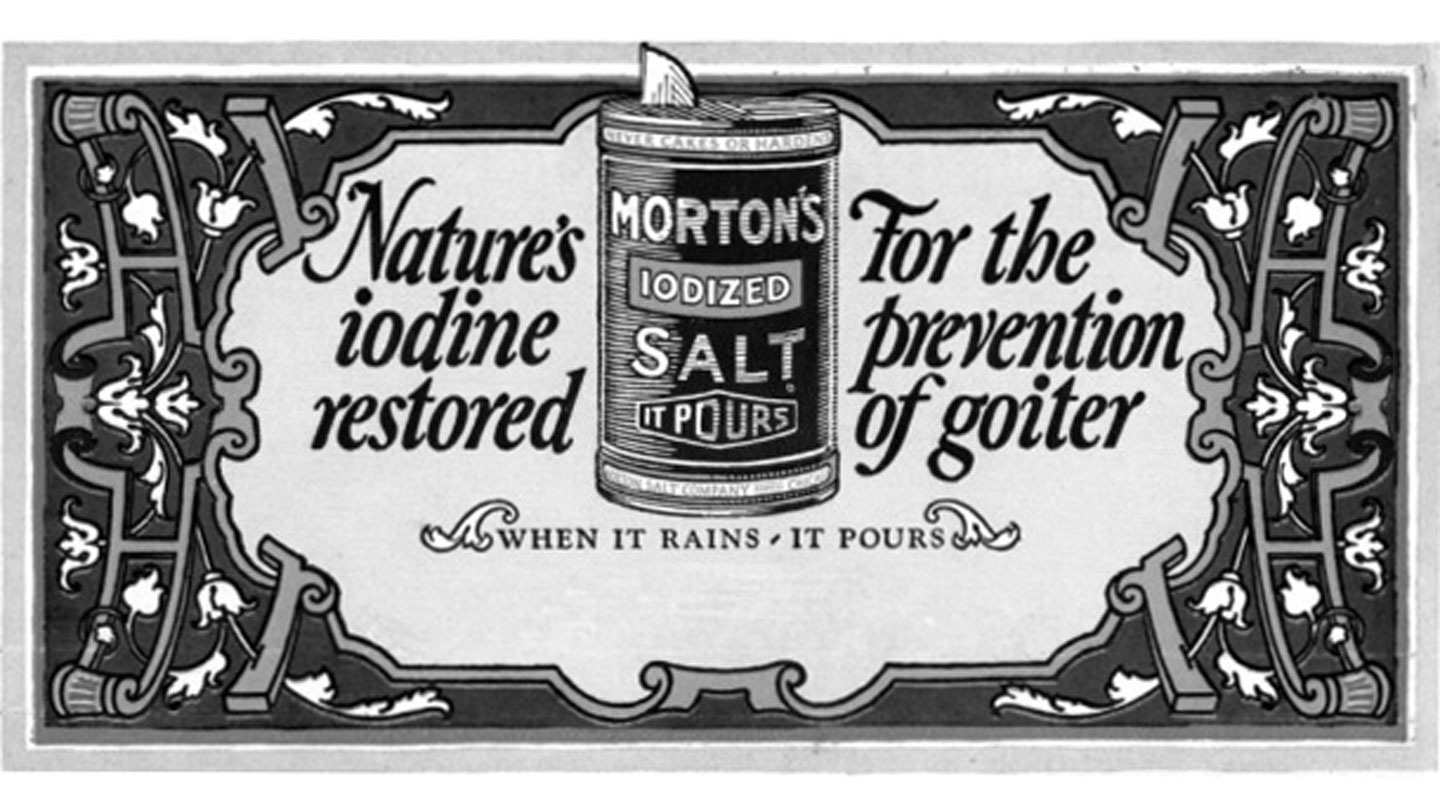
In response to the state’s iodine issues, the Michigan State Medical Society recommended the addition of the nutrient to table salt. The minimal expense for iodization meant this common kitchen staple would remain affordable. Companies introduced iodized salt in Michigan in the spring of 1924. By the fall, the Morton Salt Company, a major producer, was selling iodized salt nationwide. Over time, the goiters of the “belt” dwindled.
Salt iodization has been linked to rising IQ in the United States. For example, for men born in areas without natural sources of iodine, there was a significant jump in World War II Air Force acceptances, based on a qualifying exam, after widespread salt iodization. The increase did not occur among men born in areas with adequate natural sources of the nutrient, researchers reported in the Journal of the European Economic Association in 2017.
Adding iodine to salt was never mandated by the U.S. government. But for a long time, the voluntary approach — combined with how most people consumed salt and other dietary habits — did the trick to get people enough iodine. Today, different meal practices and available food options are tearing holes in the iodine safety net. “Iodized salt is important, but it may not be reaching everybody anymore,” Pearce says.
There are many more noniodized salt options today, with one analysis reporting that only 53 percent of table salt sold in U.S. stores is iodized. People get much of their salt from prepared, processed and packaged foods, which generally are made with noniodized salt. Milk can provide iodine, due to iodine-supplemented feed and the use of an iodine cleanser on cows’ udders. But the amount of iodine in milk can vary greatly, a recent analysis found, probably because industry practices can differ. Diets that restrict dairy may also put people at risk of consuming too little iodine.
The U.S. recommended dietary allowance for iodine for adults is 150 micrograms per day, which rises to 220 mcg for pregnant people and 290 mcg for those breastfeeding. The amount of the nutrient that iodized salt contains can vary, but will be listed on the container’s label. Based on a 2023 federal report on food iodine content, one teaspoon of salt has around 300 mcg of added iodine. (The American Heart Association recommends a limit of 2,300 milligrams of sodium per day; one teaspoon of salt has 2,400 mg of sodium.)
The American Thyroid Association and the American Academy of Pediatrics recommend that pregnant and breastfeeding people, as well as those planning to become pregnant, take a daily supplement with 150 micrograms of iodine. Sufficient iodine is especially important in the first trimester of pregnancy, when a developing embryo relies solely on the mother’s supply.
When choosing table salt, “look for salt that’s iodized,” Pearce says. For people on a low-salt diet, it’s better to cut out packaged and prepared foods, Serrano-Gonzalez says. “We do want to have moderation with salt intake, but we need a little bit” of iodized salt, she says.
The consequences of too little iodine
People have largely forgotten why it’s important to choose iodized salt, Pearce says. It’s not a decision that many people have to make globally: One hundred and twenty-six countries mandate salt iodization, while only 21 have voluntary polices.
An observational study of an iodine crisis in Ethiopia indicates the catastrophic consequences of losing the nutrient. The country adopted a salt iodization policy in the 1990s, and by 1995, 80 percent of households reported using iodized salt. But the country’s stock came from Eritrea, and in 1998, a conflict between the two countries closed the border and interrupted the supply of iodized salt. By 2005, the Ethiopian population was severely iodine deficient, with up to 40 percent of school-aged children and 36 percent of women of reproductive age developing goiters. Ethiopia’s government was able to reinstate mandatory salt iodization in 2012, and household coverage climbed to 85 percent by 2015.
But the severe iodine disruption during the war had a devastating effect on the children born and raised in that period. In rural areas, which had very low soil iodine levels, mortality among children in the first two years of life reached 25 to 30 percent, compared with 10 percent in other areas, researchers reported in Nature Food in September. The children from rural areas who reached secondary school scored lower on national exams. The study team took other effects of the conflict into account, to focus on the impact of the iodine nutrition emergency.
In the United States, the worst manifestation of iodine deficiency was the long ago “goiter belt.” “There needs to be public health education,” Pearce says, “so people understand again what the dangers are if we don’t have adequate iodine nutrition, and how to just ensure that they’re protected.”
