


Unlock the Editor’s Digest for free
Roula Khalaf, Editor of the FT, selects her favourite stories in this weekly newsletter.
The Ultimate Fighting Championship is looking to build on its presence in China as the combat sport beloved of US President Donald Trump hosted a record-breaking fight night in the country.
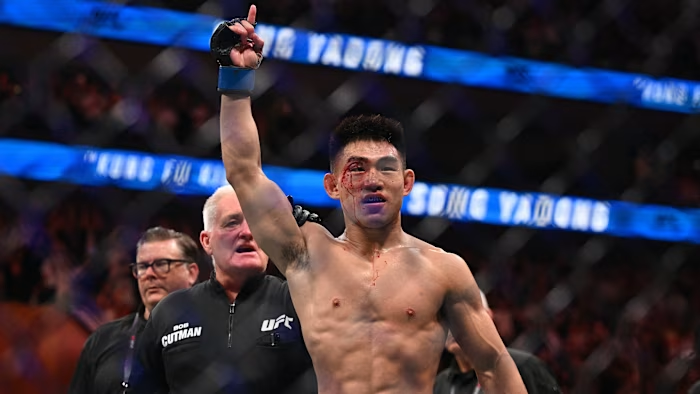
More than 16,000 fans attended last weekend’s UFC event in Shanghai — more than any previously held in China — to witness a surprise knockout victory for homegrown bantamweight Song Yadong.
The UFC, which held its first mainland China event in 2017, returned to Shanghai last year after a Covid-19-related pause. It is now betting its audience will grow in a country with a long history of martial arts, from the kung fu popularised globally by Bruce Lee to Sanda, a variety of kickboxing.
“We’re making our way back, and our intention is certainly to have this consistent presence and schedule as far as events are concerned,” said Kevin Chang, vice-president and head of Asia for UFC, who added the sport was “re-establishing that mission” in China.
“We just have a lot more to talk about these days.”
The Las Vegas-headquartered UFC, part of TKO Group Holdings, is often associated domestically with America’s Maga movement, and held a special event on the lawn of the White House in June attended by Trump.
But the promotion company — which has a broad global footprint from Brazil to the Middle East — has sought to carve out a bigger role in China, home to a vast viewership market where global sports from Formula 1 to golf have made inroads.
The UFC launched a 92,000 sq ft Performance Institute in Shanghai in 2019 — the first to be opened outside of Las Vegas — and now has 20 fighters from the country among its roster of hundreds of athletes, around half of whom are from outside the US.
“Our goal is to really see the proliferation of Asian martial arts and Chinese mixed martial artists, you know, succeed in the UFC,” said Chang.
Song, a 28-year-old from Harbin in northern China, was greeted with a deafening roar by the Shanghai crowd on his entry to the ring last weekend, only for the decibel count to be surpassed minutes later as he knocked out odds-on favourite Umar Nurmagomedov of Russia in the second round.

“I only want to say three words: hai you shei [who else]?” Song exclaimed into the microphone following jubilant celebrations in the Shanghai arena that capped off days of events.
Zhang Weili, a female fighter in the strawweight division, became the first Chinese champion in the UFC in 2019. Her victory marked a “turning point” in China, said Chang, who added that the sport had 18mn followers on social media in the country.
“Our thesis, and I don’t think that’s rocket science, is proven by Yao Ming,” he said, referring to the Chinese basketball player whose NBA success spurred the sport’s development in the 2000s.
“You do need that local star in order to build around,” he added. “You need that to become relevant and mainstream in a market.”
Ian Moore, an analyst at Bernstein, said: “China remains a key market that appears to still be underserved — especially if Song Yadong can continue his path towards potentially becoming the second ever Chinese UFC champion.”
He added that the local media rights fees “could see a sizeable future step-up in five years as the sport’s domestic fan base continues to grow”.
The UFC in March renewed until 2031 a relationship with Migu, part of China Mobile, to be the exclusive distributor for live events in Greater China.
TKO Group Holdings, which owns both the UFC and wrestling promotion company WWE, had net income of $546mn last year on revenues of $4.7bn. The company’s chief executive, Ari Emanuel, is the brother of prominent Democrat and former ambassador to Japan Rahm Emanuel.
Additional reporting by Samuel Agini in London
