


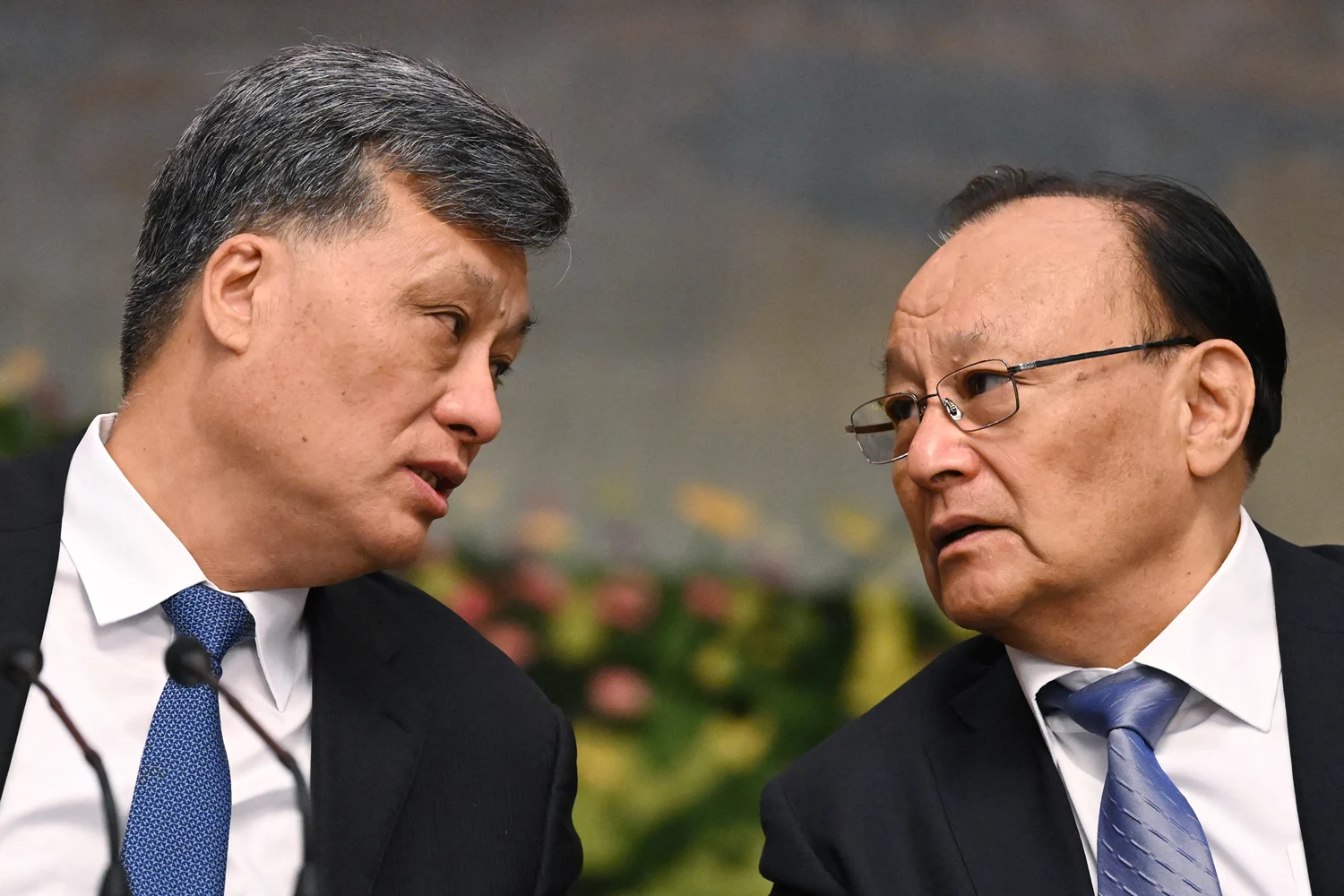
Ma Xingrui’s rise inside the Chinese Communist Party (CCP) took 38 years. His fall took about six months. After he disappeared from public view last November, an investigation into Ma was formally announced on April 3, and three months later he was dismissed from the party with a long list of charges. For a high-flying Politburo member whose career spanned the defense and aerospace establishment, Guangdong, and Xinjiang, the case was handled with remarkable speed.
When an ordinary official becomes corrupt, the problem can be attributed to personal character. But when an official who has passed through layer after layer of screening, been entrusted with one of the country’s most politically sensitive regions, and been elevated to the Politburo spends years operating an extensive family corruption network, the failure lies not only with the individual. It lies with the systems used to identify, promote, and supervise senior officials.
Ma Xingrui’s rise inside the Chinese Communist Party (CCP) took 38 years. His fall took about six months. After he disappeared from public view last November, an investigation into Ma was formally announced on April 3, and three months later he was dismissed from the party with a long list of charges. For a high-flying Politburo member whose career spanned the defense and aerospace establishment, Guangdong, and Xinjiang, the case was handled with remarkable speed.
When an ordinary official becomes corrupt, the problem can be attributed to personal character. But when an official who has passed through layer after layer of screening, been entrusted with one of the country’s most politically sensitive regions, and been elevated to the Politburo spends years operating an extensive family corruption network, the failure lies not only with the individual. It lies with the systems used to identify, promote, and supervise senior officials.
Reading dismissal notices depends on a careful understanding of the fixed phrases used and what it means to deviate from them. Ma’s notice provides us with a couple of interesting clues as to why he fell. The first is the charge that Ma “engaged extensively in family-based corruption.” In previous cases involving fallen senior officials, disciplinary notices often stated that they had failed to discipline or educate their spouses and children or had allowed relatives to profit from their influence. Such wording left at least some room to suggest that the official himself might not have participated directly.
The notice on Ma leaves no such room. It explicitly states that he “conspired with” relatives and close associates to accept enormous sums of money. The phrase “conspired with” indicates that he was not merely a passive enabler of corruption by family members but a direct participant in the network of interests and was very likely the center of power around which it operated. This also confirms earlier rumors that Ma’s wife had been deeply involved in corrupt dealings.
The second notable phrase is “members of his personal staff.” This suggests that the network surrounding Ma extended beyond his family to include secretaries, office personnel, or longtime subordinates. His relatives received the benefits, his aides connected private interests to political power, and business deals, construction projects, and official promotions became channels through which that power was monetized. This was not a matter of accepting money once or twice. It was a corruption mechanism built around Ma’s office.
What’s missing from the accusations is also important. Although the notice uses harsh political language, it does not accuse Ma of “forming cliques,” harboring “inflated political ambitions,” being “disloyal and dishonest toward the party,” or “undermining the party’s unity.” These are the formulations normally associated with political factions or organized political disloyalty.
There is therefore no need, at least for now, to form theories that Ma plotted against President Xi Jinping. The accusation that he had “lost his political position” is better understood as the political characterization of serious corruption by a Politburo member. At its core, Ma’s case remains one of systemic corruption combining political power, money, and family interests.
The real question, however, is not how much money Ma accepted or exactly how his relatives operated on his behalf. It is this: How was a Politburo member regarded as politically reliable and professionally capable—and screened through the CCP’s strictest system of cadre vetting—able to operate such an extensive family corruption network for so long?
Ma was not an ordinary local official who climbed the political ladder through regional connections. He was a talented technocrat who emerged from China’s aerospace and defense establishment and had a strong scientific background. He served as party secretary of Shenzhen and governor of Guangdong before being transferred to Xinjiang and eventually elevated to the Politburo.
Being placed in charge of Xinjiang was itself evidence that China’s top leadership had judged him to be highly reliable politically. Xinjiang is not an ordinary province. Its top official must not only possess administrative competence but also be regarded as absolutely politically dependable. Ma’s appointment indicated that he had passed the most rigorous political screening available within the CCP’s cadre system.
But that’s exactly the problem. Under Xi, political loyalty has been given overriding importance in the selection of senior officials. But Xi has no insight into his underlings’ souls. He judges that loyalty through public declarations, policy execution, obedience, and political posture. Whether an official firmly upholds the party’s “core,” remains aligned with the central leadership on major issues, and successfully carries out tasks assigned by Beijing has become the principal measure of political reliability.
The concentration on loyalty distracts from more important questions: How does that official actually use power? Are family members or staff profiting from his position? Those questions need to be answered by research and investigation, not political performance. An official can display absolute loyalty in public and implement policy without hesitation while simultaneously converting political authority into a source of private and family wealth.
Indeed, the more skillful an official is at expressing loyalty and demonstrating obedience, the more likely he is to win the trust of his superiors. Once he has secured the confidence of the top leadership, oversight is likely to weaken.
In a highly centralized personnel system, the party’s organization departments, disciplinary authorities, and local leadership teams must first defer to the central leadership’s judgment—especially Xi himself—about a particular official. His subordinates may see him making backroom deals or his family members getting rich off the public purse, but they won’t dare to question a leadership favorite.
The CCP maintains one of the largest and most elaborate cadre evaluation systems in the world. Every promotion involves reviews of personnel files, internal assessments, interviews, personal disclosure reports, inspections, and audits.
Yet while the system may be able to establish an official’s career history, family relationships, and political declarations, it is far less capable of identifying how he actually exercises power. Both the vetting process and the information on which it relies remain entirely within the party organization. Colleagues do not wish to offend one another. Subordinates are afraid to report their superiors. Local officials are even less likely to expose a rising political star. The procedures may appear rigorous, but the most critical information may never enter the process at all.
Xi’s high-pressure anti-corruption campaign has not solved this problem. Ma is accused of having refused to restrain himself even after the CCP’s 18th National Congress in 2012, which means that much of his misconduct occurred during the period when Xi’s anti-corruption drive was at its most intense.
This shows that an aggressive campaign can quickly uncover wrongdoing once the political leadership has decided who to investigate. But it can’t ensure the wrongdoing will be discovered before the leadership makes that decision.
It is a powerful mechanism of punishment after the fact but not an effective system of routine oversight. Without an independent media, public disclosure of officials’ assets, or institutional forces genuinely capable of constraining senior officials, even the most frequent party inspections must depend on internal information and the will of the top leadership.
In a personalized system of cadre selection, the more an official is trusted by the paramount leader, the more likely he is to become a blind spot in the system of supervision. To discredit such an official is, to some extent, also to discredit the leadership’s earlier personnel judgment.
As long as the top leadership’s attitude remains unchanged, institutions below it are usually able only to continue demonstrating that the official in question is “politically sound and professionally capable.” Only when that trust suddenly disappears do previously suppressed or ignored problems erupt all at once.
Thus, someone held up yesterday as a model of political reliability can become today a corrupt official who has “completely betrayed the principles of party character.”
The more reliable Ma was once considered, the greater the institutional irony of his downfall.
His case demonstrates with brutal clarity that political loyalty cannot substitute for institutional oversight and that the personal trust of the top leadership cannot serve as proof of integrity. Xi has constructed a system of cadre selection centered on loyalty, but he cannot ensure that those selected will not turn that trust into a protective shield.
