


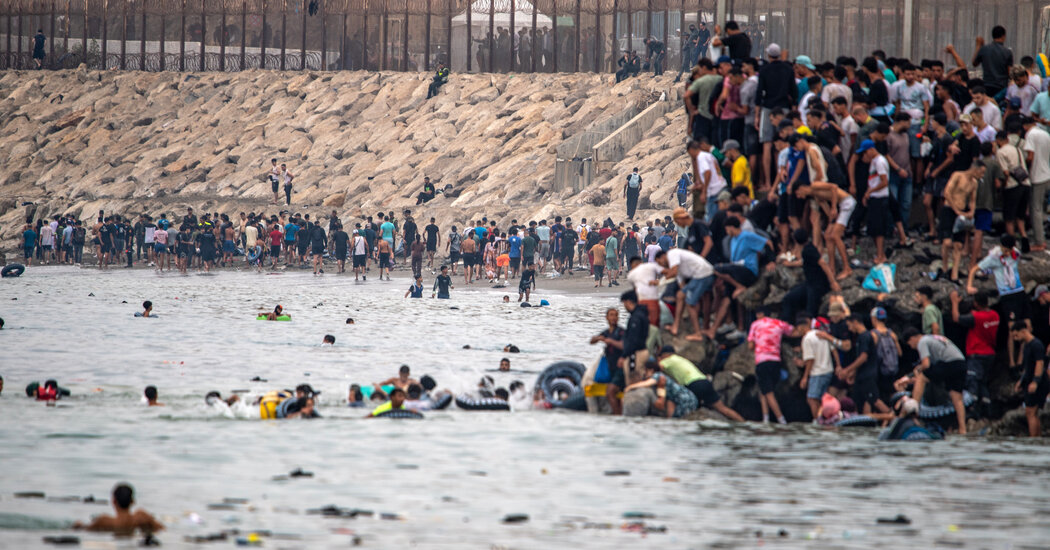
As many as 60,000 migrants entered a small Spanish territory alongside Morocco on Thursday and Friday, according to Spanish authorities. Although at least 48,300 had returned to Morocco by Friday afternoon, the mass crossing prompted an immediate backlash from far-right politicians in Europe that seemed poised to linger.
Scenes of chaos in Ceuta (pronounced say-YOU-tah), the North African exclave that Spain has held for centuries, splashed across news networks and social media. Juan Jesús Vivas, the head of Ceuta’s government, said that nearly three dozen migrants had died in attempting the crossing and called the situation “absolutely unsustainable” in a territory with about 83,000 residents. Local authorities said they had no operation in place to feed or shelter migrants who remained in Ceuta. Many said they hadn’t eaten in nearly two days.
But the surge was quickly seized upon by Europe’s right-wing political parties as well as by members of the Trump administration. They criticized Spain’s prime minister, Pedro Sánchez, who has cast himself as a pro-immigration liberal whose government announced a law allowing more than a million unauthorized migrants to apply to formalize their status.
He has emerged as Europe’s most prominent critic of the Trump administration’s hard line against migrants.
Mr. Sánchez arrived in Ceuta on Friday to address what his conservative opponents have called an invasion of Spanish soil. He said his government would deploy buoys at a sea wall where many of the migrants had crossed. Spain’s Supreme Court recently ruled that a migrant intercepted at sea could not be immediately sent back unless they had bypassed a barrier while attempting to reach Spanish territory. The buoys would help establish such a barrier, Mr. Sánchez said.
Ceuta and another Spanish exclave in Morocco, Melilla, are part of both the European Union and the Schengen Area, which allows freedom of movement among member states. But the two cities operate under a special exemption that restricts onward travel to mainland Spain and the rest of the bloc. So far, no onward movements have taken place from Ceuta to mainland Spain or other E.U. member states, a senior E.U. official said on Friday afternoon.
Nevertheless, the French interior minister said he had issued orders to “immediately step up controls at the Spanish border,” and Italy was considering the suspension of an agreement with Spain that permits free movement between the two countries.
Migrants began crossing into Ceuta in large numbers on Thursday. They climbed over border fences or swam, sometimes for hours, to its shores.
On Friday, hundreds if not thousands of young men were lingering on the beach in Ceuta, some carrying satchels and plastic bags. “You ask why everyone came — because there’s no work in Morocco,” said Ajoub el-Arrot, 24, a Moroccan arrival.
Several people said they had been encouraged to enter Ceuta by the Moroccan authorities. “They just kept saying, ‘Go that way, go that way,’” said Youssef Alaoui, 26, referring to police officers who he said pointed them in the right direction. He swam across the maritime border, he said, and saw several dead bodies in the water.
In recent years, as Morocco became a key staging ground for migrants seeking to reach Europe, Spain has depended on Moroccan border guards to prevent arrivals. Tensions grew in the past when Morocco appeared to let more migrants move toward Ceuta, as a way to exert political pressure on Spain. In 2021, more than 10,000 people crossed into Ceuta in two days.
Here’s what else we’re covering:
-
Military response: The Spanish government on Thursday evening said it had mobilized the armed forces to reinforce the severely overwhelmed police in Ceuta.
-
Far right response: Europe’s anti-immigrant politicians blamed Spain’s migrant-friendly policies. Read more >
Carlos Barragán, Aida Alami, Elisabetta Povoledo, Ségolène Le Stradic and Lynsey Chutel contributed reporting.
