


- A new experiment found that sitting in a restored urban forest while listening to birdsong lowered people’s stress and improved their mood more than any other setting tested.
- Researchers had 106 students at North Carolina State University in the U.S. sit in either a restored forest or a paved plaza while hearing birdsong or traffic noise, isolating the effects of place and sound.
- Both the natural setting and the birdsong helped independently, and the benefits were largest when combined.
- The forest was a human-made restoration completed in 2006, suggesting cities could build mental-health benefits into parks rather than relying on remote wilderness.
Sitting in a small, restored forest while listening to birdsong lowered people’s stress and lifted their mood in the moment, according to a recent study published in the journal Environmental Conservation.
Researchers asked 106 students at North Carolina State University in the U.S. to sit outdoors in noise-canceling headphones at two spots on campus: A strip of riparian forest restored two decades ago and a paved plaza facing a road intersection. At each location, participants listened to 10 minutes of birdsong and 10 minutes of traffic noise, in random order, then rated their stress, their positive and negative feelings, and how mentally restored they felt.
The design, swapping both the place and the soundtrack, let the researchers separate the effect of where someone sits from what they hear. Both mattered, and their effects stacked. Participants in the forest hearing birdsong reported an average stress score of 3.2 on an 11-point scale, compared with 6.4 for those on the plaza hearing traffic.
The forest-and-birdsong pairing also produced the highest positive emotion and the strongest sense of restoration. The two mismatched conditions (forest with traffic, plaza with birdsong) landed in between, better than the plaza-and-traffic combination but short of the full effect.
“For participants who were in a green space listening to the birds, there were significant effects. Positive emotions went up, negative emotions went down, stress went down, and perceptions of feeling restored went up more than any other combination,” study lead author Nils Peterson, a professor in NC State’s College of Natural Resources, said in a press release. The reverse held for people on the plaza hearing traffic.
However, for mental restoration, the physical setting mattered more than the soundtrack. The forest did more of the work than the birdsong did. The authors suggest that this may partly reflect the scale they used to measure restoration, which leans on how people perceive a place and may nudge them toward its visual features. For stress and for positive and negative emotion, sound and setting carried roughly equal weight.
Cindy Frantz, an environmental psychologist who chairs the psychology department at Oberlin College in the U.S. state of Ohio and was not involved in the research, said the value of a study like this is that it reproduces laboratory findings in a real-world setting. She cautioned against reading too much into a single result, which cannot show how long the effects last, whether people grow used to them, or whether everyone benefits equally.
Still, Frantz told Mongabay, the effects were notably large. “The impact of natural environments and birdsong are not tiny ‘around the margins’ results,” she said. “Effect sizes this large suggest that the impacts they observed are likely to make a difference in people’s lived experiences.
The forest used in the study is not old growth but a restoration completed in 2006, re-engineered from a degraded urban creek and now carrying more than 70% canopy cover, wedged inside a working college campus. That a relatively young, human-made patch of forest produced the full effect suggests the benefits could be rebuilt into city parks with strategically placed seating and the bird communities to fill them, rather than requiring access to remote wilderness.
“Designing outdoor spaces with birds in mind is not just a ‘tree-hugger’ priority, but also sensible public health policy,” Frantz said.

The result adds to a growing body of research linking bird sounds to better mental health. Eleanor Ratcliffe, an environmental psychologist at the University of Surrey in England whose work the NC State team cites, has found that bird sounds can restore attention and ease stress. However, the effect depends on the species, the sound and the listener. Quiet, melodic, complex songs tend to soothe, while loud or harsh calls, like a magpie’s, can grate. Whether birdsong helps at all, her work suggests, hinges partly on what a listener associates with it, meaning any therapeutic use would need to be tailored rather than applied wholesale.
Researchers offer two main explanations for why nature, and birdsong in particular, calms people. Birdsong signals that an environment is alive and, by implication, safe, an all-clear that a silent landscape does not give. The other is that built environments demand a certain kind of focus to tune out noise like traffic. Nature may offer respite, letting a person’s capacity for attention recover.
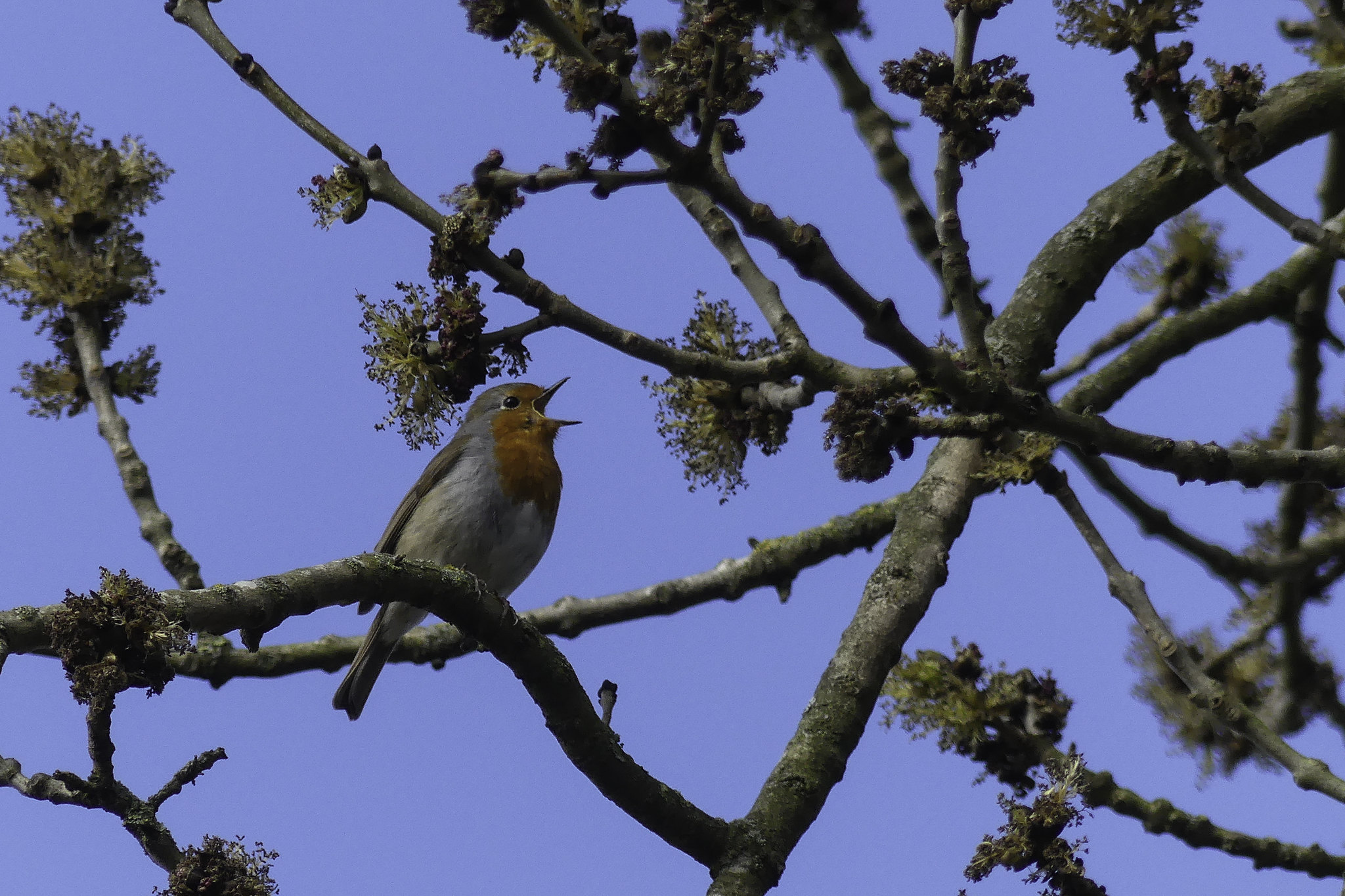
Banner image of robin singing by saxman1597 via Flikr (CC BY-SA 4.0).
Once lost, now found: Five “missing” bird species rediscovered in 2025, offering hope
Citation:
Peterson, N., Larson, L. R., Ford, T., DeMay, P., Swartz, F., Kluttz, J. D., … and Burke, C. J. (2026). Both restored forest and birdsong promote psychological well-being. Environmental Conservation, 1-9. doi:10.1017/S0376892926100484
Cite this article
Liz Kimbrough (2026). Listening to birdsong in a forest lowered a person’s stress during experiment. Mongabay Conservation news. DOI: https://doi.org/10.66709/news-324625

