


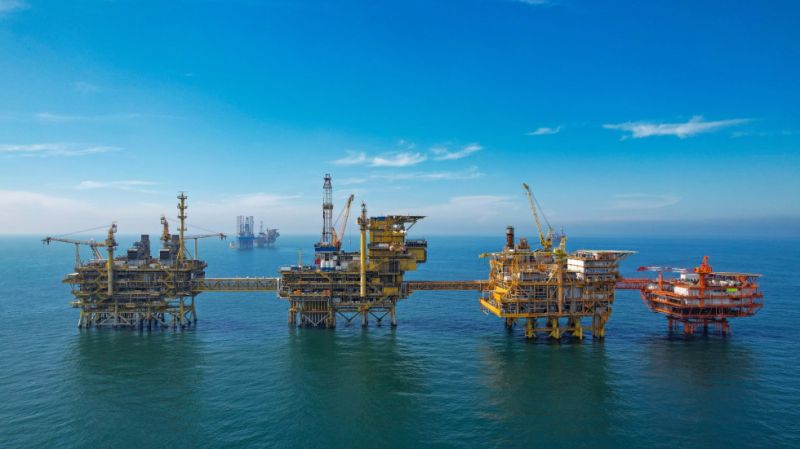
Chinese state-owned oil and gas giant China National Offshore Oil Corporation (CNOOC) and its partner, the U.S.-headquartered energy firm ConocoPhillips, have brought online the next expansion segment at an existing oilfield off the coast of China, enabling the project to be home to 19 offshore platforms and a floating production, storage, and offloading (FPSO) vessel.
According to ConocoPhillips, Bohai Phase 5 is now fully online, adding two new wellhead platforms, four platform expansions, and 91 wells to the CNOOC-operated Penglai field in Block 11/05 of Bohai Bay in the south-central Bohai Sea at an average water depth of 30 meters.
“The momentum continues with the recent successful installation of the Penglai Power from Shore electrical power platform, as part of China’s largest and highest-voltage offshore electrification project,” elaborated the U.S. firm.
The project, equipped with a 220-kV power system, will enable grid power to support safer, more reliable offshore operations. The Penglai oilfield was discovered in 1999. CNOOC has a 51% operating interest, and ConocoPhillips China holds the remaining 49% stake.
The U.S. company claims that this field has grown into one of China’s largest offshore oilfields, encompassing 19 offshore platforms, an FPSO unit, and more than 70 kilometers of subsea pipelines. The start of the Penglai Offshore Windfarm Pilot project was disclosed in November 2022.
This move was announced as a joint low-carbon energy development effort, enabling the harnessing of wind energy to supply power to the Penglai oilfield through four wind turbines with a total installed capacity of 34 MW.
The wind farm was tied back to the central processing platform via subsea cables, distributing energy to the field’s power grid. At full capacity, the windfarm’s potential was to cover over 30% of the power needed for the oilfield’s operations and achieve tens of thousands of tons of annual CO2 reductions.
The partners were also evaluating opportunities in power from shore, as well as carbon capture and storage (CCS) and carbon capture, utilization, and storage (CCUS) to help decarbonize the field in line with the Asian country’s energy, sustainable development and carbon neutrality goals.
CNOOC is actively drilling to discover more hydrocarbons, as demonstrated by the Qinhuangdao 29-6 oilfield discovery in the shallow Neogene formations of the Bohai Sea, adding over 100 million tons of oil equivalent in place.

Power Your Brand With Offshore Energy ⤵️
Take the spotlight and anchor your brand in the heart of the offshore world!
Join us for a bigger impact and amplify your presence at the core hub of the offshore energy community!
