

Close Menu
NCIJ Network NCIJ Network
    What's Hot

    26 Amazon Prime Perks You Might Know You Have (2026)

    September 18, 2026

    Can You Prove a New CVE Is Exploitable Before Attackers Do? Learn How in This Webinar

    September 18, 2026

    US Sanctions Iran’s BitBank Over IRGC Bitcoin Transfers

    September 18, 2026
    Facebook X (Twitter) Instagram
    Trending
    • 26 Amazon Prime Perks You Might Know You Have (2026)
    • Can You Prove a New CVE Is Exploitable Before Attackers Do? Learn How in This Webinar
    • US Sanctions Iran’s BitBank Over IRGC Bitcoin Transfers
    • JWST’s mysterious little red dots may be black holes growing at incredible speeds
    • In Southeast Asia, residents grapple with life under Indonesia’s wildfire haze
    • Dear Ed Sheeran, fence-sitting is so last century: musicians can no longer opt out of politics | Zoe Williams
    • Legal observer said she saw forklift repeatedly hit Kennedy Center pillars
    • Syria warns Israel poses ‘the greatest threat’ to Middle East stability | Conflict News
    • About
      • Our Team
      • Editorial Policy
      • Editorial Independence
      • International Support
    • Trust & Standards
      • AI Usage Policy
      • Conflict of Interest Policy
      • Corrections Policy
      • Ethics Policy
      • Fact-Checking Policy
      • Source Protection
    • Get Involved
      • Guide for Sources
      • Support Independent Journalism
    • Legal
      • Cookie Policy
      • Privacy Policy
      • Terms of Use
    Facebook X (Twitter) Instagram
    NCIJ Network NCIJ Network
    Friday, September 18
    • Home
    • World
    • Ai
    • Business
    • Politics
    • Health
    • Crypto
    • Science
    • Technology
    • Cybersecurity
    • Defense & Security
    • Economy
    • Energy
    • Europe
    • More
      • Fact Check
      • Investigations
      • Opinion & Analysis
      • Environment
    NCIJ Network NCIJ Network
    Home»Science

    JWST’s mysterious little red dots may be black holes growing at incredible speeds

    NCIJ NETWNCIJ NETWORKBy NCIJ NETWNCIJ NETWORKSeptember 18, 2026 Science No Comments4 Mins Read
    Share
    Facebook Twitter LinkedIn Pinterest Email

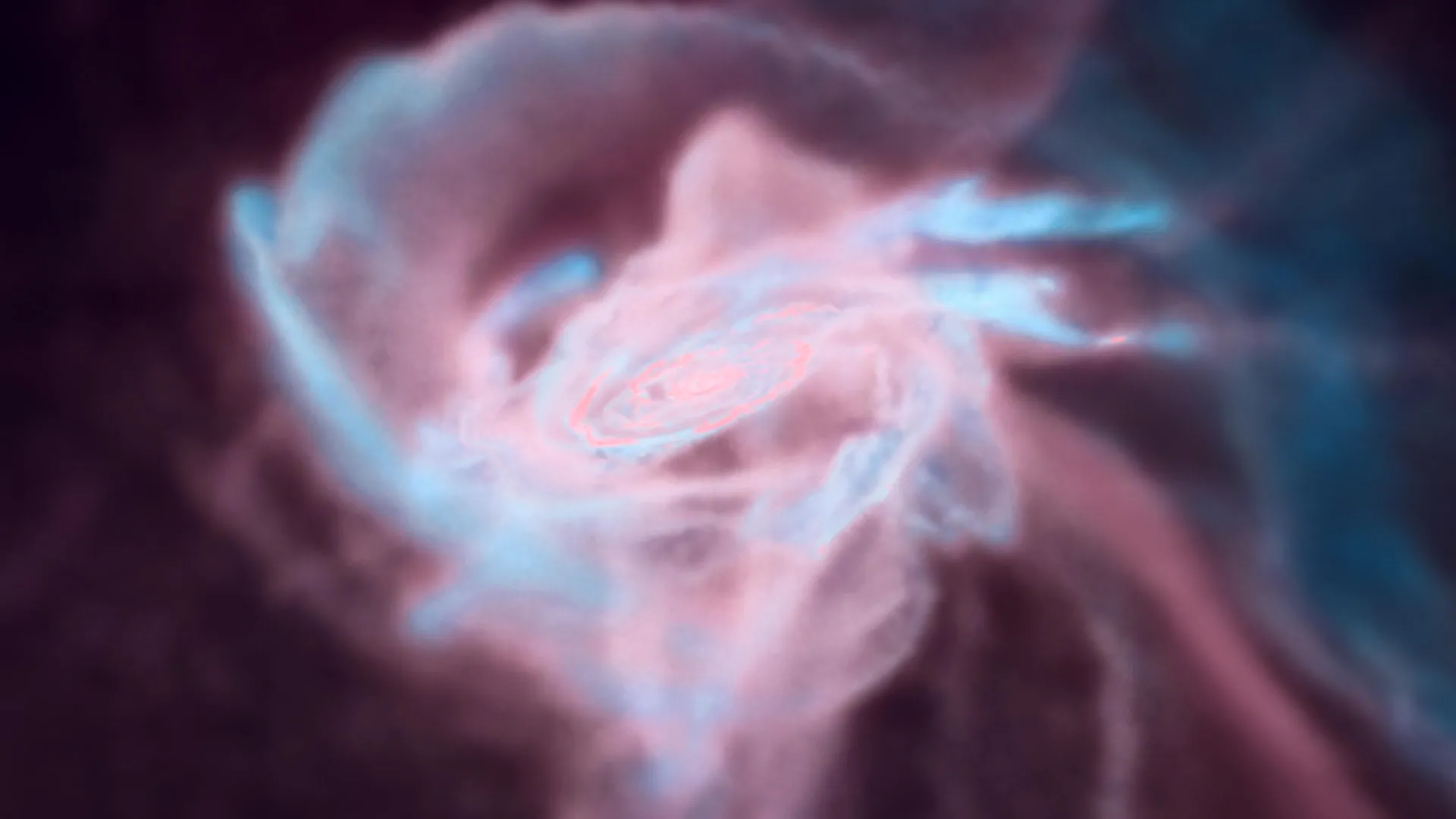
    Among the many surprises uncovered by the James Webb Space Telescope, one of the strangest has been a large population of tiny, intensely red objects known as Little Red Dots. Their true nature has remained unclear. Now, new simulations performed with Japan’s ATERUI III supercomputer suggest these objects may be rapidly growing black holes that took advantage of conditions in the early Universe that no longer exist today.

    The findings do not require unusual physics or highly unlikely events. Instead, the simulations indicate that Little Red Dots could arise naturally from the environment of the young cosmos, where black holes were able to grow at extraordinary rates.

    Simulating the Early Universe

    The research was led by Sunmyon Chon of the Max Planck Institute for Astrophysics. The team used the ATERUI III supercomputer at the National Astronomical Observatory of Japan to carry out some of the most detailed cosmological simulations yet of the early Universe.

    The simulations began on the scale of a young galaxy and then progressively focused on smaller regions, eventually reaching individual clouds of gas. This demanding approach required the high-resolution computing power of ATERUI III.

    The results suggest that intense far-ultraviolet (FUV) radiation from nearby galaxies can prevent ordinary stars from forming inside some gas clouds. Instead of breaking apart into many smaller stars, the gas can collapse into a single supermassive star.

    That enormous star can then collapse and create a black hole seed.

    Black Holes Growing at Extreme Speeds

    Once these black hole seeds form, the simulations show that they can become surrounded by thick disks of dense gas. These gas-rich environments trap radiation and allow the black holes to consume material much more efficiently than black holes can in the modern Universe.

    Under these conditions, the black holes can grow dozens of times faster than would be possible today.

    The properties of these simulated black holes closely resemble the Little Red Dots (LRDs) observed by the James Webb Space Telescope (JWST). That similarity suggests the mysterious red objects could represent an early stage of extremely rapid black hole growth.

    A Longstanding Black Hole Mystery

    Astronomers have struggled for years to explain how supermassive black holes appeared so early in cosmic history. Some of these black holes contain millions or even billions of times the mass of the Sun, yet they already existed less than 600 million years after the Big Bang.

    JWST was expected to help solve this puzzle by detecting fainter and more distant galaxies than previous telescopes could see.

    Because light moves at a finite speed, observing very distant objects also means looking into the past. If a galaxy is 11 billion light-years away, its light has traveled for 11 billion years before reaching Earth. What we see is therefore the galaxy as it appeared 11 billion years ago. The same principle applies to a galaxy 12 billion light-years away, whose light is 12 billion years old.

    JWST can peer farther back in time than earlier observatories, giving astronomers an unprecedented view of the young Universe.

    Little Red Dots May Hold the Answer

    Instead of immediately resolving the mystery of early black hole growth, JWST revealed something unexpected: a large population of tiny, extremely red objects that researchers began calling Little Red Dots (LRDs).

    The new simulations suggest those objects may actually be the missing piece of the puzzle.

    According to the model, the conditions needed to create and rapidly grow these black holes developed naturally in the early Universe. No exotic assumptions or rare coincidences were necessary. That could also help explain why Little Red Dots appear to be so common in JWST observations.

    As JWST continues finding more LRDs and future telescopes look even deeper into cosmic history, this model could give astronomers a valuable framework for understanding how some of the Universe’s earliest black holes formed, grew, and helped shape the evolution of the cosmos.

    Black dots growing holes incredible JWSTs mysterious Red speeds
    NCIJ NETWNCIJ NETWORK
    • Website

    Keep Reading

    A $100 detector can see invisible particles raining down from space

    Black Hat USA 2026 | OpenAI Discusses the Hugging Face Incident

    Scientists discover a mysterious new frog hiding in the Amazon

    This popular fermented food may help flush nanoplastics from the body

    NASA Invites Media to SpaceX’s 35th Resupply Launch to Space Station

    Big space mirrors could bring Earth on-demand light — and upend our night sky

    Add A Comment
    Leave A Reply Cancel Reply

    Editors Picks

    26 Amazon Prime Perks You Might Know You Have (2026)

    September 18, 2026

    Can You Prove a New CVE Is Exploitable Before Attackers Do? Learn How in This Webinar

    September 18, 2026

    US Sanctions Iran’s BitBank Over IRGC Bitcoin Transfers

    September 18, 2026

    JWST’s mysterious little red dots may be black holes growing at incredible speeds

    September 18, 2026
    Latest Posts

    ADNOC, SLB roll out AI-powered tool across over 120 rigs to enhance drilling ops

    August 4, 2026

    Mining threat persists in Raja Ampat, Indonesia’s ‘Amazon of the Seas’

    August 4, 2026

    Smoke Streams Across Eastern Washington

    August 4, 2026

    Subscribe to News

    Get the latest sports news from NewsSite about world, sports and politics.

    NCIJ Network is an independent digital news platform delivering trusted investigative journalism, European and global news, in-depth analysis, and fact-based reporting with accuracy, transparency, and integrity.

    Facebook X (Twitter) Instagram Pinterest YouTube

    26 Amazon Prime Perks You Might Know You Have (2026)

    September 18, 2026

    Can You Prove a New CVE Is Exploitable Before Attackers Do? Learn How in This Webinar

    September 18, 2026

    US Sanctions Iran’s BitBank Over IRGC Bitcoin Transfers

    September 18, 2026

    Subscribe to Updates

    Get the latest creative news from FooBar about art, design and business.

    Type above and press Enter to search. Press Esc to cancel.