


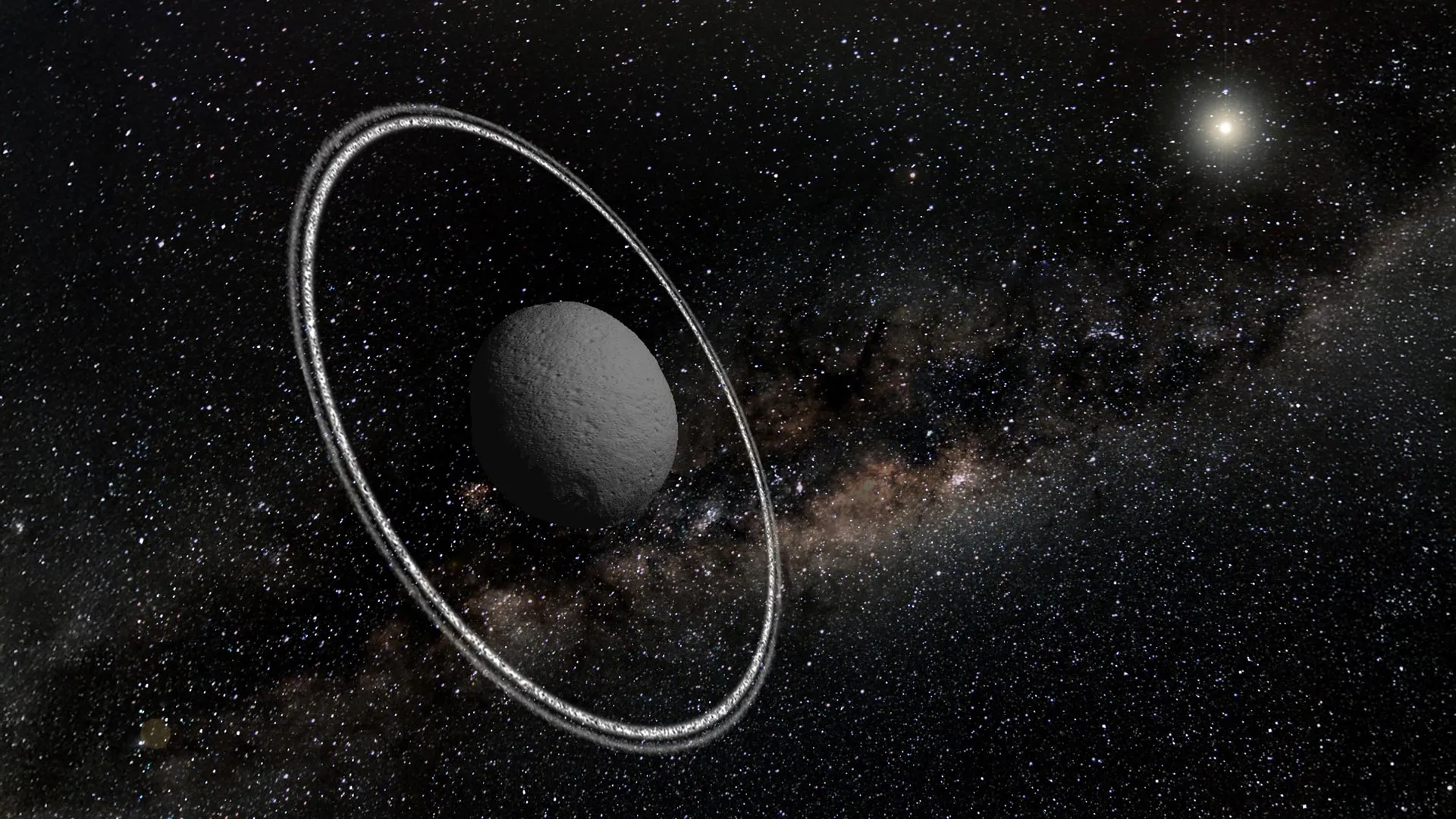
For most of modern astronomy, rings were associated only with the Solar System’s giant planets: Jupiter, Saturn, Uranus, and Neptune. That picture changed in 2013, when astronomers discovered two dense rings around Chariklo, a small object only about 250 kilometers across that travels between Saturn and Uranus, nearly 17 times farther from the Sun than Earth.
Now, new observations from the James Webb Space Telescope (JWST) show that those rings are not as stable as scientists once assumed. A study published in Science Advances, led by the Institute of Astrophysics of Andalusia (IAA-CSIC), provides the first evidence that Chariklo’s ring system has changed over a period of only a few years.
James Webb Detects Changes in Chariklo’s Rings
The key observation took place on October 18, 2022, when researchers used JWST to watch Chariklo pass in front of a distant star. This event, known as a stellar occultation, allows astronomers to study objects that are too small or distant to image directly. As Chariklo and its rings crossed in front of the star, they briefly blocked some of its light, producing measurable dips in brightness.
Researchers compared the JWST data with earlier stellar occultation observations collected over the previous decade. The comparison revealed that Chariklo’s two rings have changed in different ways.
“By comparing JWST observations with those obtained during other stellar occultations over the last decade, we discovered opposite changes in the two rings: while the inner ring shows significantly higher opacity, the outer ring shows lower opacity, ” explains Pablo Santos-Sanz, an IAA-CSIC researcher who leads the study.
In other words, the inner ring now blocks more light than before, while the outer ring blocks less. That unexpected contrast suggests that Chariklo’s rings are active, evolving structures influenced by physical processes that may be more complicated than scientists previously realized.
A First for the James Webb Space Telescope
The observation was also a technological milestone. It marked the first time a stellar occultation had been specifically predicted and planned for JWST and then successfully observed with the space telescope.
Pulling off the observation required extraordinary precision. Scientists needed highly accurate information about Chariklo’s orbit, the location of the background star, and JWST’s own movement through space.
“Achieving this required knowing with extraordinary precision the orbit of Chariklo, the position of the star — thanks to ESA’s Gaia mission — and the trajectory of JWST itself around the L2 Lagrange point, a region of space located about 1.5 million kilometers beyond Earth, away from the Sun. JWST follows an orbit around this region that requires periodic corrections through station-keeping maneuvers,” notes Yücel Kilic, postdoctoral researcher at the IAA-CSIC and co-author of the study.
A Rarely Detailed Look at Invisible Rings
When the occultation occurred, Chariklo was moving relative to JWST at only 2.5 kilometers per second. That unusually slow relative motion gave researchers exceptionally detailed spatial information about the structure of the rings.
Direct photography is not an option. Chariklo is extremely distant, and its rings are so narrow that even JWST and the largest ground-based telescopes cannot resolve them in an image. Stellar occultations provide a workaround by using a distant star like a backlight. Each time one of the rings crosses the star, the amount of starlight briefly decreases, allowing astronomers to measure properties of the ring that would otherwise remain hidden.
Small Ring Systems May Be Far More Dynamic
Scientists had generally regarded rings around small Solar System bodies as relatively stable structures. Chariklo now provides evidence that this assumption may need to be reconsidered.
The changes seen over just a few years suggest that such ring systems can evolve on surprisingly short timescales.
“Our results force us to rethink how they form, how they evolve, and what mechanisms maintain their stability. The ability to detect these changes opens a new window for understanding the evolution of these systems and, possibly, that of other ring systems in the Solar System,” says Santos-Sanz.
Exactly what caused the apparent changes remains uncertain. They may represent genuine evolution within Chariklo’s rings, differences produced by the filters used during different observations, or some combination of both.
Understanding How Chariklo’s Rings Evolve
The Institute of Astrophysics of Andalusia (IAA-CSIC) directed every major stage of the research, including the scientific design of the project, prediction of the Chariklo occultation observed by JWST, analysis of the resulting data, and interpretation of the physical processes involved.
The IAA-CSIC team also played a central role in modeling the rings and carrying out the statistical analysis used to establish that the observed changes are real. Researchers from Spain, Brazil, France, Hungary, and the United States collaborated on the work.
By showing that Chariklo’s seemingly stable rings can change within only a few years, the observations give astronomers a new way to investigate how ring systems around small worlds form, evolve, and remain intact over time.
