


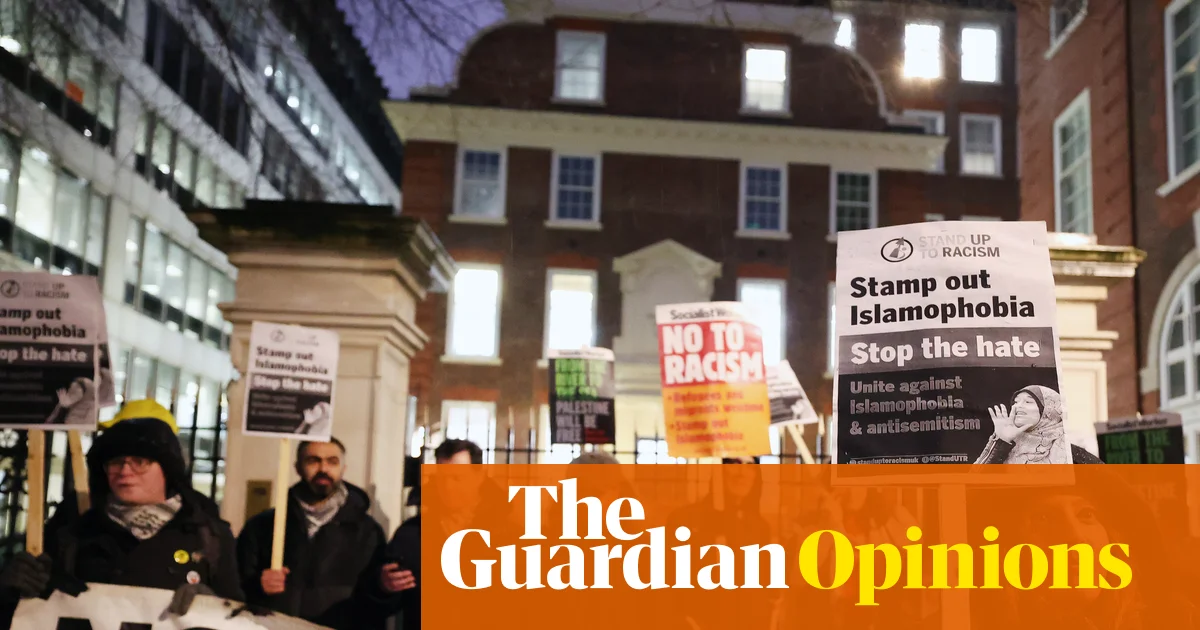
Five years ago, many Muslims wondered if the prejudices they faced were set to fade away. The “war on terror” was dwindling in prominence, and new enemies such as Russia seemed to be displacing fears of Islamic terrorism. Yet Britain’s Islamophobia has only intensified since then. A poll published in July found that two out of five Britons believe Muslims cannot integrate into British society. Earlier in the summer, it was reported that more than half of Muslims in Britain had personally experienced anti-Islam prejudice in the last year, and a quarter in a public place.
The evidence of a worsening climate for Muslims has been mounting since two summers ago, when racist riots erupted across the UK, targeting mosques and asylum hostels. Watching videos of those events, I was disturbed by the parents who brought their young children to watch while mobs attempted, with apparently murderous intent, to break into the buildings. It was not only hardened far-right activists but a much broader cross-section of British society that was willing to participate in racist violence directed at Muslims or asylum seekers assumed to be Muslim.
But it is the widespread indifference to anti-Muslim racist violence that is most distressing. Last October, a white man raped a Sikh woman in her Walsall home while shouting Islamophobic abuse, believing her to be Muslim, and telling her he was a “British master”. The case attracted little public comment, despite seeming to be part of a pattern of racist sexual crimes in the region. Likewise, there was only modest coverage of the rampaging knife attack that began at an Edinburgh mosque in June that left a number of men injured.
To understand why Islamophobia is so pervasive, we need to grasp the deeper forces that enable it. The first is a bedrock of anti-Islam attitudes set during the 1990s when, with the cold war over, neoconservative intellectuals began to see in Islam a new enemy to replace communism. After Muslim protests against Salman Rushdie’s The Satanic Verses, some liberal commentators also began to declare that Islam was incompatible with western values. That all might have remained a problem of cultural adaptation to be solved through community-building, but during the “war on terror”, anti-Muslim racism was institutionalised in the daily functioning of the British state by the Labour government. Ministers made regular speeches singling out Muslim communities as threats, while under the Prevent policy, thousands of public sector workers were trained to regard ordinary Muslim political and religious behaviours as indicators of extremism.
The second has to do with Palestine. The groundswell of opposition to Israel’s genocide in Gaza has been profoundly disconcerting to Britain’s foreign policy establishment. In turn, the hundreds of thousands of people who marched on demonstrations have been depicted as supporters of, or aligned with, Islamic extremism. That has restored a virulent atmosphere of animosity towards Muslims, who are again seen as dangerous and disloyal.
We might think, for example, of Keir Starmer’s description of planned protests on 7 October 2025 as “un-British”, his suggestion that further protests could be banned and his call for prosecution against demonstrators using contested phrases such as “globalise the intifada” – despite repeated explanations that such slogans are not calls for violence. His comments reflect a widespread belief that ordinary protest – against a genocide! – is actually something else: the importing by Muslims and their allies of dangerous foreign ideologies. But to say that is to demonise the bond of allegiance between Muslims in the west and Muslims in other parts of the world fighting colonial occupations. That community-based international solidarity, of the kind that Britain used to hold up as evidence of its tolerance, should only be welcomed.
Third, there are the barriers that make it hard to even raise the issue of anti-Muslim racism in a fruitful way. Talk about Islamophobia in the mainstream of British public life and you will face the ritual demand that you also condemn Islamic extremism and acknowledge antisemitism among Muslims. Of course, an attack on a synagogue is to be condemned as forcefully as an attack on a mosque. But the harder political question is how to create the conditions in which neither one of those attacks is made likely. In this, Jewish communities have the resolute support of the British government. Muslims do not. For decades, they have been on the receiving end of official disdain, and when they attempt to assert a modicum of political representation they are accused of “family voting”.
This matters because racism is about power. Its function is to divide society so that certain groups can be subjected to exceptional forms of exploitation or elimination. It is typically experienced as routine and structured powerlessness: the daily struggle to eke out a living in the face of discriminatory employers, public services riddled with suspicion, oppressive policing, immigration enforcement. Twenty-five years ago, policymakers at least paid lip service to racism as “institutional”, which helped to make visible some of its structural features. But that is no longer true. Racism is nowadays framed mainly as a problem of extremist individuals radicalised by hateful and polarising ideologies.
Tackling racism means overcoming that lack of power. But the opposite is happening as governing elites continuously reinforce racist attitudes. A decision, for instance, to allow Ukrainians fleeing war preferential entry to the UK while many Afghans fleeing war have to risk their lives in dangerous sea crossings – a policy of racial segregation that is as absolute and violent as those of the Jim Crow south of the US – is also a form of public messaging. Policymakers can hardly be surprised when ordinary people take their cue from such policies and decide that non-white immigrants must indeed be a threat to national identity. Racism applied at the border inevitably seeps into other areas of public life.
Then there is the other response to talking about Islamophobia: to switch the conversation to a victimhood competition, the never-ending game of fighting over whose oppression is greater, as if there were some way to rank Black people, Jews and Muslims by the scale of horrors they have experienced. What this misses is that the fate of Muslims is inseparable from the fate of all people of colour in the UK. What Britain does to Muslims today it is likely to do to Black people tomorrow, and vice versa. And if a future government of Britain decided to carry out the mass deportation of Muslims from the country, I have no doubt it would decide soon afterwards to do the same to Jews. When supporters of Israel promote Islamophobia, they are playing with fascist fires that will end up engulfing us all.
after newsletter promotion
For decades, Britain’s mainstream political leaders have been enabling anti-Muslim racism, creating the ideal conditions for the rise of hard-right political parties. They continue to do so, sleepwalking to social disaster with an unconscionable recklessness and complacency. It is high time they woke up.
-
Arun Kundnani is editorial director of Monthly Review Press
-
Do you have an opinion on the issues raised in this article? If you would like to submit a response of up to 300 words by email to be considered for publication in our letters section, please click here.
