


Welcome back to Foreign Policy’s Situation Report. It’s August, and everyone is in vacation mode, but we’ve still got plenty of national security news for you this week.
Alright, here’s what’s on tap for the day: The Iran war continues to reveal U.S. weaknesses, Ukraine once again displays its drone prowess, and hackers target U.S. water supplies.
Welcome back to Foreign Policy’s Situation Report. It’s August, and everyone is in vacation mode, but we’ve still got plenty of national security news for you this week.
Alright, here’s what’s on tap for the day: The Iran war continues to reveal U.S. weaknesses, Ukraine once again displays its drone prowess, and hackers target U.S. water supplies.
Much has been said about how the Russian military’s strength was vastly overinflated prior to its full-scale invasion of Ukraine. Iran is striking a similar tone now with regard to U.S. military strength, months into a war that has become a quagmire for the Trump administration.
Iranian Brig. Gen. Mohammad Reza Naqdi, a top advisor to the leader of the Islamic Revolutionary Guard Corps (IRGC), said in a recent interview with PBS News Hour that “the American military is weaker than what we perceived.”
While many might dismiss Naqdi’s comment as propaganda or psychological warfare, there’s also no doubt that the Iran war has exposed serious vulnerabilities for the United States.
Seeking new friends. For starters, the war has greatly undermined the notion that partnering with the United States can serve as a strong security guarantee. Countries across the Middle East have for years hosted U.S. troops as an insurance policy in an often-volatile region, believing that doing so would deter attacks from adversaries.
But when the war began in late February, Iran quickly began targeting U.S. bases—as well as civilian infrastructure—in countries across the region. Iran has continued to do so in the months since, leading Persian Gulf countries to reassess the value of hosting U.S. troops and seek new alliances. Last week, for example, Saudi Arabia joined a NATO-like mutual defense pact with Turkey and Pakistan. Gulf states have also sought help from Ukraine in shoring up defenses against drones (as the United States has simultaneously struggled to defend against Iranian drones).
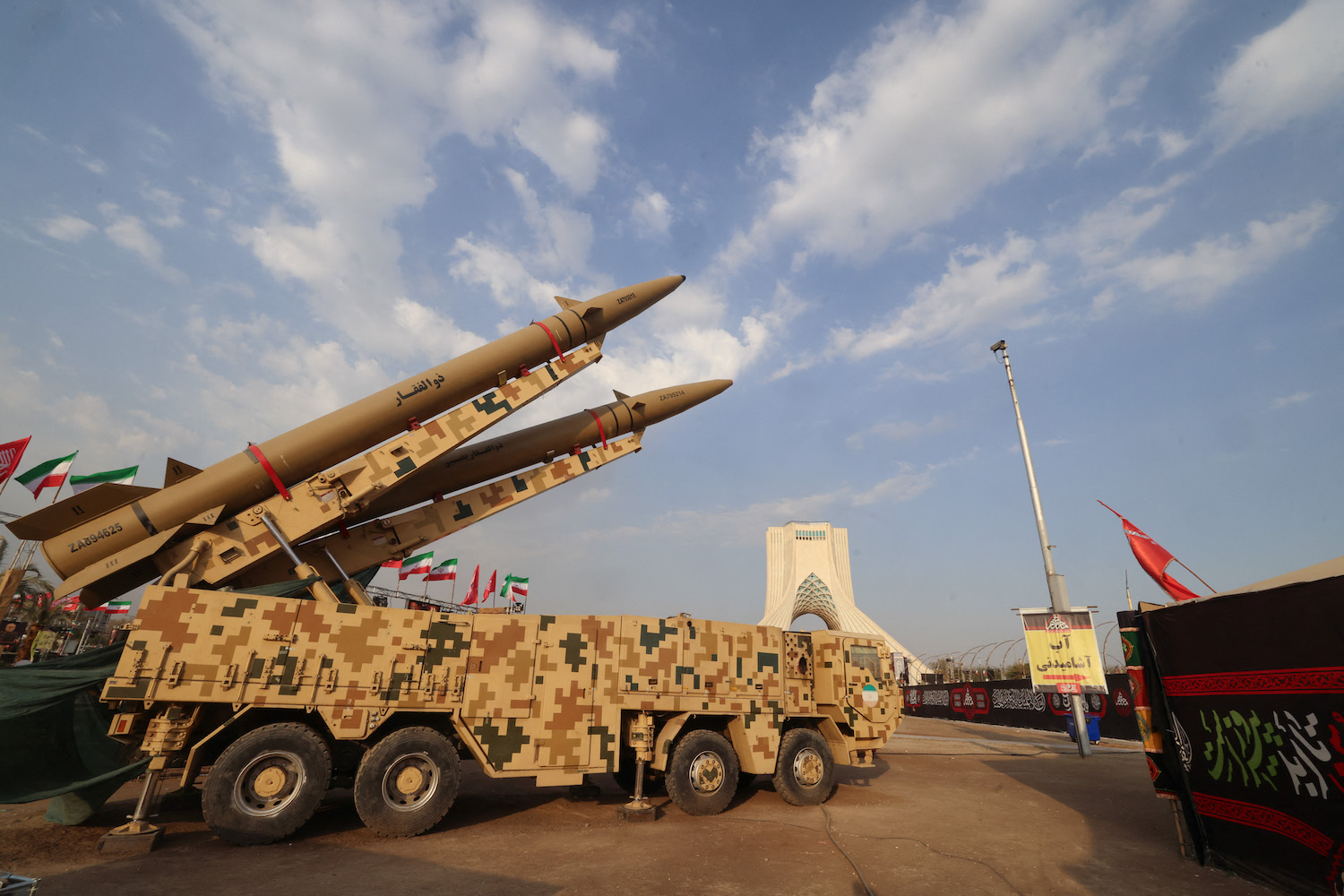
Missile math. Much like the Russia-Ukraine war, the United States’ fight against Iran has also once again shown how a weaker adversary can leverage asymmetric warfare to undermine a far more powerful military. Despite repeated U.S. and Israeli strikes, Iran retains many military capabilities and remains a threat to its neighbors, U.S. forces in the region, and shipping in the Strait of Hormuz. Meanwhile, its strikes with one-way attack drones and missiles have dwindled vital U.S. munitions and weapons stockpiles that are costly and take significant time to replace.
The United States has reportedly used 1,500 Patriot missile interceptors during the war and has around 1,700 remaining. Patriot interceptors cost roughly $4 million and take more than two years to build. Reports also suggest that the U.S. military has also burned through close to 80 percent of its THAAD interceptors; used “virtually all” of its long-range precision missiles; and lost roughly a quarter of its MQ-9 Reaper drones (which, at $30 million to $50 million apiece, aren’t exactly cheap).
Though the administration publicly denies that there are missile shortages, the apparent stockpile concerns reportedly led President Donald Trump to lash out at Defense Secretary Pete Hegseth during a recent meeting at Camp David—and seemingly contributed to the president’s decision to call off another large-scale attack on Iran.
The clock is ticking. The war was launched with a confusing array of objectives, ranging from destroying Iran’s ballistic missile program to preventing Tehran from obtaining a nuclear weapon. But the war is now primarily a fight for dominance over the Strait of Hormuz. The crucial waterway was open when the conflict began but has been largely closed for months now, with devastating impacts on global energy markets and rippling economic consequences.
Meanwhile, Trump continues to undermine the United States’ credibility by painting a picture of the war that’s completely at odds with reality. In just the latest example, Trump has claimed in recent days that the United States is in control of the strait, but ship traffic through Hormuz dropped near a three-month low this week. There’s no peace deal in sight, and Trump appears to be unwilling to cut his losses and agree to Tehran’s hard-line demands—believing that Iran will eventually cave to a campaign of economic pressure.
But maintaining the status quo carries considerable risks, including further exposing U.S. vulnerabilities that could be exploited by Tehran and other adversaries.
White House press secretary Karoline Leavitt will be leaving her role at the end of the month to spend more time with her family, Trump announced in a Truth Social post, adding that she will continue to be one of his “top outside advisors.” Leavitt posted on X that serving as press secretary has been “the honor and adventure of a lifetime” and that she “relished holding the liberal media accountable.”
Trump nominated Julia Nesheiwat, a former State Department and homeland security official who is married to U.S. Ambassador to the United Nations Mike Waltz, to the newly created position of ambassador-at-large for the Arctic.
Iran majorly shook up its military leadership, naming former IRGC commander Mohsen Rezaei as secretary of the country’s Supreme National Security Council and elevating six other individuals seen as more hard-line than previous leadership to top positions.
What should be high on your radar, if it isn’t already.
Ukraine’s drone domination. Ukraine keeps reminding the world that it is now an elite fighting force—in real as well as simulated battlefields. The Ukrainian military on Tuesday conducted successful drone and missile strikes on Russian naval infrastructure in the Black Sea, Ukrainian President Volodymyr Zelensky revealed in a post on X, adding that it recorded confirmed hits on “defense positions, piers, and seaport infrastructure.”
Separately, the Wall Street Journal reported on Thursday that Ukrainian drone operators easily defeated U.S. troops in a military exercise in Germany earlier this year.
Water wars. Hackers are increasingly going after U.S. water supplies, with cyberattacks suspected to have been carried out by Iran compromising water utilities in possibly as many as a dozen U.S. states over the past month. While no major disruption to households and businesses was reported, the spate of hacks serves as a reminder of how particularly vulnerable water is, as Rishi and our FP colleague Christina Lu outline in their latest piece.
Soldiers load supplies onto a military truck with its lights off during a night tactical exercise in Tainan, Taiwan, on Aug. 12. Cheng Chia Huang/Getty Images
12—the number of airplanes that the U.S. Department of Homeland Security has purchased in the past year, most of which it said would be used for deportations but are either sitting idle or being used for travel by Trump administration officials.
“We do not feel the need to engage in needless, loud, rhetorical provocations to prove our resolve.”
—U.S. Undersecretary of Defense for Policy Elbridge Colby in a speech in the Philippine capital of Manila on Monday.
Iran has unleashed another round of meme warfare in response to the Washington Post’s reporting that Trump hid in a catering truck to secretly switch planes from Air Force One to a military aircraft over an alleged Iranian assassination threat. Multiple Iranian embassies—including the ones in Armenia and South Africa—shared artificial intelligence-generated images of Trump in the truck, with the latter referring to the U.S. president as a “coward.”
