


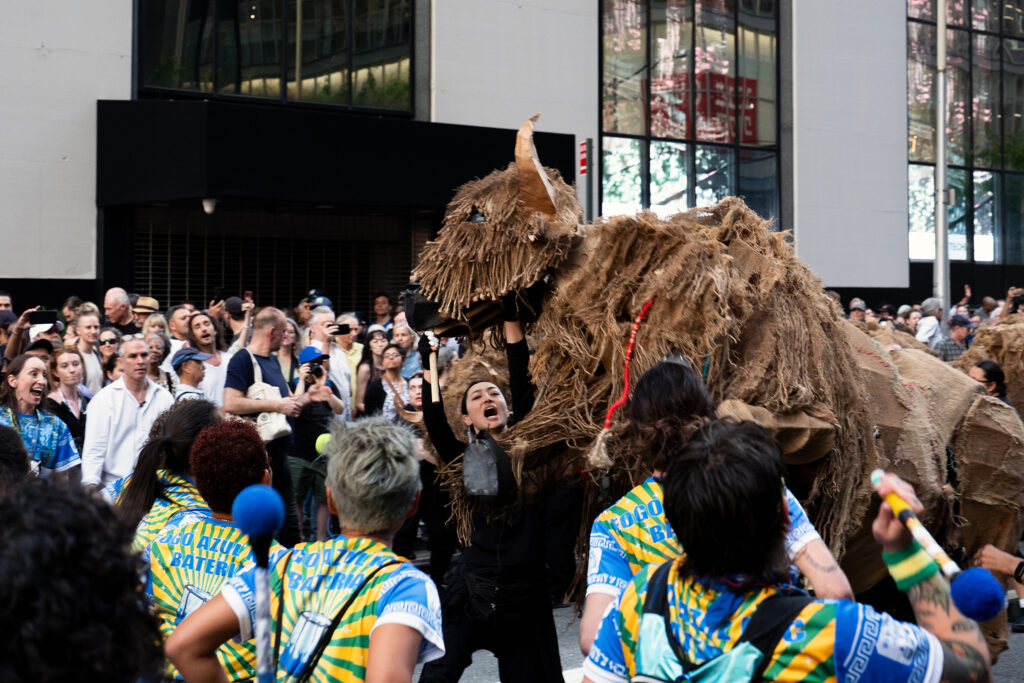
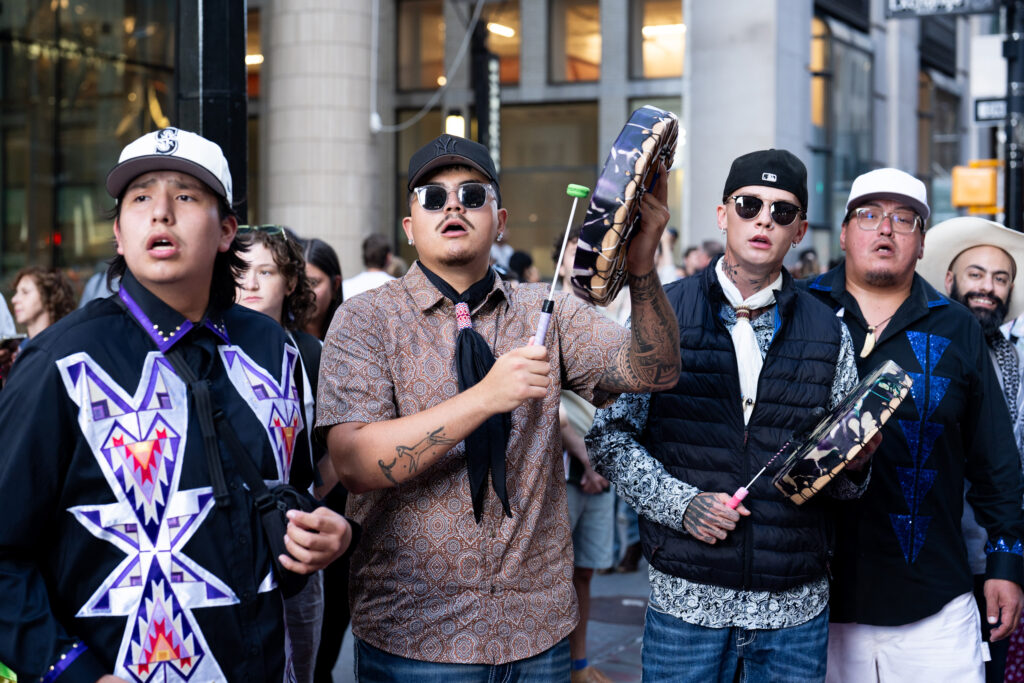
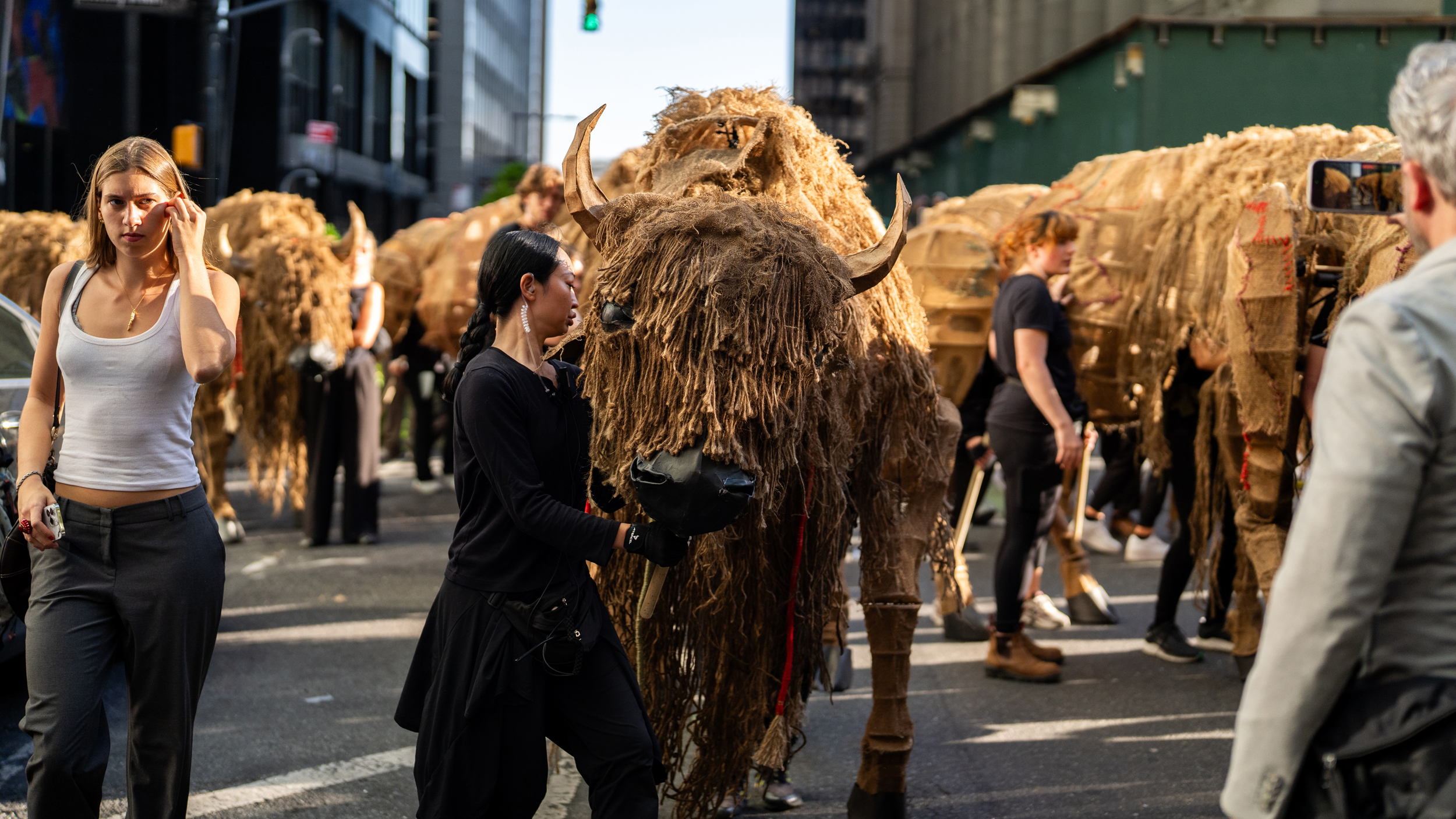
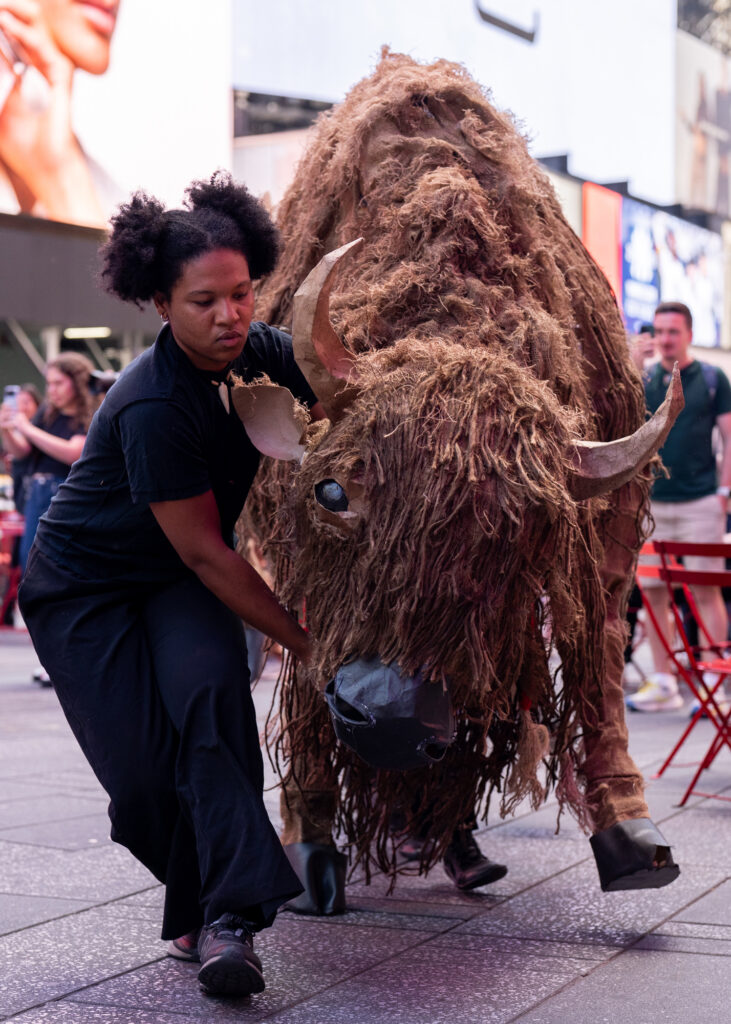
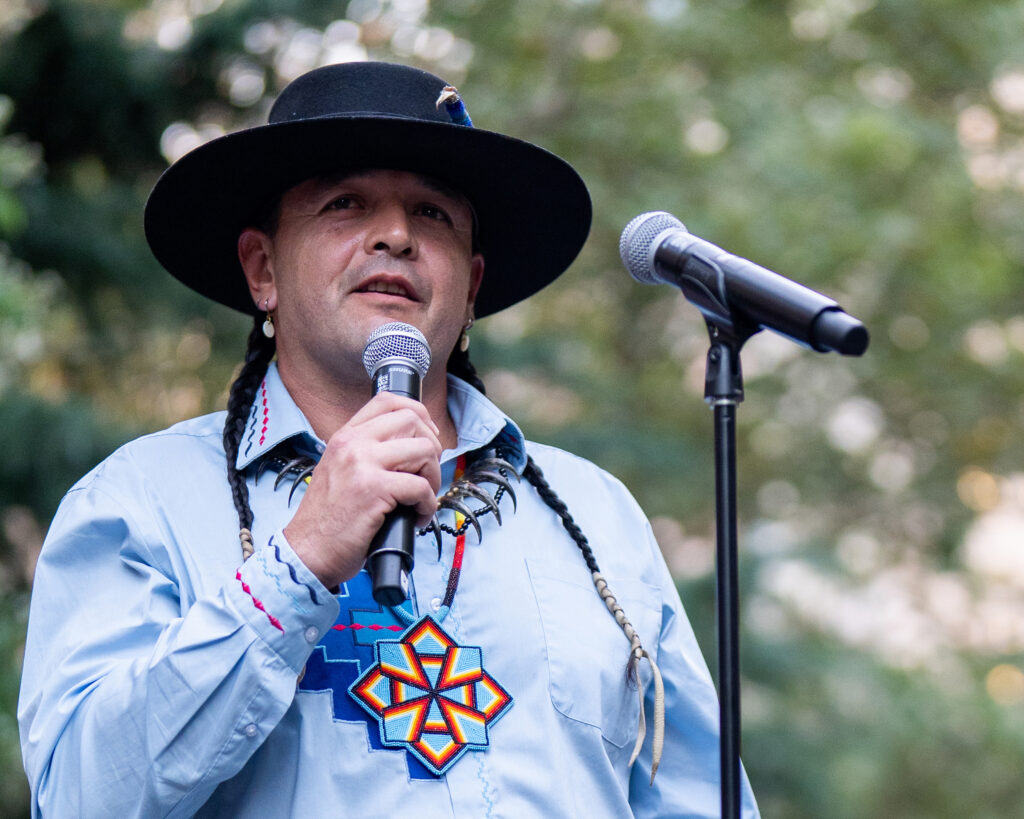
Standing on Manhattan’s High Line, Jason Baldes watched pedestrians, cyclists, cars and trucks braid their way through New York City. The executive director of the Wind River Tribal Buffalo Initiative in Wyoming was in town for New York’s first-ever buffalo march, a showcase of 40 life-sized bison puppets accompanied by performances to honor the animal’s history and connection to native cultures.
North America’s largest land mammal, American bison once numbered in the millions before European colonists systematically slaughtered them, bringing the keystone species to the brink of extinction by the end of 19th century. Buffalo remain an important spiritual figure for many Native tribes, and indigenous peoples and scientists have connected their presence to increased biodiversity, less destructive fire regimes and increased water-retention in soils, among many other cascading effects.
For decades, tribes and conservation groups have built buffalo restoration herds across the U.S.
But Baldes, whose many other titles include vice president of the InterTribal Buffalo Council, has also seen initiatives to grow buffalo herds face significant headwinds. This summer, the Department of the Interior tried to revoke bison grazing permits for American Prairie, a conservation organization focused on restoring biodiversity to North America’s grasslands, including by expanding bison herds.
At the beginning of September, a judge ruled the Bureau of Land Management could not block American Prairie’s bison from grazing public lands.
Baldes, an enrolled member of the Eastern Shoshone Tribe, said he spends about two-thirds of his time these days off the Wind River Indian Reservation engaged in buffalo work. Despite the difficulties the Trump administration might pose for buffalo restoration efforts, the Wind River Tribal Buffalo Initiative herd is approaching 200 and the organization is expanding.
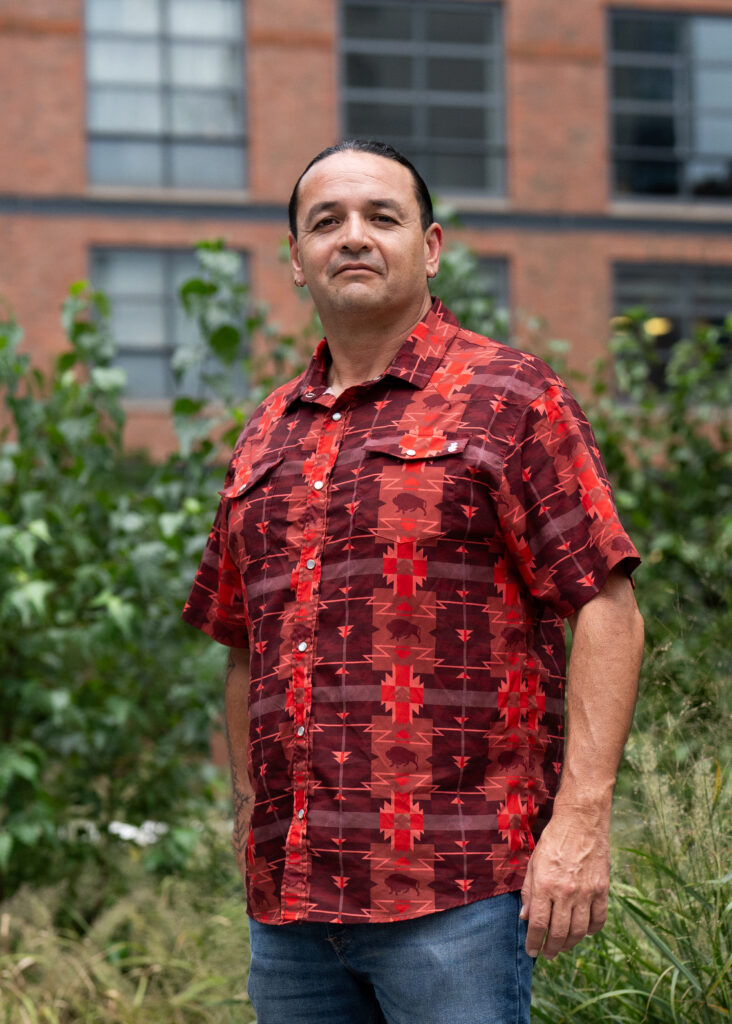
The Wind River Tribal Buffalo Initiative is currently in the design phase of a $9 million expansion of the organization’s headquarters, a new 14,000-square-foot facility that will contain a small meat-processing space and serve as an ecotourism attraction for travelers on their way to Yellowstone.
“At Wind River, we’ve got potential to really restore buffalo in a different way,” he said.
This fall marks 10 years since Baldes brought 10 buffalo back to Wind River to found the Eastern Shoshone’s herd. As Baldes’ work has left him with less time to himself, he relaxes by going out where the buffalo roam to sit with the animals.
“I’ve approached a burnout a few times, and then I escape for a week and come back re-energized,” he said.
Inside Climate News caught up with Baldes the day before the buffalo march in downtown Manhattan on Friday, Sept. 18. This conversation has been edited for length and clarity.
BOLSTER: How do you go about crafting a message about the importance of buffalo for people here in New York City?
BALDES: There’s a lot of diversity in New York City, and really our country was very diverse with Native American people a couple hundred years ago. That was something that was celebrated and respected, and I can feel that sense of community in New York City. That collaborative way of knowing and respecting one another is something that we need in this country.
How do we empower the people to get behind an important movement like Buffalo Restoration? It’s gonna take the American people to get behind something like that, to see it percolate out into how federal agencies and state agencies are managing these animals [or not]. How do we implement some programs that think long term about bison restoration on millions of acres as opposed to just thinking about ranching ‘em?
Most people don’t even know what happened to buffalo, let alone it being our national mammal.
BOLSTER: What’s it been like to do your work under the second Trump administration?
BALDES: Work doesn’t stop depending on who’s in office, because we’re sovereign governments. We can choose how we want to manage our own land. There’s still a lot of work and things that can move in the right direction at home, despite what’s happening regionally or nationally. We just gotta weather the storm, which we’ve kinda been doing since 1776.
BOLSTER: How does tribal sovereignty make your work different from something like American Prairie in a moment like this?
BALDES: Federally recognized tribes, there are 575 in the country, have treaties with the federal government. When tribes today are exercising their treaty rights or their sovereign authority for land management or whatever it may be, the federal government, the Supreme Court, have to follow the precedence that’s been set in court, that federal Indian law continues to be upheld. American Prairie is a 501c3 nonprofit. It’s an organization that was established under the IRS. That’s not sovereignty. That’s not a treaty right. That’s not something that is a promise made to an entity a couple hundred years ago.
As a nonprofit organization, American Prairie can raise money and capital and purchase land and designate what they want on purchased properties. But it’s not the same as a tribe doing that because the tribe has that self-determination and sovereignty recognized by those treaties.
This story is funded by readers like you.
Our nonprofit newsroom provides award-winning climate coverage free of charge and advertising. We rely on donations from readers like you to keep going. Please donate now to support our work.
BOLSTER: I imagine an example of where that difference is important is what’s happening with the Trump administration trying to revoke their grazing permits.
BALDES: That’s problematic, because [the Trump administration is] referring to the Taylor Grazing Act that doesn’t specify anything about buffalo. It’s actually about protecting grasslands. It’s not about what grazes those grasslands.
What American Prairie has been doing with buffalo is actually very advantageous to restore prairie grasslands, which is supported by the Taylor Grazing Act. So it’s kind of counterintuitive, the argument that’s been made. Fortunately, a judge has seen that that’s the case. [But] it’s concerning that the federal government would assert that kind of authority or language that would be counterproductive to bison restoration efforts. The Bison Working Group was formed during the first Trump administration, so why would they work to undermine all those efforts in the second one?
It’s concerning also that there’s not broad public support for a lot of the decisions that are being made. There’s a small faction of folks that are highly opposed to anything because they see bison as a threat to the cattle industry, which isn’t a very good argument ’cause there’s 90 million cattle in the country today, 2.5 million killed per month to feed American people. There’s less than 500,000 buffalo in the whole country. It’s a drop in the bucket.
BOLSTER: Why do you think there’s so much fear of bison’s impact on cattle and ranching when the numbers are so disproportionate?
BALDES: I think people get used to the status quo and are opposed to change if it disrupts their comfort level. There’s some racial connotations to that.
I think change is a good thing if it’s beneficial for future generations. Farming and ranching and agriculture hasn’t gotten us very far on our reservation if 3 percent of us are ranchers. Why are our lands still prioritized for ranching even though a small number of people actually benefit from that? We want to create a future for our young people that’s more grounded in culture, language, spirituality, a relationship and connection to buffalo or being able to exercise our hunting and fishing and gathering rights. What would be more beneficial than trying to restore some of those things … that were deliberately taken from us?
BOLSTER: You’re studying the ecological impacts of your buffalo restoration work at Wind River Buffalo Initiative. What have you found?
BALDES: Climate resiliency.
My own research in grad school was cultural plant biodiversity and relic bison wallows, which is essentially the foods and tools and medicines that grow in association with areas wallowed by bison. They have dust bathing behavior that creates these micro depressions in the landscape that’s important for water accumulation and seed dispersal. Oftentimes the seeds that are dispersed by these buffalo are their foods, their tools, their medicines in the plant community that we would have utilized.
We can monitor things like plant respiration, soil water holding capacity and the pH, and we can understand the climate, meteorological information. We can monitor the birds because buffalo hair is part of the reason why birds increase with bison. Buffalo hair is the second warmest natural fiber on the continent, and the bison has 18,000 hairs per square inch, which is more than twice what cattle have. So when they lose that winter coat in the spring, those birds come and they pick that up and that helps their eggs reach the right incubation temperature.
We are collecting various data that really … demonstrate why what we’re doing is different. It’s not a livestock operation. This is restoring animals and maintaining as natural a system as possible till we can get to larger landscapes.
Until we work cross collaboratively or think about corridor migration and connectivity, then we’re not going to see bison restored to any meaningful level to create that ecological change that’s so important for biodiversity, carbon storage, ecosystem integrity, water quality, plant biodiversity. That should be reason enough, as a keystone ecological species, to be restoring this land animal back to the land.
But then you add the human component to it and the dietary and the consumptive importance of this animal in our diet as a healthy protein. Then you scratch your head about why hasn’t this already happened? It’s colonial paradigms that have made it possible for farmers and ranchers to take advantage of the system.
BOLSTER: Do you think people see tribes as the most powerful players in buffalo restoration?
BALDES: I think if tribes really were to exercise sovereignty and work collaboratively to do so, the American people would be blindsided by the authority that may still exist for land management or getting lands returned. There isn’t an understanding of the philosophical belief systems and values that are held by Indigenous people, and it isn’t well understood or accepted or even taught well enough for people generally to understand why those belief systems are different.
If that bridge could be built through buffalo, maybe there would be more of an understanding collectively about what buffalo means not only for American Indian people but all American people. I think that’s partly why this artist has selected buffalo for telling that story. We need people to understand the history of what happened, but not in a way to shame or guilt-trip anybody, but a way to heal.
In this day and age, we’re grasping for hope. Buffalo certainly bring that for Native American communities, but I think that can certainly trickle over to others, too. Buffalo medicine is strong. It goes to places and to people that you never would expect.
About This Story
Perhaps you noticed: This story, like all the news we publish, is free to read. That’s because Inside Climate News is a 501c3 nonprofit organization. We do not charge a subscription fee, lock our news behind a paywall, or clutter our website with ads. We make our news on climate and the environment freely available to you and anyone who wants it.
That’s not all. We also share our news for free with scores of other media organizations around the country. Many of them can’t afford to do environmental journalism of their own. We’ve built bureaus from coast to coast to report local stories, collaborate with local newsrooms and co-publish articles so that this vital work is shared as widely as possible.
Two of us launched ICN in 2007. Six years later we earned a Pulitzer Prize for National Reporting, and now we run the oldest and largest dedicated climate newsroom in the nation. We tell the story in all its complexity. We hold polluters accountable. We expose environmental injustice. We debunk misinformation. We scrutinize solutions and inspire action.
Donations from readers like you fund every aspect of what we do. If you don’t already, will you support our ongoing work, our reporting on the biggest crisis facing our planet, and help us reach even more readers in more places?
Please take a moment to make a tax-deductible donation. Every one of them makes a difference.
Thank you,

Reporter, Wyoming and the West
Jake Bolster reports on Wyoming and the West for Inside Climate News. Previously, he worked as a freelancer, covering climate change, energy, and the environment across the United States. He holds a Masters in Journalism from Columbia University.
