


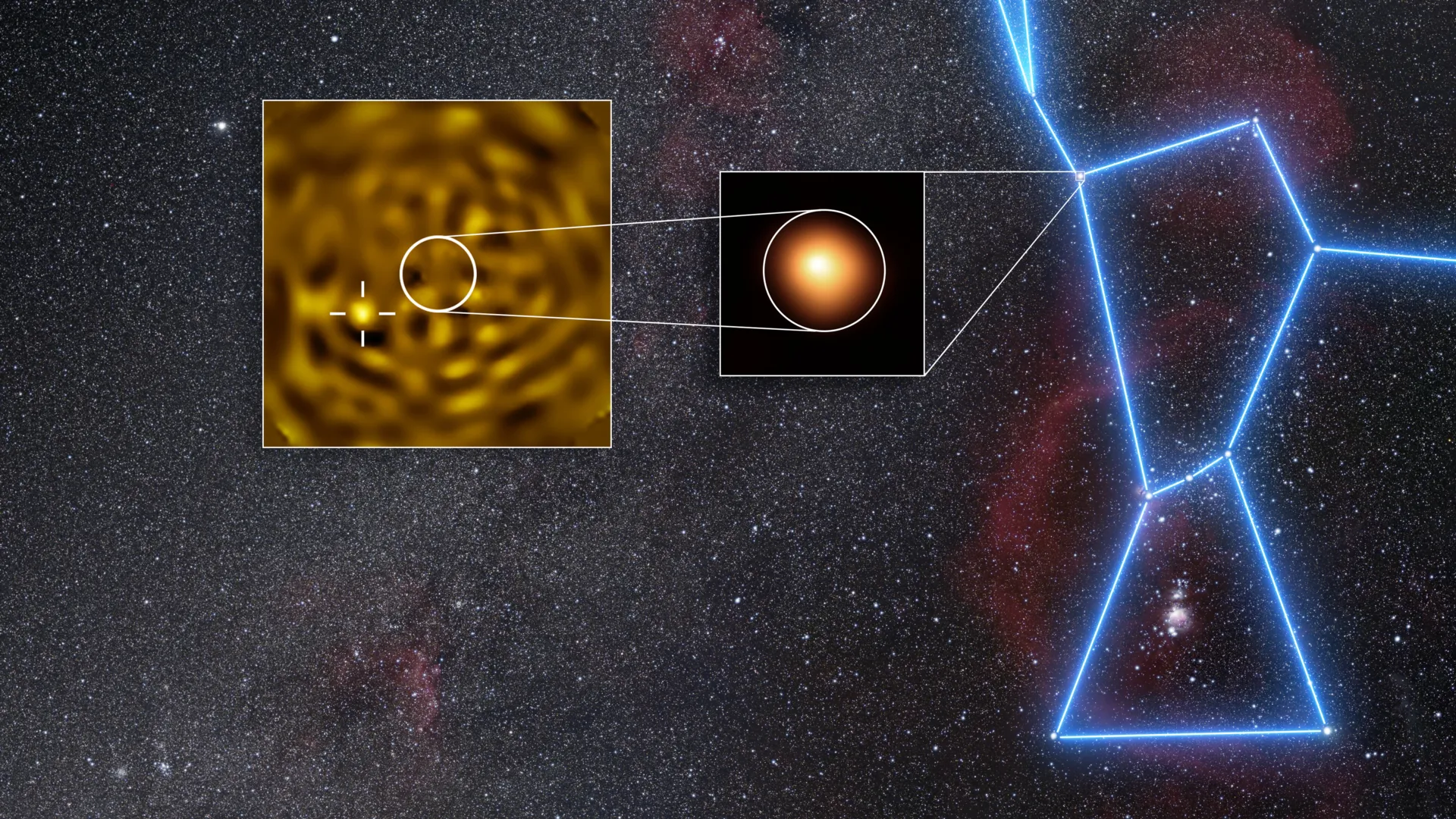
Astronomers now have their strongest evidence yet that Betelgeuse, one of the best-known stars in the night sky, has a stellar companion. A team led by French astronomer Miguel Montargès used the European Southern Observatory’s Very Large Telescope (ESO’s VLT) to capture the clearest image so far of what is believed to be Betelgeuse B, a star orbiting the famous red supergiant.
“This is the conclusion of a century-long quest,” says Montargès.
“We have shown that Betelgeuse is not single, it is accompanied by a faint stellar companion,” says Montargès, astronomer at the Observatoire de Paris — PSL, France, and lead author of the study published today in Astronomy & Astrophysics.
Betelgeuse — a reddish star in the Orion constellation that is easily visible with the naked eye and is known to change in brightness — has been watched by people for thousands of years. Even after centuries of scientific observation, however, the star continues to produce surprises.
A Century-Long Search for Betelgeuse B
“I jumped from my chair when I saw the processed images,” recalls Montargès.
The possibility that Betelgeuse has a companion was first raised roughly a century ago as a potential explanation for some of its changes in brightness. Despite decades of observations, astronomers had been unable to clearly detect such a star.
That changed after Two studies published in 2024 made strong predictions about where the suspected companion should be. The studies indicated that Betelgeuse B would reach its greatest apparent separation from Betelgeuse in December 2024, giving astronomers their best opportunity to see it.
Montargès and his colleagues observed Betelgeuse with ESO’s VLT that December. They then spent several months carefully processing and analyzing the observations.
“Honestly, I thought we did not have the sensitivity to detect Betelgeuse B as it was predicted,” explains Montargès. “Because it is more massive than predicted, we see it!”
Scientists had initially estimated that the companion would have roughly the same mass as the Sun. The new observations instead suggest that Betelgeuse B is considerably larger, with about two to three times the Sun’s mass.
“The fact that we can still discover a nearby companion, more massive and brighter than the Sun, around such a well-studied star is remarkable,” says Montargès. “These are among the best moments in science: seeing something new, unexpected.”
The Clearest Image Yet of Betelgeuse’s Companion
The researchers directly imaged Betelgeuse B, meaning they detected light coming from the companion itself. They accomplished this using the SPHERE instrument on ESO’s VLT in Chile’s Atacama Desert.
Previous observations had already provided clues that the companion existed, including a possible direct detection made with the Gemini North Telescope in Hawaiʻi, USA. The latest VLT observations, however, provide the strongest evidence so far and the clearest image yet of Betelgeuse B.
“It is remarkable to see how SPHERE and advanced post-processing techniques, originally developed to find exoplanets, also excel at detecting a companion around a massive, evolved star like Betelgeuse,” says co-author Anthony Boccaletti, also an astronomer at the Observatoire de Paris.
The case is not considered completely closed yet. Astronomers want another observation showing the candidate companion where its orbit predicts it should next appear.
“To be certain that the companion is really there, we still need to observe it in one year on the other side of the star, but there is very little space left for doubt,” adds Montargès.
Betelgeuse’s Famous Dimming Event
Betelgeuse attracted worldwide attention several years ago when its brightness noticeably dropped. Because the evolved supergiant is expected to eventually end its life in a supernova explosion, the dramatic dimming prompted speculation that the star might be preparing to explode.
That turned out not to be the explanation. A team led by Montargès studied the star with ESO’s VLT and found that a cloud of dust was instead blocking part of Betelgeuse’s light.
Now the likely discovery of Betelgeuse B introduces another factor astronomers must consider when studying the star’s evolution.
Could the Companion Affect Betelgeuse’s Supernova?
Researchers will now investigate whether Betelgeuse B could influence the future evolution of the red supergiant, including its eventual supernova explosion.
“The question is truly opened whether this companion is going to have an impact on the evolution of the red supergiant,” concludes Montargès.
The research was presented in a paper titled “VLT/SPHERE images the candidate companion of Betelgeuse” to appear in Astronomy & Astrophysics.
The team is composed of M. Montargès (Laboratoire d’Instrumentation et de Recherche en Astrophysique, Observatoire de Paris, Université PSL, Sorbonne Université, Université Paris Cité, CY Cergy Paris Université, CNRS, France [LIRA]), A. Boccaletti (LIRA), O. Flasseur (Universite Claude Bernard Lyon 1, Centre de Recherche Astrophysique de Lyon UMR5574, ENS de Lyon, CNRS, France), A. de Koter (University of Amsterdam, Anton Pannekoek Institute for Astronomy, The Netherlands), J. Milli (Univ. Grenoble Alpes, CNRS, IPAG, France), P. Kervella (French-Chilean Laboratory for Astronomy, IRL 3386, CNRS and U. de Chile, Chile and LIRA), S. Ridgway (National Optical Astronomy Observatory, USA), E. Bordier (I. Physikalisches Institut der Universität zu Köln, Germany), E. Lagadec (Université Côte dAzur, Observatoire de la Côte dAzur, CNRS, Laboratoire Lagrange, France), A. K. Dupree (Center for Astrophysics-Harvard & Smithsonian, USA), F. Backs (Institute of Astronomy, KU Leuven, Belgium), T. Calderwood (American Association of Variable Star Observers, USA [AAVSO]), and P. Morgan (AAVSO).
