


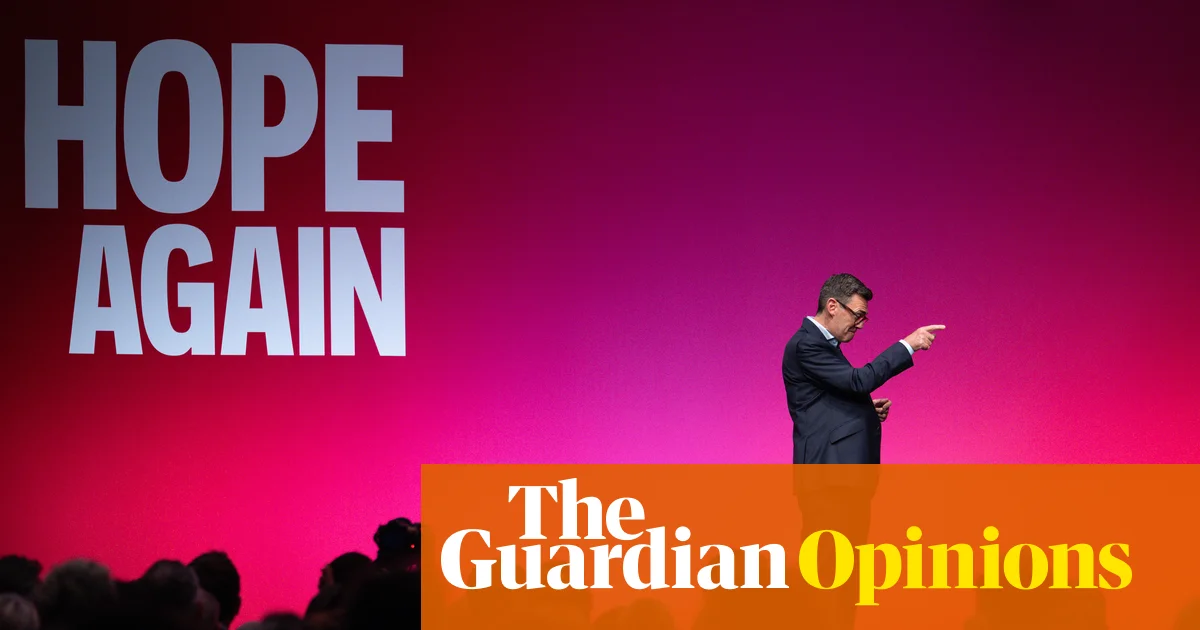
As Andy Burnham delivered his conference speech to the Labour faithful yesterday, it was hard not to recall Jeremy Corbyn’s words after the party’s shattering 2019 election defeat. “I am proud that on austerity, on corporate power, on inequality and the climate emergency,” he wrote for this publication, “we have won the arguments and rewritten the terms of political debate.” Given Boris Johnson’s 80-seat majority, widespread mockery ensued.
But when it comes to rhetoric, who can now deny that the left has won the argument? A Labour prime minister has declared that “Britain has been on the wrong path for a long time”, listing five villains: “Deindustrialisation, deregulation, privatisation, austerity, Brexit.” His speech was infused with class politics, as he condemned a society “run for vested interests, not in the public interest, with power held in too few hands”.
When he committed to break with the “flawed thinking of the last 40 years”, he lumped together Conservative and Labour governments. He has already repeatedly labelled the culprit: neoliberalism. This has long been the received wisdom of the left: that as Clement Attlee’s postwar government established a social-democratic consensus that the Tories upheld for a generation, so Margaret Thatcher bequeathed a settlement that New Labour maintained.
These beliefs were condemned to the fringes of Labour, even though Tony Blair himself eventually confessed: “I always thought my job was to build on some of the things she had done rather than reverse them.” Any mention of neoliberalism was a sure way of provoking an eye-roll from a mainstream politician or commentator. We were denied any debate about an economic system based on extraction rather than investment; an economy based on financialisation rather than making things. Corbynism was an insurgency against all of this – until it crashed on the shores of Brexit.
Add to this the new foreign secretary, Ed Miliband, telling those who opposed Israel’s genocide and were infuriated by Labour’s position on Gaza: “You were right.” We should add, too, the disastrous past wars backed by Labour: Iraq, Afghanistan and Libya.
The left should feel vindicated by the political shift taking place. We were right – at home and abroad. We were mocked, demonised and marginalised for making these arguments. Now most of the left’s worldview is embraced by the Labour top brass. This happened after Keir Starmer’s faction based their entire project on defining themselves against the left. As the Labour activist Ali Milani – who was part of Burnham’s team – told me, that strategy nearly brought about the party’s destruction.
Burnham only became prime minister because Labour’s leftwing voters rebelled – by defecting en masse to Zack Polanski’s Green party in the Gorton and Denton byelection, then in local elections in England, Scotland and Wales. That is clearly understood by Burnham’s team, or they would not be so confidently doubling down on their new strategy.
But winning the argument on a rhetorical level is not the same as substance. Burnham is clearly shifting towards state intervention. That’s taking the form of Great British Grid, a new publicly owned network body, and he condemned privatised water as “a symbol of what has gone wrong with Britain”.
The shift in this direction actually began under the last Conservative government. Did Liz Truss not commit to a subsidy for energy bills worth tens of billions of pounds? What of Rishi Sunak being forced to bring railways into public ownership? Starmerism expanded the semi-nationalisation of the railway and founded Great British Energy. Neoliberalism has exhausted itself and governments are being forced to abandon its tenets, whether they want to or not.
But full public ownership of water seems far off, with “public control” acting as a rather flexible label. Burnham has committed to a large-scale building of new council homes and preventing them from being flogged off through right to buy. Yet he has already backtracked on a pledge to spend the government’s entire £39bn affordable homes programme on council and social housing.
Crucially, he remains committed to the suffocating fiscal rules that block the investment Britain’s crumbling infrastructure and starved services need, especially given there remains no promise to hike taxes on the well-to-do.
While committing to a national care service is extremely welcome, scrapping the triple lock on pensions is not. Britain still spends significantly less on pensions than other major European countries such as Germany, France and Spain, and about two million pensioners languish in poverty.
Consider, too, that the Labour parliamentary benches were stuffed with candidates deemed loyal to the Starmer project. The rightwing factionalists who ran the party may currently be sulking on the fringes, but do not underestimate their capacity to inflict damage.
A key difference between Burnhamism and what came before may well be expressed by what Miliband told activists attending a Labour fringe event organised by the soft-left pressure group Mainstream. “Too often in the past, we thought that kicking some of our supporters would do us political credit,” he said, “and we were absolutely wrong.” Offending people “in the progressive community”, he admitted, was sometimes done “deliberately”.
Because of pressure from the streets and the ballot box, Labour has shifted its rhetoric. The substance is a bit more complicated. Where Starmerism defined itself against the left, could this new government be pushed in a more progressive direction? That question has not yet been answered. But the left should indeed feel emboldened. The winds are shifting in our direction.
-
Owen Jones is a Guardian columnist. His latest book, The Fall of the West: How They Really Lost It, is published on 1 October. Order your copy at the Guardian bookshop
