


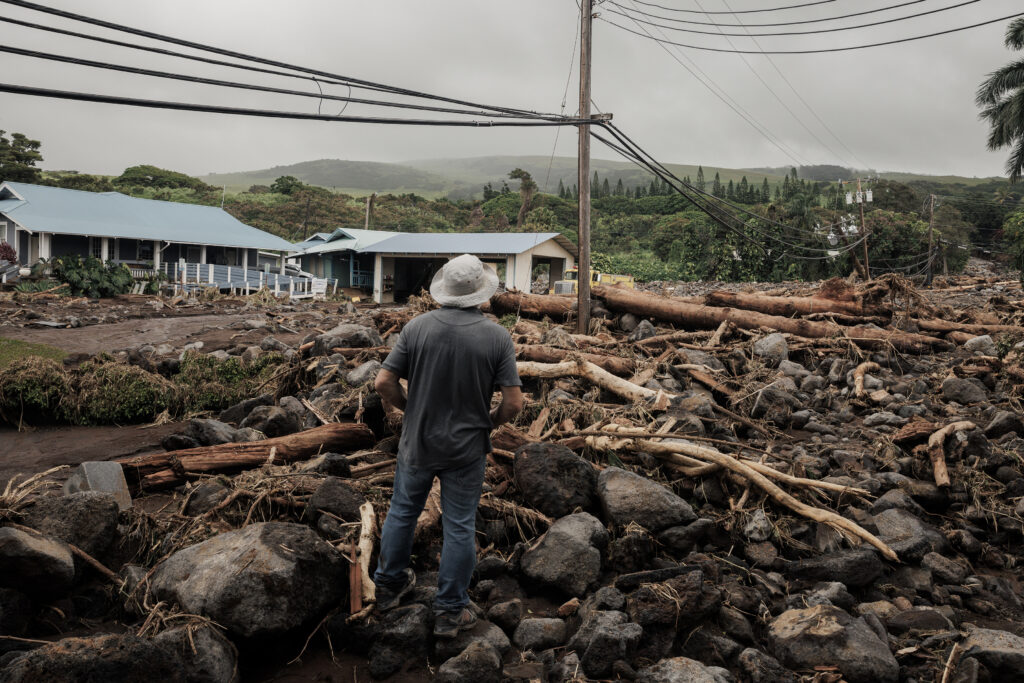
Despite never making landfall, Hurricane Lala left a path of destruction across Hawaii over the weekend. Strong winds, torrential rain and mudslides damaged or swept away more than 100 homes while felled trees blocked key roads on the island of Hawaii, or the Big Island, which suffered the brunt of the tropical cyclone’s wrath. More than three feet of rain dumped in some areas.
The hurricane was downgraded to a tropical storm by Sunday but still managed to take down key transmission lines across Hawaii, leaving nearly 200,000 homes and businesses without electricity. On parts of the Big Island, the power could be out for weeks or months as repair crews struggle to access transmission lines that crisscross rugged and remote terrain, officials say.
“There’s a lot of damage that we’ll be working on,” said Hawaii Gov. Josh Green on Sunday, adding that he would be seeking federal assistance for recovery efforts.
Due to Hawaii’s cooler marine waters and location in the vast Pacific Ocean, hurricanes in the area are rare, with only two ever making landfall, according to records. But a strong El Niño climate pattern—potentially even historic—is driving up ocean temperatures in the central and eastern tropical Pacific, fueling stronger storms like Lala in the region this year.
And while the climate change contribution is not yet clear for Hurricane Lala, scientists say a stronger tropical storm season is likely on the horizon in the coming decades for this region as temperatures continue to rise.
Sideswiped By Tropical Storm Lala
Oceanographer David Ho was in Mexico City for a meeting last week to discuss a forthcoming global climate report he is working on, and he anxiously watched the track of Hurricane Lala head toward his home in Honolulu.
“My first worry was that my flight would be canceled and I wouldn’t be able to get back to secure my house,” Ho, a professor at the University of Hawaiʻi at Mānoa, told me over email. “Once I got back, it was just anticipating the wind and rain.”
Though the eye of the storm never crossed over land, Lala’s tail affected every island over the weekend. Winds and rain on Maui and Oʻahu were strong enough to topple trees and trigger road closures. Ho’s home on Oʻahu was spared, but his power was out for more than a day, which he said on Monday was “unusual.”
The worst of the damage was seen on the Big Island in the northern part of the archipelago, where the storm produced near hurricane-force winds even at the tail. Residents in towns across the southern part of the island were evacuated amid flash flooding, and around 18 people were rescued, including two paramedics caught in the deluge. At least one death was linked to the storm.
Honolulu Civil Beat reported that the storm unearthed bones and headstones in one of the island’s cemeteries, an unsettling trend as climate-fueled flooding worsens around the world.
“It’s complete and utter devastation,” state Rep. Jeanne Kapela, whose district includes Kaʻū, an especially hard-hit community, told Honolulu Civil Beat. “Families have lost their homes; the entire community is impacted.”
Hawaiian Electric, the main utility provider on the islands, restored power for more than 180,000 customers after the storm’s peak subsided in the area. But tens of thousands of people are still in the dark, which officials say could continue for weeks or even months in rural communities.
More Hurricanes on the Horizon?
Hawaii has some of the wettest areas in the entire United States. Even so, Lala brought a massive amount of rain, with more than 40 inches falling on part of the Big Island, as Yale Climate Connections reports. The storm comes nearly five months after low-pressure systems known as Kona lows fueled intense, windy and exceptionally wet storms over the islands, causing widespread damage across Oʻahu, Maui and parts of the Big Island.
“Personally, the Kona Lows in March were more damaging, since they were prolonged and dumped so much water where I live,” Ho said in his email. “Lala’s impacts are still being assessed, but this short event damaged many homes on the Big Island and may take longer to recover from.”
Ho said several factors make Hawaii vulnerable to intense storms: houses that don’t meet modern hurricane-building codes; mudslides, flooding and storm surge; the low domestic food supplies if imports stop; and the electrical power grid, which is isolated and relies on above-ground power lines.
Local politicians have warned that this lack of storm-resilient systems and inadequate emergency preparedness could be catastrophic in the event of a hurricane or tsunami. El Niño, which occurs every two to seven years, has a well-defined impact on hurricane behavior around the world, increasing storm likelihood in the eastern and central Pacific while reducing activity in the Atlantic.
There’s less data to predict how climate change will influence hurricane behavior near lands in the eastern and central Pacific than for the Atlantic, as my colleague Bob Berwyn reported. However, scientists have found in recent years that environmental conditions will become more favorable for storms in and around the Hawaiian islands by the end of the century. With hotter oceans, storms are primed to get windier, wetter and more destructive.
“In general, Hawaiʻi needs to do a better job of preparing for extreme weather events,” Ho said, “especially since climate change will continue to make these events more severe.”
More Top Climate News
A new study from New York City’s Health Department found that the recent toll to reduce traffic congestion in the Big Apple has barely improved air quality, Hilary Howard reports for The New York Times. The data also showed that congestion pricing did not worsen air quality in the Bronx or other neighborhoods that critics were concerned people would drive through more frequently to avoid the toll. The findings differ from a recent study I covered in February led by Cornell University, which used air monitors and modeling to conclude that air quality improved significantly from the tolling program in its first six months.
In a new survey of Americans, nearly 40 percent of respondents said extreme weather—from tornadoes to floods—damaged their community in the past year. And of those individuals, around 60 percent are worried it will happen again in the next year. Concerns are highest in the Mountain region of the country—from Arizona to Wyoming—which has experienced heat waves, wildfires and a drought this summer alone, as I’ve reported on in recent months.
Meanwhile, as heat waves and drought increasingly plague England, old oak trees are dying at rapid rates, Pippa Neill and Safeerah Ahmed report for the Guardian. Many trees in the country are losing too much water and wilting early, though the oldest ones are disproportionately at risk, experts say.
“When you get these incessant droughts year after year, it’s a cumulative effect which compounds across time and gets worse,” Ed Pyne, a senior conservation adviser at the Woodland Trust, told the Guardian. “Almost all of our ancient trees are struggling under these conditions. They’re dying of this drought stress.”
About This Story
Perhaps you noticed: This story, like all the news we publish, is free to read. That’s because Inside Climate News is a 501c3 nonprofit organization. We do not charge a subscription fee, lock our news behind a paywall, or clutter our website with ads. We make our news on climate and the environment freely available to you and anyone who wants it.
That’s not all. We also share our news for free with scores of other media organizations around the country. Many of them can’t afford to do environmental journalism of their own. We’ve built bureaus from coast to coast to report local stories, collaborate with local newsrooms and co-publish articles so that this vital work is shared as widely as possible.
Two of us launched ICN in 2007. Six years later we earned a Pulitzer Prize for National Reporting, and now we run the oldest and largest dedicated climate newsroom in the nation. We tell the story in all its complexity. We hold polluters accountable. We expose environmental injustice. We debunk misinformation. We scrutinize solutions and inspire action.
Donations from readers like you fund every aspect of what we do. If you don’t already, will you support our ongoing work, our reporting on the biggest crisis facing our planet, and help us reach even more readers in more places?
Please take a moment to make a tax-deductible donation. Every one of them makes a difference.
Thank you,

Reporter
Kiley Price is a reporter at Inside Climate News, with a particular interest in wildlife, ocean health, food systems and climate change. She writes ICN’s “Today’s Climate” newsletter, which covers the most pressing environmental news each week.
She earned her master’s degree in science journalism at New York University, and her bachelor’s degree in biology at Wake Forest University. Her work has appeared in National Geographic, Time, Scientific American and more. She is a former Pulitzer Reporting Fellow, during which she spent a month in Thailand covering the intersection between Buddhism and the country’s environmental movement.
