


Reading Time: 8 minutes
Click here to read highlights from the story
- Federal funding cuts forced Literacy Green Bay leaders to reduce the number of classes they offer from 15 to eight and to stop offering child care.
- But the need for services has only increased: The organization has a 300-person waitlist.
- To offer students more casual ways to practice English, Literacy Green Bay hosts a monthly informal gathering at a downtown Green Bay coffee shop.
- Community members and students speak for an hour in English about their families, their work and more.
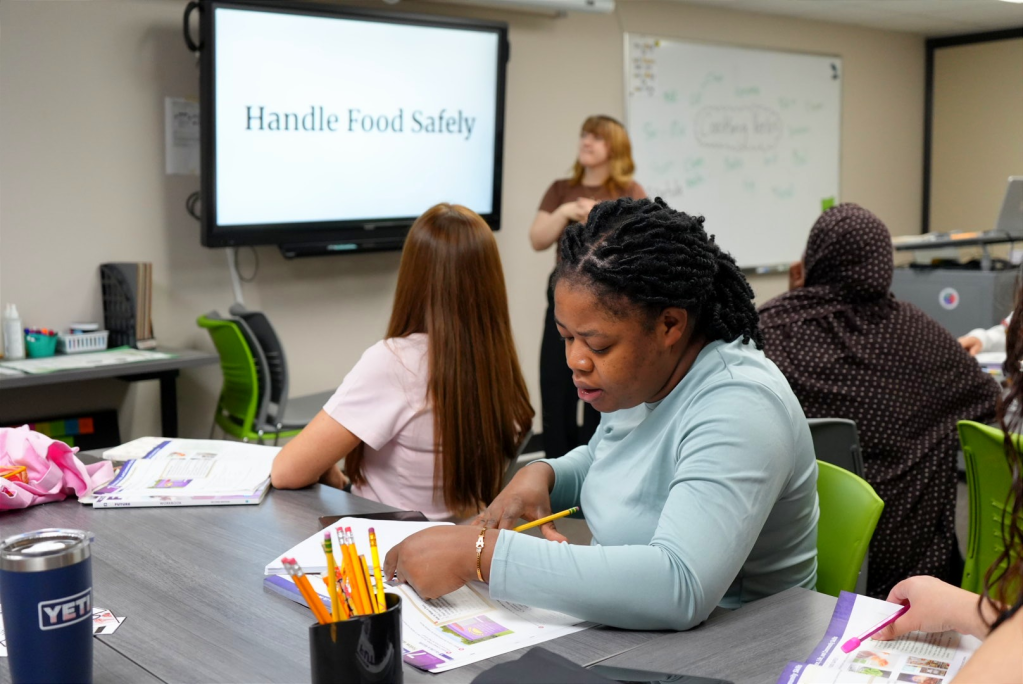
Halfway through her English language class on an early September morning, teacher Sierra Susa asked each of her adult students to write down a positive affirmation on a sticky note.
One by one, the students, hailing from roughly 10 countries, stuck the light green papers to a hallway wall:
“I help and encourage others.”
“I like learning new things and my family is my whole world.”
“A veces pensar mucho no es buena idea (Sometimes thinking too much is not a good idea).”
“I am studying hard! I will be a nursing assistant!”
“English is really difficult. … When you are having a bad day, you can walk by and say, ‘OK. I’ve got motivation. I feel better,’” Susa said.
That day, roughly two dozen students gathered in a basement classroom at Literacy Green Bay, the city’s largest resource for helping immigrants, refugees and other adults learn English as a second language.
Sign up for Northeast News, our free email newsletter focused on northeast Wisconsin.
Demand is only growing for the organization’s services, which help residents learn to use a computer, study for a citizenship test or speak English well enough to attend school or find work.
But the nonprofit took a major blow recently, when the Trump administration slashed billions in federal funding and gutted refugee resettlement programs. That’s trickled down to funding losses for Literacy Green Bay, leading it to cut its services nearly in half: It has reduced from 15 ESL classes to eight, stopped offering child care and has a 300-person waitlist.

In the aftermath, the staff has turned to the surrounding community for help — with funding and with helping students sharpen their skills. As immigration enforcement and anti-immigrant rhetoric draw more attention nationwide, they’re making an even stronger effort to be visible in the community and squash the stigma around being an adult English learner.
“It’s very hard for most of our students to break out of their bubble. A lot of them will just work and go home. … Some of them don’t have anybody else,” Development and Communications Coordinator Grace Hageman said. “And so this is where they come to get community, this is where they make friends and this is people coming from all across the world that get to hang out together.”
Hub for immigrants, refugees
In 1981, Literacy Green Bay launched as an initiative of volunteers helping integrate Hmong refugees who recently settled in the area by providing English language education.
Four decades and thousands of students from nearly 100 countries later, Hageman said Literacy Green Bay is well-known among local immigrant and refugee communities.
“We can be one of the first stops for people as they’re getting settled and they’re looking for opportunities to grow, but that’s definitely not all of our students,” she said. “For some, it could be years of living in Green Bay speaking limited to no English until they sign up for classes.”

The largest share of students at the school are Hispanic, followed by Somali, Afghan, Syrian and Ukrainian refugees. All are adults.
All of Literacy Green Bay’s services are low-cost to students — they pay a $65 fee to begin and are also asked to purchase books for $35. But if a student can’t afford that, the school will find a way to cover the cost.
The school’s classes begin at a level considered “pre-literate,” for people who don’t know how to read, write or use a computer in their native language — often women from Pakistan and Somalia who never went to school.
“We start at that level of people just learning how to hold a pencil,” Hageman said.
From there, Literacy Green Bay’s classes span through level 3. To a native English speaker, this skill level looks like someone who can generally be able to participate in a basic conversation, while still being apparent that they are learning English. ESL programs at local technical colleges generally begin where Literacy Green Bay leaves off, meaning students must enroll to continue learning English.
Literacy Green Bay also offers a volunteer-based, one-on-one adult tutoring service, which about 100 people utilize. These sessions are tailored to each person’s goals and might include preparing for a citizenship test, learning computer skills, studying for a driver’s license, doing homework or conducting a job search.
Across the board, the school focuses on helping students navigate a community that isn’t designed for non-English speakers.

“That’s a big misconception of what happens in the classrooms here. It’s not like we’re just having them read and write,” Hageman said. “They’re learning how to go to the bank. They’re learning how to talk to a doctor.”
The classes also provide social connection for students, who spend two days a week together and often forge friendships.
Potlucks are common and a favorite way for students to connect and share their cultures with one another. On that Wednesday morning in September, student Ikuko Mader brought a meal of taco rice to share with everyone. Originally from Okinawa, Japan, Mader moved to Green Bay for love: Her husband is a former Marine from Wisconsin. She said the food is what she misses most about her home country — not just Japanese food, but the amount of choice she had in restaurants.
Today, Mader takes classes at Literacy Green Bay to better communicate with her family, who speaks English.
“I married and have kids that use English, but my English is basic level. … Talking in detail about stuff (is hard),” Mader said. “Of course, in Japanese, I can, but when it’s English, it’s hard.”

Demand soars, funding dips
President Donald Trump made budget cuts his priority when he took office and targeted refugee resettlement programs, including those that funded refugee literacy programs in Wisconsin.
For Literacy Green Bay, those measures cut deep.
The school’s roughly $800,000 budget has largely been funded by federal grants. According to the organization’s 2023 financial report — the most recent available online — 38% of its revenue came from the federal government.
In 2024, Literacy Green Bay received more than $150,000 in grant dollars from the Office of Refugee Resettlement. In 2025, that number dropped to $60,000. Funding ended altogether in July.
(function(){function e(){window.addEventListener(`message`,function(e){if(e.data[`datawrapper-height`]!==void 0){var t=document.querySelectorAll(`iframe`);for(var n in e.data[`datawrapper-height`])for(var r=0,i;i=t[r];r++)if(i.contentWindow===e.source){var a=e.data[`datawrapper-height`][n]+`px`;i.style.height=a}}})}e()})();
Statewide, funding to Wisconsin Literacy — which distributes grants to organizations like Literacy Green Bay — declined from $2,857,703 in 2025 to $737,890 in 2026 because of federal cuts to the Office of Refugee Resettlement.
Literacy Green Bay whittled its services from 15 English classes to eight. It opened a waitlist, which has stretched to 300 people waiting for basic English literacy education.
Staff rearranged class schedules so everyone who was already enrolled in a program could stay and finish. Small barriers add up, Hageman said, and it’s easy for students to fall behind or stop showing up when things change.

“We want to keep things as consistent as possible for them,” Hageman said. ”These are folks who have at least been mildly inconvenienced for their entire life.”
The organization also had to eliminate free child care. Paid staff members used to watch children during morning and evening classes.
Bringing that resource back when they can afford it is a priority, staff said, because it’s a barrier that keeps students from attending class. Affordable child care is increasingly difficult to find — a search made more difficult when someone is still learning English.
Meanwhile, demand for English education at Literacy Green Bay has climbed higher than school leaders can keep up with.
“We will have three to four people a day come in, walk in off the street, and come sign up to be on the waitlist, or reach out online,” Hageman said.
From 2022 to 2024, people moving from outside of the country were the primary driver of Brown County’s population growth. That was no longer true last year, as immigration to the state plummeted under the Trump administration.
‘They have all these skills’
While every student’s journey at Literacy Green Bay is deeply personal, many share a common goal: finding good work.
“It’s like we have a community that exists here that nobody knows,” Hageman said. “People that most of the time are not out front and public-facing right now, especially at their jobs. They’re working their kitchens. They’re working back-of-house.”
For many, learning English is a step toward pursuing higher education — and, ultimately, the careers they want.
That’s true for Wedcia Jean, a student from Haiti, who told Wisconsin Watch she wants to study at the University of Wisconsin-Green Bay before eventually opening her own public speaking business.
Others are simply trying to regain the socioeconomic standing they achieved in their home countries.
Student Carmen Hernandez holds a master’s degree in nursing from Mexico. Today, she’s learning English while working toward another nursing degree at Northeast Wisconsin Technical College so she can restart her career in the United States.

“There’s a lot of students that have master’s degrees, they’re doctors, they’re teachers, they’re very educated in their country, but then here they’re just working at JBS, cutting meat,” Susa said. “And it’s just very frustrating that English is really the only barrier. They have all these skills. That’s what I try to focus on is, trying to get them back to where they are, and so that English isn’t a barrier for their goal and their dream.”
For student Olver Corado, learning English is the key to being able to grow the career he already has.
Corado, from Guatemala, works as a general contractor and owns a construction company based in Appleton. The level 3 English student builds houses and repairs homes across northeast Wisconsin, but gets nervous talking to customers in English.
“I need to grow my business. It’s really important to learn English. I need to have good communication with customers … I don’t speak perfect English, but I’m smart,” Corado said.
Letting students ‘live out loud’
These days, Literacy Green Bay staff are trying to “rebuild.”
After having to cut the number of classes, staff started thinking about how students could practice English in more casual ways.
One tutor began meeting with his students at Kavarna, a staple coffee shop in downtown Green Bay. His students felt comfortable there, so he suggested inviting more students.
Now, once a month, Literacy Green Bay hosts “Coffee, Culture and Conversation” – an informal gathering where students are paired with community members who come to talk with them in English. The school provides questions to get the conversation started, but from there, it flows naturally.

At their mid-September event, there were about three eager attendees for every student. Students from Laos, Guatemala, Haiti and more practiced English by speaking with strangers for an hour about their families, their work and their paths to living in Green Bay, among other topics.
“When I saw the advertisement, I’ve always been interested in having conversations like this: ‘Where are you from? Where have you been? Why are you here?’ Underneath, we’re all the same,” said Gayle Frame, a retiree, former Literacy Green Bay tutor and self-described “people person.”
After, students have another place in Green Bay they feel comfortable visiting and ordering at, because they’ve been welcomed there before.
“Especially with what our community can look like towards someone who’s trying, that’s beautiful to have the opportunity (where) they can feel comfortable,” Hageman said.
The coffee events also offer a lower-barrier way for people to get involved. Previously, tutoring was one of the main ways community members could volunteer with the school, which requires a regular time commitment and preparation. Hageman said roughly 70% of the volunteers at the August event had never worked with Literacy Green Bay before.
That’s encouraging for Literacy Green Bay staff, especially as tensions around immigration flare nationwide. They’re wrestling with how visible the organization — and its students — should be. Should they advertise more? Should they post students on social media? How do they celebrate the people they serve without putting unwanted attention on them?
They don’t have the answers, Hageman said, but getting students out in the community with events like this is one way to help students “live out loud.”
“They’re proud to be here,” Hageman said. “If they’re living their life, we have to keep living too, which is daunting. … But we just adapt, we just keep moving forward every day, as all people do.”
Miranda Dunlap reports on pathways to success in northeast Wisconsin, working in partnership with Open Campus. Find her on Instagram and Twitter, or send her an email at mdunlap@wisconsinwatch.org.

Wisconsin Watch is a nonprofit, nonpartisan newsroom. Subscribe to our newsletters for original stories and our Friday news roundup.
Hundreds of immigrants, refugees await English education as Literacy Green Bay weathers federal cuts is a post from Wisconsin Watch, a non-profit investigative news site covering Wisconsin since 2009. Please consider making a contribution to support our journalism.
