


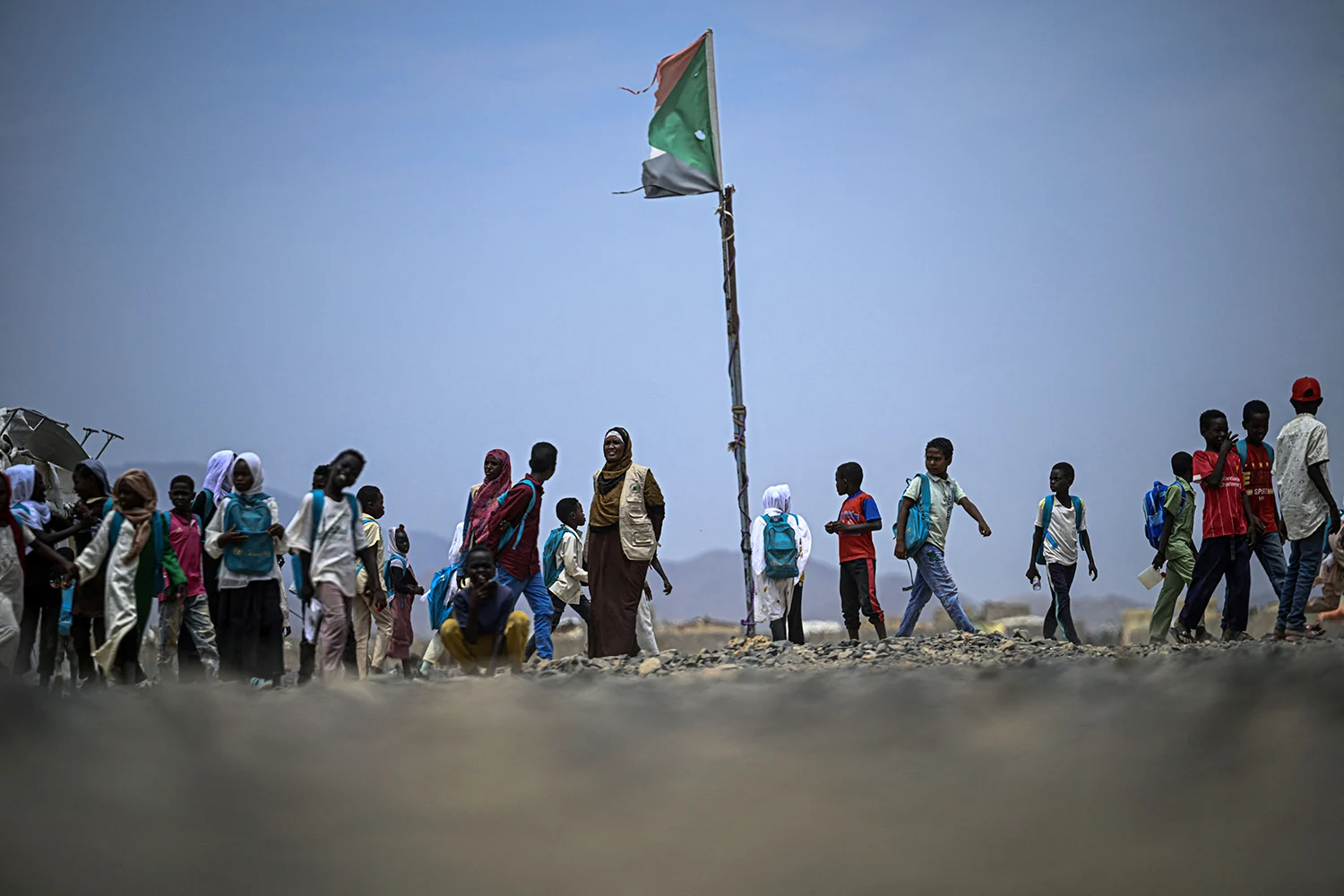
Well into its fourth year, the war in Sudan is the world’s largest humanitarian crisis. At least 59,000 people have been killed and more than 14 million displaced, while famine and widespread sexual violence have left millions in urgent need of food, medicine, and mental health support.
Sudanese people know the war must end—and, God willing, it will. But after more than a dozen failed cease-fires brokered by international parties, it is time to put a lasting end to this war so the guns do not return when the world looks away. That is what Sudanese civilians ask of me, as president of Sudan’s Transitional Sovereignty Council, and of others entrusted with governing: that the war is ended for good and that the foreign meddling that has fractured our nation and profited from our suffering ceases completely.
Well into its fourth year, the war in Sudan is the world’s largest humanitarian crisis. At least 59,000 people have been killed and more than 14 million displaced, while famine and widespread sexual violence have left millions in urgent need of food, medicine, and mental health support.
Sudanese people know the war must end—and, God willing, it will. But after more than a dozen failed cease-fires brokered by international parties, it is time to put a lasting end to this war so the guns do not return when the world looks away. That is what Sudanese civilians ask of me, as president of Sudan’s Transitional Sovereignty Council, and of others entrusted with governing: that the war is ended for good and that the foreign meddling that has fractured our nation and profited from our suffering ceases completely.
The war in Sudan is not a fight between two “factions” or a “civil war”; our sovereign state and the Rapid Support Forces (RSF) militia do not sit on equal moral and legal ground. Rather, this is an assault on a United Nations member state by a paramilitary group that survives on looting, killing, and ethnic cleansing. The RSF must not be legitimized or treated as an equal partner. After all, the RSF’s leaders—Mohamed Hamdan Dagalo and his top deputies—are the same commanders who ordered the Janjaweed militia to rape and massacre non-Arab communities in Darfur in the early 2000s.
Last year, the 30-month siege of El Fasher ended in mass slaughter. Neighborhoods were decimated, families were murdered in their homes, and bodies rotted in the streets with no one to bury them. Before the assault, the U.N. counted more than 260,000 civilians trapped in the city, half of them children. Since El Fasher fell in October 2025, the U.N. has recorded some 127,000 people displaced from the city and the villages around it. Although independent investigators have not been able to enter the city, Yale University’s satellite analysts found evidence of mass graves—which suggests the deliberate targeting of civilians—while a U.N. fact-finding mission found the atrocities to bear the “hallmarks of genocide.”
A militia cannot sustain a war of this scale alone. Hundreds of foreign fighters have reinforced the RSF since 2024, recruited through networks funded by transnational entities operating across several countries. This has been widely recognized: In June, the U.S. Treasury Department sanctioned eight individuals and entities linked to those networks. Last month, drones struck Khartoum and other cities in the largest coordinated barrage in months, demonstrating the increasingly sophisticated military capabilities enabled by foreign interference.
Read More
-
A Sudanese flag is held by a machine gun covered with an ammunition belt in Abraq, Sudan, on June 22, 2019. A Sudanese flag is held by a machine gun covered with an ammunition belt in Abraq, Sudan, on June 22, 2019. Peace in Sudan Can Only Flower After a Weapons Embargo
The case for the White House’s Security Council resolution on Sudan, made by two senior administration officials.

-

Around a dozen trucks painted with green camouflage are seen across a dusty stretch of land beneath a hazy sky. Fighters in matching khaki uniforms and hats perch on the trucks, most of them carrying rifles. Around a dozen trucks painted with green camouflage are seen across a dusty stretch of land beneath a hazy sky. Fighters in matching khaki uniforms and hats perch on the trucks, most of them carrying rifles. Sudan’s Rapid Support Forces Are Terrorists
Designating the group as such could help bring an end to Sudan’s civil war.
-

Students leave a school south of Port Sudan on April 26. More than 8 million children are out of school in the country, according to UNICEF. Students leave a school south of Port Sudan on April 26. More than 8 million children are out of school in the country, according to UNICEF. The Iran War Has Only Worsened Sudan’s Conflict
The country is uniquely vulnerable to regional shocks.
The government I lead is transitional and imperfect. We accept the standards of international law, and we will be measured by it. But unlike the RSF, this government is the lawful authority of a sovereign U.N. member state and is answerable to its people. The U.N. Security Council has reaffirmed Sudan’s “sovereignty, independence, unity and territorial integrity” and rejected the authority of the RSF in the territory it holds. Our people recognize this as well: Where the RSF advances, people flee; where the state is restored to power, people come home. Almost 4 million Sudanese have returned to Khartoum, Gezira, and Sennar following the RSF’s retreat from those cities.
I have put forward a plan before the Security Council to establish a lasting cease-fire and a transition to civilian-inclusive rule. With U.N. oversight and assistance, fighters and weapons would be removed from civilian areas, creating a clear path to settlement so the state can govern in peace.
Following a cease-fire, security must rest on a single national army under civilian supervision rather than parallel armed forces with competing loyalties and paymasters. A political settlement must be reached through Sudanese dialogue and the next constitution written by Sudanese hands—not drafted abroad. Free, fair, and internationally supervised elections, followed by a smooth transition of power, would return agency to the people.
Peace must therefore be homemade—by Sudanese, for Sudanese, in Sudan. Partnership is welcome, and credible monitors can (and should) add restraint and legitimacy. But peace dictated from the outside does not last. Cease-fires have collapsed over the course of this war because they were written about Sudan without Sudan and because their sponsors knew they would not have to pay the price if those negotiations failed. A “pause” became time for the RSF and its backers to regroup, while the world’s attention drifted once again—as was made horribly clear by the massacre in El Fasher. Sudan has lived that cycle and will not accept it again.
While our lawful government offers a plan, the leader of a militia vows to fight for 40 years if necessary. For the international community, the choice is clear: back a settlement anchored in sovereignty and law or indulge false equivalence by legitimizing RSF leaders and allow Sudan’s forever war to continue.
As the U.N. General Assembly takes place this week, I am calling on the international community to commit to four priorities. First, back the plan I have submitted to the Security Council. Second, cut funding and supply lines enabling the RSF to continue killing Sudanese civilians. Third, provide assistance and support for the U.N. as it monitors a future cease-fire. Fourth, give Sudanese politics room to decide what comes next.
My request is simple: Trust our nation to write its own peace and use your influence to help sustain it. Sudan has been urged to accept far less than it deserves through terms convenient to distant capitals and pauses mislabeled as peace. Those who have endured this war have earned the right to define the peace that ends it.
Let these words guide any settlement: Peace that is homemade, not imposed. Peace that is built on law and strong institutions. Peace that is worthy of those who have given everything for it. That is the peace Sudan can build—with the world’s help.
