


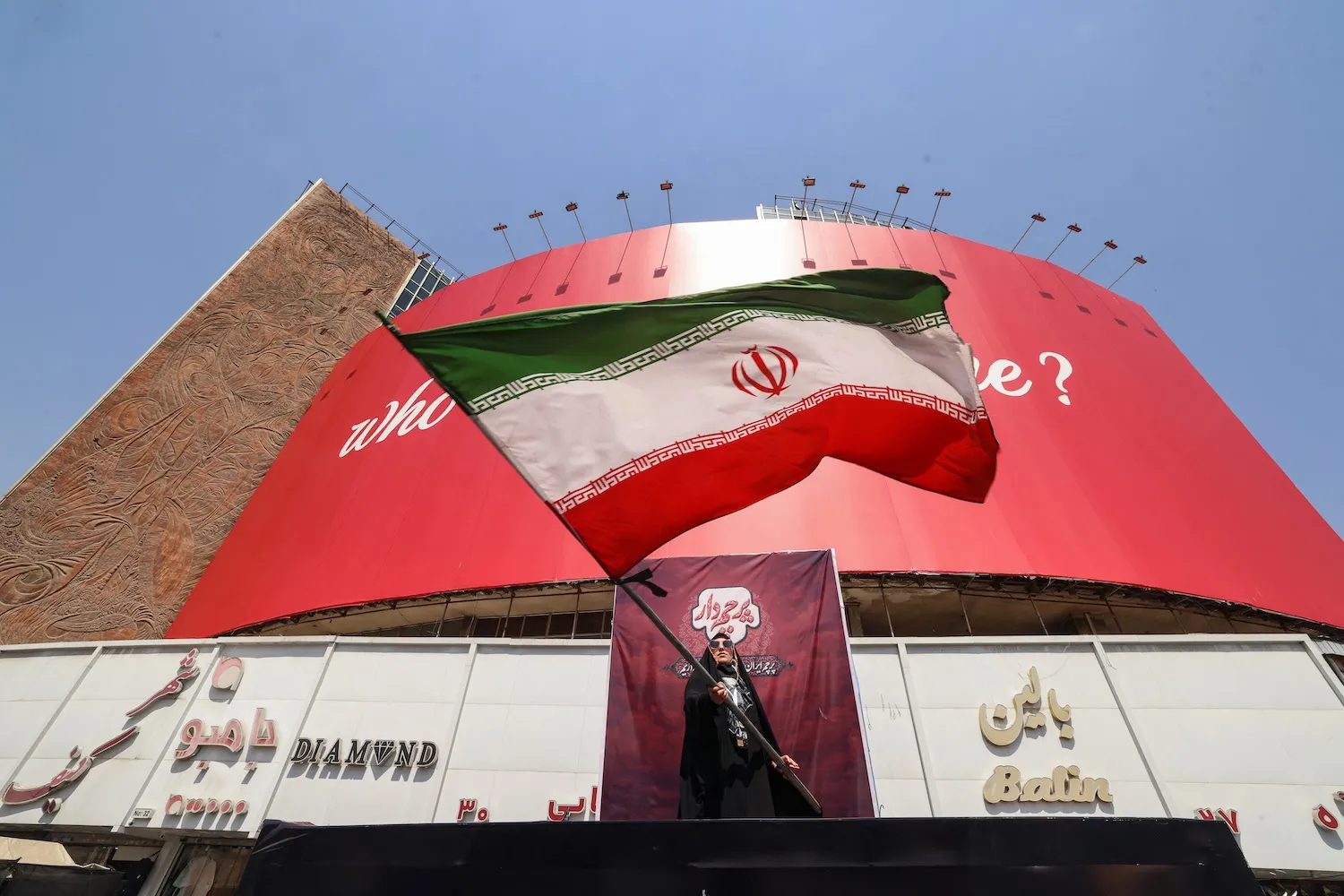
In the wake of their short-lived conflict with Iran last year, the United States and Israel could almost be forgiven for any hubris they might have felt.
That 12-day war was armed conflict of the kind that Washington had spent decades perfecting, and it seemed to go almost completely according to script. A combination of exquisite intelligence and peerless, high-tech weaponry—including stealthy aircraft and so-called standoff munitions, which could be fired outside the range of Iran’s defensive systems—allowed the United States and Israel to attack Iran with near impunity, bombing key nuclear sites and assassinating military leaders and scientists.
What is more, the United States’ advanced ship-based anti-missile systems, Israel’s Iron Dome shield, and the quiet cooperation of a clutch of Iran’s Arab neighbors, which helped track long-distance drone and ballistic missile ripostes and sometimes shot them down, kept U.S. and Israeli casualties to a minimum. After the clash, a feeling seemed to have spread among U.S. and Israeli officials that their alliance had finally managed to back Iran into a corner, revealing their adversary to be a mere paper tiger.
The feelings of exultation this produced quickly turned infectious and then, finally, self-deluding. With Iran so utterly outclassed, almost anything seemed possible. A future in which the country’s proxies—Hezbollah in Lebanon, Hamas in Gaza, and the Houthis in Yemen—could be tamed, and perhaps even eliminated, felt within reach. And Iran itself, so weakened in the face of such proven might, could be brought to its knees and dictated to. The need for patience and diplomacy had been revoked.
This was the backdrop against which U.S. President Donald Trump sold the sequel to the 12-day war as a mere “excursion.” The campaign, which was launched in February, began with a lethal strike against Iran’s supreme leader, Ali Khamenei, and some of his closest associates. Never mind that negotiations about the future of Iran’s nuclear program were then ongoing and may even have been making progress. The United States and Israel concluded that the time had come for Iran’s capitulation and, failing that, the overthrow of its Islamist government by a population said to be sick of it.
Yet the view from the present, approaching six months later, could scarcely be more different. There will almost certainly be many twists and turns to come in what has gone from being a war measured in weeks to an open-ended conflict, but strikingly, it is now Iran that seems to have its enemies just where it wants them.
Early in the war, the Trump administration expended breathtaking quantities of money and munitions, even boasting in April of having successfully bombed 13,000 Iranian targets. But this achievement, dubious from the start, was rendered less meaningful for having occurred in a campaign whose goals have remained head-spinningly mutable. These include ending Iran’s nuclear program, regime change, and ensuring the free passage of oil tankers and other traffic through the Strait of Hormuz—a problem, as many analysts have noted, that did not exist prior to the U.S. offensive.
Now that Trump has flailed for weeks over the implementation of the vague and hastily written memorandum of understanding between Washington and Tehran, it is clear as day that none of these objectives are any closer to being achieved than they were at the height of the U.S.-Israeli bombing campaign. At a loss for how to extract itself and save face, the United States would instead have the public believe that the resumed and seemingly open-ended punitive bombing of Iran, now in its 12th day, will somehow bring about a success that an incomparably more intense campaign earlier in the war failed to secure.
Unfortunately for the war’s architects, peace on U.S. terms seems unlikely. Although Washington once boasted that it would extract an unconditional surrender from Tehran, Iran shows no signs of loosening its grip on Hormuz. The price of oil and gasoline has begun to climb sharply again. Stockpiles of the expensive systems that allowed the United States to intercept Iranian missiles and drones with apparent ease are reportedly worrisomely low. Meanwhile, the Defense Department’s leadership, which is already held in low esteem in Congress, has been forced to seek $67 billion in supplemental funding from lawmakers, on top of a pending and unprecedentedly large $1.5 trillion budget request. In a Senate hearing on Tuesday, Republican Sen. Susan Collins said the Pentagon, the most richly funded military establishment in history, now faces “near-term solvency challenges.”
From the perspective of the United States, this isn’t even the worst of the story. On top of the military’s steady march toward fiscal ruin, this week has brought news that one of Iran’s supposedly chastened proxies, the Houthis, has vowed to halt maritime traffic in the Red Sea, through which, via the Bab el-Mandeb, an estimated 7 percent of global oil supplies flows. Given Iran’s proof of concept with the Strait of Hormuz, it would be imprudent to take this as a bluff.
To understand how the United States can possibly extract itself from such a calamitous position, one must first grasp what led to this deepening quagmire. Central to this situation are geographic realities so stubborn that no amount of high-tech weaponry can erase them.
What Washington ignored amid the sugar rush of its early successes, both last June and in the late winter, has now become painfully obvious. By dint of both its large population and position on the map, Iran is a major country, one that sits astride the world’s most important oil reserves. It cannot be made to disappear or even be neutralized. And so long as its most important goal in the fight is simply not surrendering to the United States, as opposed to defeating it in any conventional miliary sense, it is hard to see how Iran’s leadership can be forced to conform to U.S. wishes.
Another geographic feature of this war will be more surprising to many—at least, it has certainly seemed at times to surprise the Pentagon. The dense patchwork of military and political relationships that Washington has built in the Arab world over the last two generations has come with an unintended consequence: U.S. bases throughout the Middle East have steadily fallen within range of Iranian weapons systems, both ballistic missiles and inexpensive but capable attack drones. Making matters worse, their effectiveness appears to have been enhanced by the attrition of U.S. anti-missile stocks, along with damage to U.S. radar systems in the region.
As the recent news of the deaths of four U.S. service members and the wounding of scores of others has revealed, this has created a thorny and potentially debilitating problem for the United States that it never faced during previous wars in places such as Afghanistan and Iraq. To put it as directly as possible, Iran not only has the ability to suppress shipping through Hormuz. It can also land destructive and occasionally lethal blows against Washington’s regional military outposts, thereby bringing a distant war home to a U.S. public already deeply skeptical of the conflict.
The United States can try to escalate and very well may. An increasingly flailing Trump has renewed threats to attack Iranian civilian targets, including bridges, dams, and power stations, which risks infringing internationally accepted norms for legitimate behavior in war. He has also spoken of targeting an Iranian site known as Pickaxe Mountain for another heavy bombing campaign, which would allow him to claim—once again—to have obliterated Iran’s nuclear capabilities. That might provide the occasion for Trump to declare victory and “go home,” but it is unlikely to chasten the Iranian leadership, which sees control over the sea lanes out of the Persian Gulf as key to its survival in a deeply hostile world and a better security guarantee even than nuclear weapons.
This leaves Washington with a set of dauntingly unfavorable military choices: play whack-a-mole indefinitely with Iran’s surviving missile and drone forces, running up the cost of the war for the United States as it does so, or—an even greater folly—send in ground troops in pursuit of a military victory that could not be procured from the relative safety of the air.
Few in U.S. politics yet seem prepared to contemplate what it will take to resolve this crisis, even though the way forward has been hiding in plain sight for decades. As distasteful as it might seem to many in the foreign-policy establishment, that means recognizing the legitimacy of Iran’s Islamist government and offering the country strong security guarantees going forward against a future U.S. or Israeli attack.
By this point, Washington has tried almost everything else conceivable against Iran. This includes not just the two most recent campaigns but also past U.S. decisions to turn a blind eye to Israel’s development of a nuclear weapons program, arm Iraq in its 1980s war with Iran, construct a coalition of U.S.-backed Arab states against Iran, and impose long-standing severe economic sanctions. In the latest development, the United States has even theoretically opened the door for Saudi Arabia, a historic rival of Iran, to one day have nuclear weapons of its own by offering almost unrestricted U.S. cooperation with the kingdom to develop a nuclear energy sector.
It is true that Iran has long had repugnant things to say about Israel and has almost turned hatred of the United States into an official cult. But those who wield these facts to argue against a gradual detente with Iran ignore important lessons from history. As the war against the Taliban in Afghanistan recently demonstrated, the moment sometimes arrives, even in conflict against the most loathed enemy, to deconflict. Looking further back, this would appear to be a central lesson of the 20th century—just recall Japan, Germany, and, at least briefly, the Russian successor to the Soviet Union. This moment awaits the statesmen who have the imagination and courage to try something else after such a long string of failures.
